

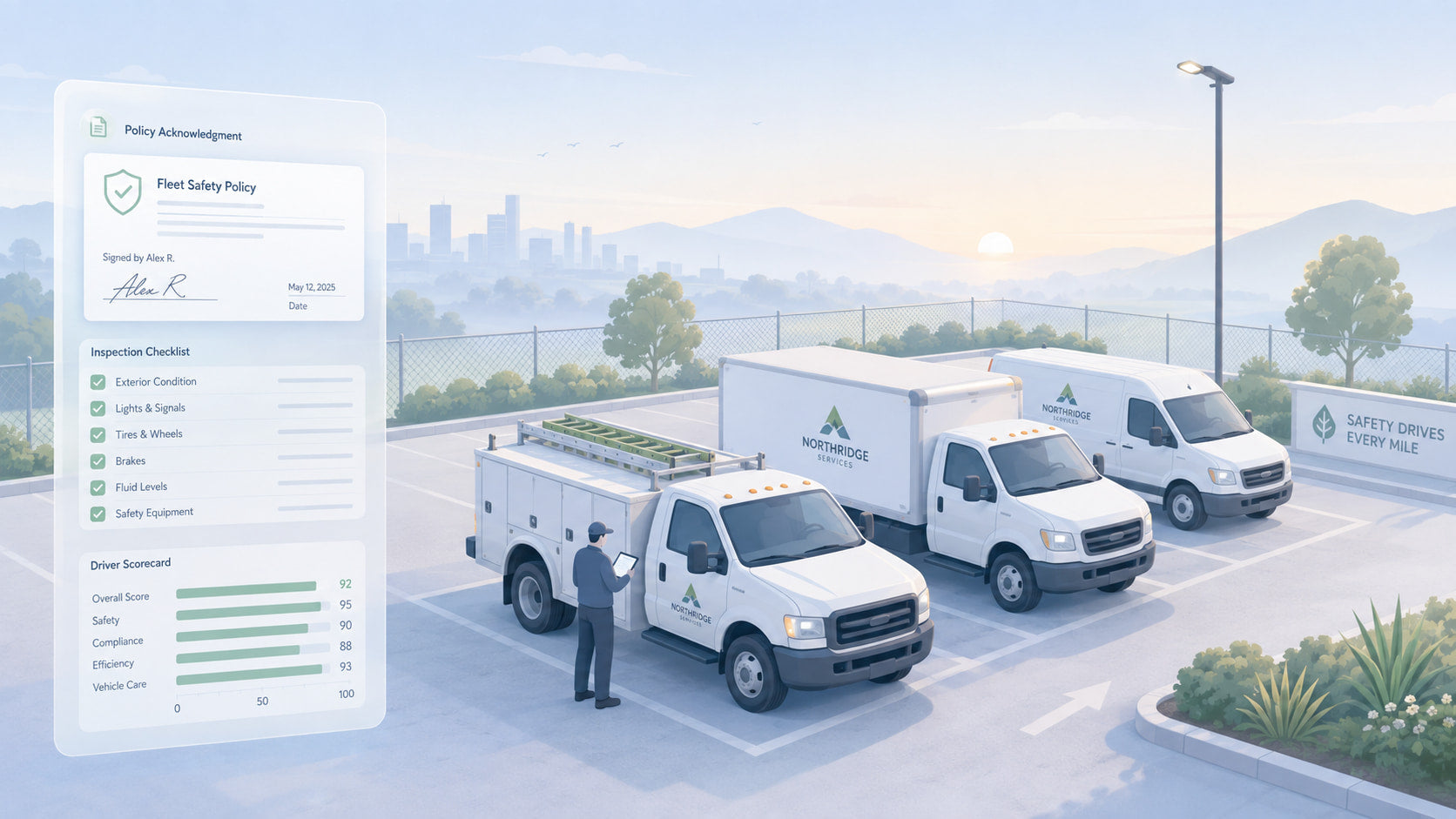
Ask most owners of a ten-truck service business whether they have a fleet safety program and you'll get some version of: "Sure — we tell people not to speed, and we'd fire anyone who drove drunk."
That's a set of intentions. It isn't a program, and the difference shows up in exactly two situations, both bad ones. Your insurance carrier asks what you have in place at renewal. Or a plaintiff's attorney asks the same question after a crash — and "we tell people not to speed" is the answer they were hoping for.
The good news is that the framework already exists, it's public, and it's short. The problem is that every version of it you'll find is written for a corporate fleet with a full-time risk manager. This is the version for a business with 5 to 50 trucks and no safety department — plus a template you can put your name on.
📄 Download: Fleet Safety Program Template
Free Word doc — twelve sections following the OSHA employer framework, scaled for 5–50 trucks. Includes a violation points table, progressive discipline schedule, and a driver acknowledgment signature page.
Download Free Template (.docx) →
Not legal advice. Have an employment attorney in your state review before you issue it.
Spytec GPS is a self-serve GPS fleet tracking platform built for small and mid-size fleets, with free hardware on every plan, no contracts, and transparent pricing from $8.95/vehicle/month on the annual plan. We publish operator tools like this one because the things that decide whether a service business survives a bad day are usually paperwork, not hardware.
One clarification before we start. This is the program that governs how your drivers drive — qualification, rules, monitoring, incidents, discipline. The separate question of what notice and consent you owe employees before tracking their vehicles is its own document; we cover that in the employee GPS tracking policy template. You want both. They do different jobs.
What a fleet safety program actually is
There's a canonical answer, and almost nobody in the trades knows it exists. OSHA publishes Guidelines for Employers to Reduce Motor Vehicle Crashes, built around a ten-element framework from the Network of Employers for Traffic Safety:
- Senior management commitment and employee involvement
- Written policies and procedures
- Driver agreements
- Motor vehicle record (MVR) checks
- Crash reporting and investigation
- Vehicle selection, maintenance and inspection
- Disciplinary action system
- Reward/incentive program
- Driver training and communication
- Regulatory compliance
That list is the whole thing. When a loss-control rep from your carrier asks what your program looks like, this is roughly what they're checking against, whether or not they say so.
It's also, read cold, intimidating — because the guidance is written for organizations with a safety department. A ten-truck plumbing company reading "implement a driver reward/incentive program" reasonably concludes this isn't for them.
It is. The elements don't change with fleet size; the ceremony does. Five of the ten carry nearly all the weight at your scale.
The five that matter most at 5 to 50 trucks
1. A written policy that someone signed
The document itself is the element. Not because paper prevents crashes, but because an unwritten standard is unenforceable — you can't discipline someone for violating a rule you never gave them, and you can't demonstrate a rule existed after the fact. A signed acknowledgment converts "everyone knows" into "here is the page he signed on his start date."
2. MVR checks — the one nearly everyone skips
Most small fleets look at a driver's license once, at hire, and never again. Meanwhile the person has three years of moving violations you've never seen, and you're the one whose name is on the truck.
Pull a motor vehicle record at hire and annually after that. Write down, in advance, what disqualifies someone — a DUI in the last three years, a suspended license, two preventable collisions — so the decision is a policy rather than a judgment call about a person you like. Then require drivers to self-report citations and collisions within 24 hours, on or off duty, because an annual check will otherwise miss eleven months of a problem.
3. Rules specific enough to enforce
"Drive safely" isn't a rule. "Seat belts on every trip by every occupant" is. "No handheld phone use while the vehicle is in motion, including at a red light" is. Write the ones you'd actually act on, add the ones specific to your trade — backing with a spotter, load securement, jobsite speed — and leave out anything you'd never enforce, because unenforced rules teach people that the document is decorative.
4. Every incident reported, every incident reviewed
Every collision, near miss and instance of vehicle damage gets reported — regardless of severity, regardless of fault. The reason isn't paperwork. It's that the crash that ends up in litigation is usually preceded by several that cost nothing, and those are the only warning you get.
Then review each one and record a determination: preventable or not, what contributed, what changes. That determination is what turns an incident log into a program.
5. A discipline system that actually has steps
This is the hard one, and the one most owners quietly avoid. Covered on its own below.
The discipline system is where programs die
Almost every small-fleet safety program fails in the same place. The rules are written, the acknowledgment is signed, and then a good tech — one you can't afford to lose in a hiring market like this one — does something he shouldn't. Nothing happens. Everyone notices that nothing happened.
The fix is a points system, decided in advance, applied mechanically. Assign points to events: a preventable collision, a moving violation on duty, a seat belt violation, handheld phone use, failure to report an incident. Set thresholds where something specific happens — a documented coaching conversation, a written warning plus retraining, a final warning, revocation of driving privileges. Let points expire after twelve months.
The mechanical part is the point. You're not deciding, in the moment, whether to discipline someone you rely on. You're applying a schedule you wrote before you knew whose name would be on it. That's easier to do, easier to defend, and much harder to accuse of favoritism.
And pair it with the ninth element people skip: recognition. A program that only ever punishes gets resented and quietly worked around. One that names the drivers with a clean twelve months — in front of everyone, with something attached to it — gets adopted.
What insurers actually do with it
Be careful with what you've read here, including on this blog.
Most carriers do not have a formal line-item "safety program discount" you can ask for by name. What underwriters do is use a documented program, plus telematics data, as favorable evidence when deciding which risk tier you belong in — which is a different and less tidy mechanism than a percentage off. The effect is real; the mechanism isn't a coupon.
What that means practically: the document alone won't move your renewal. The document, plus evidence you're running it — MVR checks on file, an incident log with preventability determinations, driver scorecards showing coaching actually happened — is what changes the conversation. When you're ready to have it, we've written up what to put in front of your broker at renewal, including the email to send.
The monitoring element, without a mutiny
Element five of the framework is crash reporting, but the modern version of it is continuous: telematics tells you about the driving before the crash, which is the only version that prevents anything.
Two things make this work rather than backfire.
Coach patterns, not moments. One speed alert is traffic, weather, a passing maneuver. The same driver firing the same alert every afternoon on the same road is a habit, and habits are what you address. If you act on individual pings, you'll spend your week arguing about single data points and your drivers will conclude the system is a gotcha. We cover how to set thresholds that catch problems instead of noise in the guide to monitoring driver speed.
Give notice properly, in a separate document. Monitoring belongs in the safety program as a standard — drivers should know the vehicles are tracked and what you'll act on. But the notice-and-consent mechanics are an employment-law question with state-by-state requirements, and they belong in their own signed policy. Use the GPS tracking policy template for that half.
If cameras are part of the monitoring element, budget for the whole system rather than the camera alone. Our study of fleet dash cam pricing for 5–50 vehicles shows how published camera prices, required GPS services and contract terms combine across 17 providers.
The other unglamorous element worth doing: vehicle inspection and maintenance. A daily walk-around and a real preventive schedule are safety elements, not just uptime ones — and they're covered in preventive maintenance for service fleets.
Running a fleet of 5+ vehicles?
Most small service fleets on Spytec start with the plug-in OBD tracker — it goes into each vehicle's OBD-II port in seconds (no installer, no wiring), streams live location, and runs $8.95/vehicle/month with free hardware and no contract. Fleets of 5+ get automatic volume discounts.
See the OBD fleet tracker → · Compare business-fleet plans →
How to roll it out in a week
The failure mode here isn't writing the program. It's writing it and never issuing it.
- Day 1. Fill in the template. Set your own point values and thresholds — the defaults are a starting point, not a standard.
- Day 2. Send it to an employment attorney in your state. The discipline schedule and the monitoring language are the two parts worth a professional read.
- Day 3. Pull MVRs on every current driver. You will find something. Decide what you're doing about it before you look, using the disqualifying criteria you just wrote.
- Day 4. Hold one meeting. Explain what the program is, why it exists, and what changes. Then collect signatures in the room — not by email, where it dies.
- Day 5. File the signed acknowledgments, set a calendar reminder for annual MVR checks and the twelve-month review, and start the incident log.
Frequently asked questions
What is a fleet safety program?
A fleet safety program is a written set of standards and procedures governing how a company's vehicles are driven and who is allowed to drive them. OSHA's employer guidance is built on a ten-element framework: management commitment, written policies, driver agreements, motor vehicle record checks, crash reporting and investigation, vehicle maintenance, disciplinary action, rewards, training, and regulatory compliance. The elements are the same at any fleet size; only the formality changes.
Does a small fleet really need a written safety policy?
Yes, for two practical reasons independent of crash prevention. An unwritten rule cannot be enforced — you cannot discipline a driver for violating a standard you never issued, and you cannot demonstrate afterwards that it existed. And both your insurance carrier at renewal and opposing counsel after a serious crash will ask what program you had in place. "We tell people not to speed" is not a good answer to either.
How often should I run MVR checks on my drivers?
At hire and annually thereafter is standard practice. Because an annual check can miss up to eleven months of a developing problem, pair it with a rule requiring drivers to self-report any citation, collision or license change within 24 hours, on duty or off. Write down your disqualifying criteria in advance so the decision is a policy rather than a judgment about a specific person.
Will a fleet safety program lower my insurance premium?
Not by itself, and be skeptical of any specific percentage you see quoted. Most carriers do not have a formal line-item discount for having a program. What underwriters do is treat a documented program plus telematics data as favorable evidence when assigning your risk tier. The document alone changes little; the document plus proof you are running it — MVR files, an incident log with preventability determinations, driver coaching records — is what affects the conversation.
What should the disciplinary section include?
A points schedule decided in advance: point values for specific events (preventable collision, moving violation, seat belt violation, handheld phone use, failure to report), thresholds where defined consequences trigger (coaching, written warning plus retraining, final warning, revocation), an expiry period for points, and a short list of serious violations that bypass the schedule entirely. Applying a schedule you wrote before you knew whose name would be on it is easier to do and much harder to call favoritism.
The bottom line
You already have a fleet safety program. It's in your head, it's inconsistent between supervisors, and it doesn't exist on the day you need to prove it did.
Writing it down is a few hours of work and one attorney review. The parts that take discipline are the ones nobody enjoys: pulling MVRs on people you already employ, and applying a points schedule to a tech you can't afford to lose. Those two are also the entire difference between a program and a document.
The monitoring half of the program. Spytec GPS is $8.95/vehicle/month on the annual plan with the tracker included free, no contract, and a 30-day money-back guarantee. Volume discounts start automatically at five devices, and everything ships in two days — no sales call, no demo.
Related reading: Employee GPS tracking policy template (free download) · How to monitor driver speed without riding along · How to lower commercial auto insurance rates using GPS data






Share:
Service Agreements That Actually Sell: A Maintenance Plan Template for Service Businesses (2026)
What Should You Charge for a Service Call? (2026)