

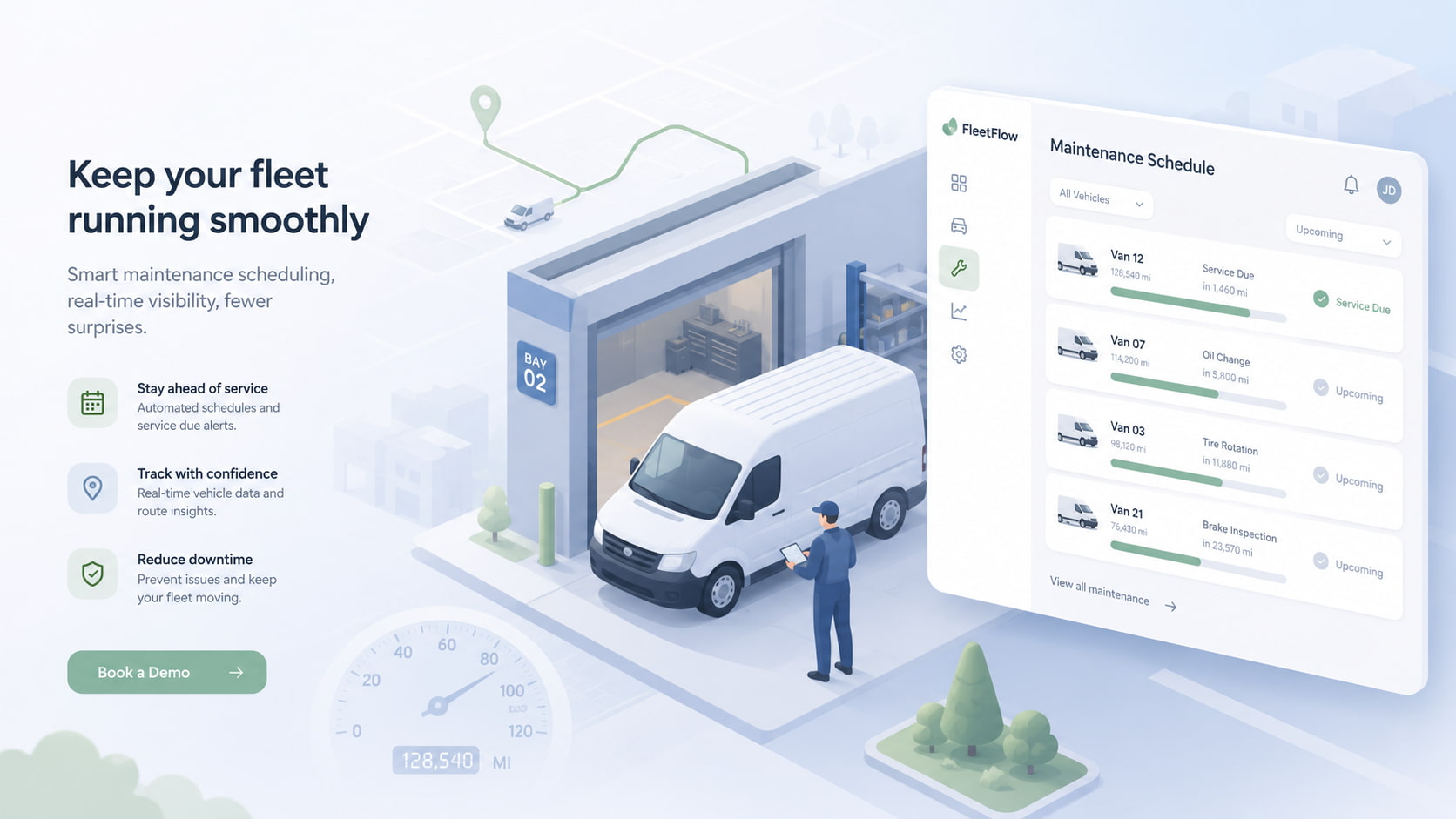
A blown alternator doesn't send you a warning email. It strands one of your trucks on the side of the road at 8:40 a.m., halfway to the first job of the day. By the time you've arranged a tow, called the customer to reschedule, and shuffled the route to cover the stops that truck was supposed to make, you haven't just lost a repair bill. You've lost a full day of billable work on that vehicle, plus the goodwill of every customer who got bumped.
For a small service fleet, that's the real cost of skipping fleet preventive maintenance. The repair was always going to happen. The difference between doing it on a Tuesday you scheduled and doing it on a Tuesday the van chose for you is a day of revenue, an angry voicemail, and the overtime you'll pay to catch back up.
Spytec GPS is a self-serve GPS fleet tracking platform built for small and mid-size fleets, with free hardware on every plan, no contracts, and transparent pricing from $8.95/vehicle/month on the annual plan. Every plan also includes a full Maintenance module with work orders, recurring schedules, and reminders, so the same tracker you use to see where your trucks are can tell you when each one is due for service, before a missed interval turns into a roadside breakdown.
Why a breakdown costs a service fleet far more than the repair
When a delivery giant loses a truck for a day, it reroutes around the gap and barely notices. When a seven-van HVAC company loses one, that's roughly 14% of its capacity gone with no notice, during peak season, in the middle of a heat wave, exactly when every hour is booked.
Add up what a single roadside breakdown actually costs a service business:
- The lost day of jobs. If a van books $1,200–$2,000 of work a day, that's the number you're really out, not the $600 alternator.
- Rescheduled customers. Some wait. Some call your competitor. The ones who wait remember that you're the company that didn't show.
- Emergency premiums. A tow you didn't plan for, a part rushed at retail price, a mechanic who fits you in as a favor. Everything costs more when it's urgent.
- Overtime to recover. The jobs don't disappear. Your other crews absorb them, late, at a higher labor cost.
Preventive maintenance is simply moving that repair from the expensive column (unplanned, roadside, peak season) to the cheap column (scheduled, in the bay, on a slow afternoon). The parts cost the same. Everything around them doesn't.
Reactive vs. preventive: the shift that pays for itself
Most small fleets run reactive by default: you fix the truck when it breaks or when a driver finally mentions the noise it's been making for three weeks. It feels cheaper because you're not "spending on maintenance" until you have to. In reality you're just paying later, at the worst possible time, with a lost day attached.
A preventive approach flips that. You service each vehicle on a set interval and act on early warning signs before they become failures. The catch has always been the same for a busy owner-operator: keeping track of which of your dozen vehicles is due for what, when you're also running the business. That's the part your fleet tracking software handles for you.
How your GPS tracker triggers preventive maintenance
Preventive maintenance for service vehicles mostly runs on mileage. Oil, tires, brakes, and transmission service all come due on the odometer. The hard part has never been knowing the intervals. It's knowing where each of your trucks sits against them without walking the lot with a clipboard. Depending on which tracker is in the vehicle, Spytec keeps that count for you and flags the van when it's due.
OBD tracker: automatic odometer, automatic reminders
The Pulse OBD Plug-In reads the odometer straight from the vehicle's computer through the OBD-II port, so mileage-based service reminders are fully automatic. Set your intervals once and each van flags itself when it's due for an oil change, rotation, or inspection. It fits any car, van, or light-duty truck from 2010 or newer, plugs in under the dash in about 30 seconds, and needs no tools, no installer, and no appointment. For most service fleets, this is the default tracker.
Hardwired tracker: set a starting odometer, then let it count
For older vehicles (pre-2010), take-home trucks, or any van where you want the tracker hidden and tamper-proof, the Pulse Wired tracker is the answer. It doesn't pull the odometer automatically, so you enter a starting mileage once at install. From there it counts miles driven and triggers the same maintenance reminders at the intervals you set. It installs hidden in minutes and can't be unplugged by a driver, which also means the maintenance count can't quietly disappear.
Dash cam: liability protection that also tracks service
The Pulse Vision AI Dash Cam is there primarily for liability: dual road-and-driver cameras, AI incident detection, and footage to defend against a claim. But it carries built-in GPS, so it works the same way as the hardwired unit for maintenance. Set a starting odometer, and it counts mileage and triggers service reminders while it protects you on the road. One device covering both jobs is a clean fit for higher-liability trucks you also want to keep on a maintenance schedule.
Fault codes: the warning your drivers ignore
The most useful early warning your fleet produces is the one drivers drive right past. A dashboard light comes on, the truck still runs, so nobody says anything until it doesn't. The Pulse OBD tracker reads vehicle diagnostics and fault codes directly from the engine computer, so a fault surfaces in your dashboard early, turning a would-be breakdown into a service appointment you get to schedule.
The Maintenance module: work orders and schedules, included free
Reminders tell you a vehicle is due. The Maintenance module is where you turn that into a job that gets done and logged. It's part of the Hapn fleet app that Spytec runs on, and it's included on every plan at no extra cost. There's no add-on fee and no separate maintenance software to buy. For a tour of the module, see Spytec fleet maintenance software.
The module has three tabs: Overview, Work Orders, and Schedules.
- Work orders. A work order is one maintenance job on one or more vehicles: an oil change, a brake inspection, a tire rotation. You set when it's due by date, odometer, or engine hours, and you can pick more than one trigger. Whichever comes first wins, so a van that sits idle still gets its oil changed on time and a van that runs hard gets it sooner.
- Schedules. A schedule is a recurring rule that creates work orders for you on an interval, by date, odometer, or engine hours. Apply one oil-change rule to eight trucks and you get eight work orders, each tracking its own vehicle's miles.
- Assignment and reminders. Assign each work order to the person responsible and set reminders so nothing slips past its due point.
- Due, overdue, and done. See every job by status in a list or on a calendar, so you can book service on the slow days instead of the busy ones.
- Cost on completion. When a work order is marked complete, you log what it cost. Over time that gives you a per-vehicle record of maintenance spend.
- Issues Dashboard. Vehicles with maintenance due show up alongside your other fleet alerts, so upcoming service isn't buried in a separate screen.
Engine hours for trucks that idle and equipment that doesn't drive
Mileage undercounts wear on vehicles that idle for long stretches on a job site, and it means nothing for a generator, a mower, or a skid steer. Engine hours fill that gap. OBD, hardwired, and dash cam trackers report engine hours for vehicles, and the Pulse Engine tracker covers powered equipment, so a trailer-mounted rig can sit on the same maintenance schedule as the truck that tows it.
Put your fleet on a maintenance schedule that runs itself. Work orders, recurring schedules, service reminders, and diagnostic alerts come standard: free hardware, no contract, from $8.95/vehicle/month.
How to build a fleet maintenance schedule
You can stand up a working program this week. The goal isn't a perfect system. It's never getting surprised by a failure you could have seen coming.
- Set a baseline interval per service. Use the manufacturer's schedule as the floor: oil and filter every 5,000–7,500 miles for most service vans, tires rotated every 5,000–8,000, brakes inspected twice a year.
- Enter each tracker's starting point. OBD units pull the odometer automatically. For hardwired trackers and dash cams, log the current mileage once so the count starts from the right number.
- Turn each interval into a schedule. Create one schedule per service (oil, tires, brakes) and apply it to every vehicle it covers. Add a date trigger alongside the mileage trigger so low-mileage vehicles don't go years between services, and use engine hours for trucks that idle a lot and for powered equipment.
- Assign the work orders and let the reminders come to you. When a vehicle's work order comes due, book it on a slow day, not the day it fails. The whole point is that you stop having to remember.
- Act on fault codes the day they appear. A code in your dashboard is a scheduling decision, not an emergency, as long as you make it before the light's been ignored for a month.
- Close every work order with its cost. Six months in, you'll see which vehicles cost the most to keep running. That's the data you need to decide what to replace.
What preventive maintenance looks like by trade
The principle is the same across every service fleet. The failure that hurts most is different for each.
- HVAC: a van down during a summer heat wave is your single most expensive breakdown of the year. Front-load service into spring, before the calls stack up.
- Plumbing: emergency and after-hours work means a truck failure can blow a same-day promise. Reliability is part of the product you sell.
- Landscaping: high-mileage trucks hauling loaded trailers wear fast, and the powered equipment on the trailer wears by the hour. Keep the trucks on mileage schedules and the mowers and rigs on engine-hour schedules.
- Pest control: tight, route-dense schedules mean one down vehicle cascades across a full day of stops. Preventing the failure protects the whole route.
- Delivery and courier: high daily mileage means service intervals come up fast. Miss one and you're rolling the dice on a route you can't afford to drop.
Frequently asked questions
How does GPS tracking help with fleet preventive maintenance?
A GPS fleet tracker keeps a running mileage count for every vehicle and reminds you when each one is due for service, so you schedule the oil change, rotation, or brake job before a missed interval becomes a roadside breakdown. On OBD-equipped vehicles it reads the odometer automatically. On hardwired and dash cam units you set a starting mileage and the tracker counts from there. Diagnostic fault codes surface early in the same dashboard, turning surprise failures into scheduled appointments.
Can a GPS tracker read my vehicle's odometer and fault codes?
The Spytec Pulse OBD Plug-In connects to the OBD-II port on any vehicle from 2010 or newer and reads the odometer and diagnostic fault codes directly from the engine computer, so mileage-based maintenance reminders are fully automatic. Hardwired trackers and dash cams don't pull the odometer directly. You enter a starting mileage once, and the tracker counts miles driven from there to trigger the same reminders.
How often should service fleet vehicles get preventive maintenance?
Start with the manufacturer's recommended schedule as your minimum: oil and filter roughly every 5,000–7,500 miles for most service vans, tire rotations every 5,000–8,000 miles, and brake inspections about twice a year. High-mileage delivery vehicles hit these intervals faster. Use your tracker's mileage count to know exactly when each vehicle is due instead of guessing.
Do I need separate fleet maintenance software?
No. Spytec fleet tracking includes a Maintenance module on every plan at no extra cost. You get work orders, recurring schedules by date, odometer, or engine hours, assignment and reminders, list and calendar views, and cost logging when a job is completed. There's no add-on fee or feature tier to unlock.
Can I schedule maintenance by engine hours?
Yes. Work orders and schedules can be triggered by engine hours as well as by date or odometer, and you can combine triggers so whichever comes first sets the due point. OBD, hardwired, and dash cam trackers report engine hours for vehicles, and the Pulse Engine tracker covers powered equipment like generators and mowers.
How much does Spytec fleet tracking cost?
Spytec plans start at $8.95/vehicle/month on the annual plan for the Pulse OBD Plug-In, with free hardware, no contracts, and no activation or cancellation fees. The Pulse Wired hardwired tracker is $12.95/vehicle/month annually, and the Pulse Vision AI Dash Cam is $399.95/year. Volume discounts up to 25% apply automatically as your fleet grows, and every plan includes a 30-day money-back guarantee. See the full fleet pricing for details.
The bottom line
Breakdowns aren't random. They're scheduled maintenance you didn't get to in time, cashing in at the worst possible moment: a lost day of jobs, a scramble to cover the route, and customers who remember you as the no-show. The repair was always coming. Preventive maintenance just lets you choose when to pay for it.
You don't need a new system to run one. If your trucks are already on a Spytec tracker, it keeps the mileage and engine-hour counts, the Maintenance module turns each interval into a work order, and you get reminded before the alternator does the deciding for you.
Fewer breakdowns, starting with the tracker you were going to buy anyway. Work orders, maintenance schedules, and diagnostic alerts on every plan: free hardware, ships in 2 days, no contracts or sales calls.






Share:
How to Monitor Driver Speed Without Riding Along (2026)
The 5 Best Fleet Tracking Systems for Small Service Businesses (2026 Guide)