

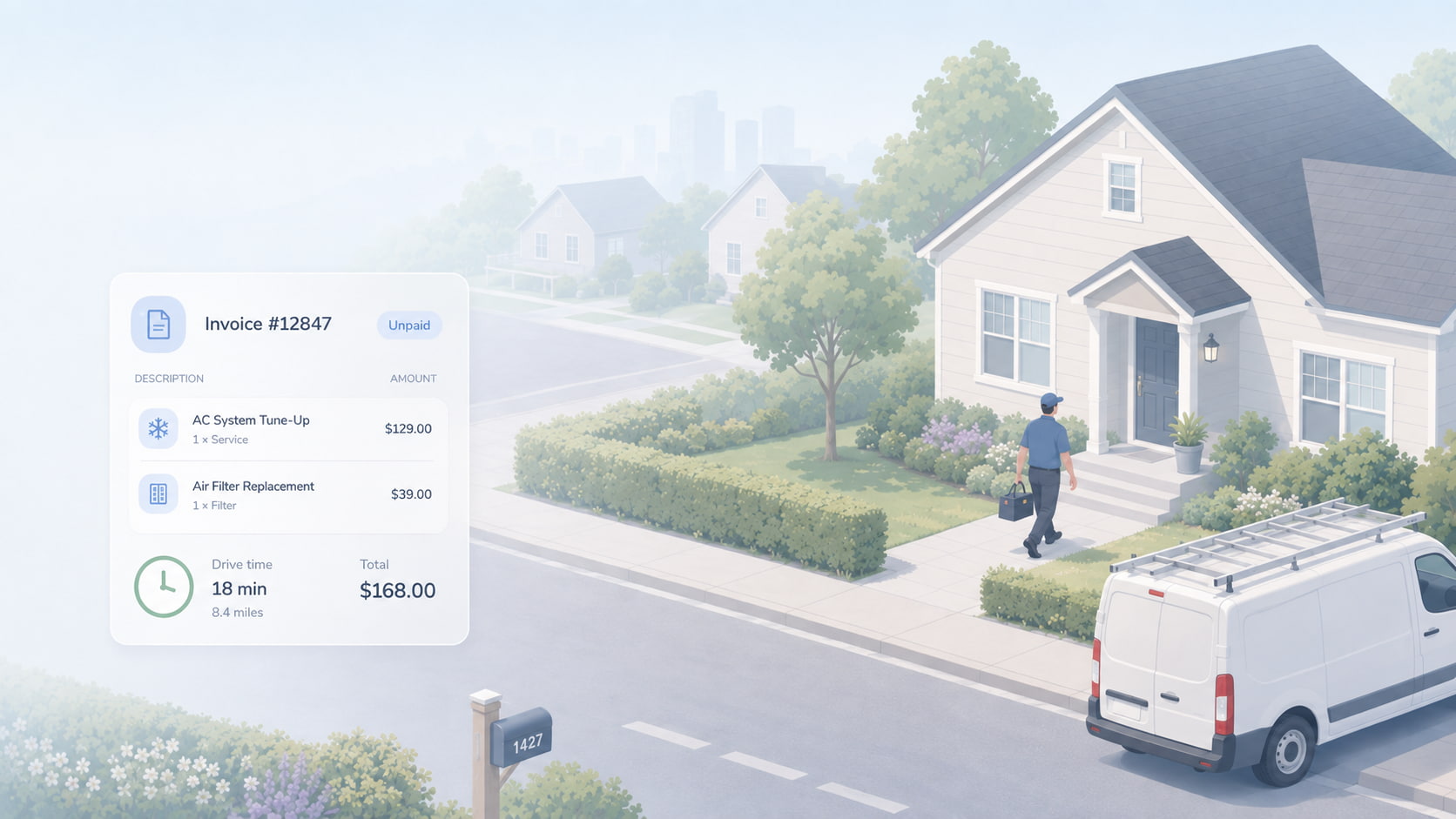
Most contractors set their service call fee the same way: look at what two competitors charge, land a few dollars under, and never revisit it. Which means the number covering your drive time, your van, your dispatcher and your risk was chosen by a stranger who may be losing money on it.
There's a better way to arrive at the number, and it takes about twenty minutes.
Scope note first. This is written for the diagnostic trades — HVAC, plumbing, electrical and appliance repair — where a customer calls with a problem, you dispatch, you diagnose, and you quote. If you run a route business like landscaping, pest control or pool service, the "service call" isn't really your unit of sale; your pricing question is how to build and price a recurring plan, and we cover that in the service agreement guide.
Spytec GPS is a self-serve GPS fleet tracking platform built for small and mid-size fleets, with free hardware on every plan, no contracts, and transparent pricing from $8.95/vehicle/month on the annual plan. We publish operator tools like this because the decisions that set a service business's margin are usually made once, early, and never audited.
First, untangle the three fees everyone calls the same thing
Half the confusion in this topic — and most of the arguments with customers — comes from three different charges sharing one name. They do different jobs and they should be priced differently.
| Charge | What it pays for | When it applies |
|---|---|---|
| Trip charge | Getting a truck and a tech to the address — drive time, fuel, vehicle cost | Every dispatch, regardless of what happens on site |
| Diagnostic fee | The labor and expertise to find the fault and explain it | When troubleshooting is required, on top of or instead of the trip charge |
| Minimum charge | The floor below which a job isn't worth dispatching at all | Any visit, including ones where the fix takes five minutes |
Most shops fold all three into one "service call fee" and then have a hard time explaining it. You don't have to itemize them on the invoice — but you do need to know which of the three your number is actually covering, because that's what tells you whether it's too low.
The most common mistake is a trip charge that quietly doubles as a diagnostic fee. A tech drives twenty minutes and spends ninety on a hard intermittent fault, and the shop collects a fee sized for the drive.
Build the number from your cost, not their price
Here's the twenty-minute version. Work per dispatch, not per hour.
1. Time the whole thing honestly. Not wrench time. Door-to-door: drive out, park and set up, diagnose, write it up, drive to the next one. Most shops underestimate this by a third, and the part they miss is almost always drive time.
If you're guessing at that number, stop and measure it — a month of real trip data beats an estimate, and it changes the answer more than anything else in this calculation. Our guide to fleet job costing covers how to get actual door-to-door times instead of remembered ones.
2. Use your fully burdened labor rate. Not the tech's wage. Wage plus payroll taxes, workers' comp, health benefits, PTO, phone, tablet, uniforms, training, and the share of the truck they drive. For most small shops the burdened rate lands somewhere between 1.5x and 2x the hourly wage — run yours rather than taking that as a fact.
3. Add the vehicle. Payment or depreciation, insurance, fuel, maintenance, tires. Divide annual vehicle cost by billable hours per year to get a per-hour number, then apply it to the door-to-door time.
4. Add unbilled overhead. The dispatcher who booked it, the software, the phone system, the office. Some shops load this into the burdened rate; others add a flat per-dispatch amount. Either is fine as long as you do it once.
5. Apply your target gross margin. That's your floor.
Worked through: a two-hour door-to-door dispatch, a burdened rate of $60/hour, and $14/hour of vehicle cost gives you $148 of direct cost before a single part. If your service call fee is $89, you are not "competitively priced" — you are subsidizing every diagnostic visit and hoping the repair makes it back.
That's the real finding for most shops. The fee isn't a profit center; it's supposed to be a break-even on showing up. If it's below your cost to show up, every unconverted diagnostic is a loss.
The bigger decision: do you waive it?
Almost every shop applies the fee to the repair if the customer approves the work. It's worth understanding what that actually does.
Waiving raises your close rate and lowers your margin on the jobs you close. It converts the fee from revenue into a discount you hand out at the moment of sale. If your close rate on diagnostics is already high, you're discounting work you'd have won anyway.
Keeping it protects the cost of every visit and filters the calls. A customer willing to pay $129 to find out what's wrong is a materially different buyer from one shopping for a free look. Fewer calls, better calls.
There's no universal right answer, but there is a way to decide: look at your close rate on diagnostic visits. Above roughly 70%, waiving is expensive — you're giving up the fee on most of them. Down near half, the waiver is buying you conversions you'd otherwise lose. Measure yours before you copy whatever the shop across town does.
A middle path a lot of shops land on: keep the fee, and apply it to the repair only if the customer approves on the spot. You protect the visit, and you create a reason to decide today rather than "think about it."
What to say when they ask on the phone
"How much to come out?" is the moment the fee either works or costs you the call. The answer that works names the number, says what it covers, and says what happens next — without apologizing for it.
Something like: "It's $[X] for the visit. That covers a licensed tech coming out and diagnosing the problem, and you get a firm price on the repair before anything gets done. If you go ahead with the repair today, we apply it to the bill."
Then stop talking. The most expensive habit in this whole topic is a dispatcher who names the fee and immediately starts justifying it, which teaches the caller it's negotiable.
Flat rate or time and materials?
Adjacent decision, worth naming because it interacts with the fee.
Under flat rate, you quote a fixed price per repair from a book, and the customer knows the number before work starts. Efficiency accrues to you; a job that runs long is your problem. It pairs naturally with a diagnostic fee, because the diagnosis is what lets you quote.
Under time and materials, the customer pays for actual hours. It's simpler to administer and fairer on unpredictable work, but it puts the customer in the position of watching the clock, and it means an efficient tech earns you less on the same repair.
Most residential service in these trades has moved to flat rate for exactly that reason. If you're on T&M, your service call fee is doing more work — it's often the only thing covering the visit if the customer declines.
The three numbers to watch after you change it
- Close rate on diagnostic visits. What share of dispatches become approved work. This is the number that tells you whether a fee increase actually cost you anything.
- Average ticket. If the fee rises and the ticket rises with it, you filtered out low-value calls. If the ticket falls, you may be losing your better customers and keeping the price shoppers.
- Revenue per truck per day. The one that matters most and gets watched least. A higher fee with fewer calls can beat a lower fee with more, and this is the only number that shows it.
Give a change a full month before judging it. Weekly numbers in this business are weather.
Running a fleet of 5+ vehicles?
Most small service fleets on Spytec start with the plug-in OBD tracker — it goes into each vehicle's OBD-II port in seconds (no installer, no wiring), streams live location, and runs $8.95/vehicle/month with free hardware and no contract. Fleets of 5+ get automatic volume discounts.
See the OBD fleet tracker → · Compare business-fleet plans →
Frequently asked questions
What is a service call fee?
A service call fee is what a contractor charges to send a technician to a customer's address, separate from the cost of any repair. In practice it usually bundles three different things: a trip charge covering drive time and vehicle cost, a diagnostic fee covering the labor to find the fault, and a minimum charge setting the floor below which a dispatch isn't worth making. Knowing which of the three your number is covering is what tells you whether it's priced correctly.
How do I calculate what to charge for a service call?
Work per dispatch, not per hour. Time the full door-to-door visit including drive, setup, diagnosis and write-up. Multiply by your fully burdened labor rate — wage plus taxes, insurance, benefits and overhead, not the tech's hourly wage. Add vehicle cost for that time, add unbilled overhead like dispatch and software, then apply your target gross margin. That result is your floor. Check the market afterwards to see whether you're structurally more expensive, but don't let it set the number.
Should I waive the service call fee if the customer approves the repair?
It depends on your close rate on diagnostic visits. Waiving raises close rate and lowers margin on jobs you win — if you already close most diagnostics, you're discounting work you'd have won anyway. Keeping the fee protects the cost of every visit and filters out price shoppers. A common middle path is to apply it to the repair only when the customer approves on the spot.
What's the difference between a trip charge and a diagnostic fee?
A trip charge pays for getting a truck and technician to the address — drive time, fuel and vehicle cost — and applies to every dispatch regardless of what happens on site. A diagnostic fee pays for the labor and expertise to find and explain the fault, and applies when troubleshooting is required. Charging one number sized for the drive while your techs spend an hour troubleshooting is the most common way shops lose money on diagnostics.
How do I answer when a customer asks how much it costs to come out?
Name the number, say what it covers, say what happens next, and stop talking. For example: it is a set amount for the visit, it covers a licensed technician diagnosing the problem and giving a firm repair price before any work starts, and it is applied to the bill if the repair is approved that day. Dispatchers who name the fee and then justify it teach callers that it is negotiable.
The bottom line
Your service call fee should be a break-even on showing up, not a number borrowed from a competitor's website. Time the full door-to-door visit, cost it at your burdened rate plus the vehicle, add overhead, apply your margin, and compare that to what you're charging now. Most shops in these trades find they're under.
Then decide the waiver question with your own close rate rather than by habit, and watch revenue per truck per day rather than call volume. Fewer, better-qualified calls at a fee that covers the visit beats a full schedule of diagnostics you lose money on.
Guessing at drive time? It's the input that moves this calculation most, and the one shops estimate worst. Spytec GPS is $8.95/vehicle/month on the annual plan with the tracker included free, no contract, and a 30-day money-back guarantee. Volume discounts start automatically at five devices, and everything ships in two days — no sales call, no demo.
Related reading: Fleet job costing: which jobs actually make money · Route efficiency: cut windshield time without routing software · Service agreements that actually sell






Share:
Fleet Safety Program for Small Service Fleets (with a Free Template)
Dash Cam Laws by State: What Service Fleets Must Do Before Recording Drivers (2026)