

Your profit-and-loss statement says the business made money last month. Good. Now answer a harder question: which jobs made money, and which ones quietly lost it? For most small service fleets, that answer doesn't exist anywhere — the winners and the losers get blended into one monthly number, and the losers keep getting booked because nobody can see them.
The reason job costing breaks down in the field isn't materials or overhead. Those you can pull from invoices. It's time. Labor and travel are the biggest variable cost on almost every job, and they're the one input most owners are still estimating instead of measuring. This is how GPS data closes that gap — turning drive time, on-site time, and routing into real numbers you can cost a job with.
Spytec GPS is a self-serve GPS fleet tracking platform built for small and mid-size fleets, with free hardware on every plan, no contracts, and transparent pricing from $8.95/vehicle/month (annual). Every plan includes the trip history, stop timestamps, and utilization reports that job costing actually runs on.
Why service-fleet job costing quietly falls apart
When you quote a job, you assume a time: two hours on site, maybe thirty minutes each way. When you bill it, you use that same assumption — because unless someone was watching the clock, the assumption is all you have. The problem is that the assumption is almost always optimistic, and the overruns don't announce themselves.
A tech leaves the shop, stops for coffee, hits traffic, takes the long way, spends an extra forty minutes on site because the customer wanted to chat, then swings by a supply house on the way back. On paper that's still "a two-hour job." In reality it consumed most of a morning. Do that across a week and a "profitable" schedule is carrying two or three jobs that lost money — you just can't point to them.
The hidden time costs eating your margin
Drive time between jobs
Windshield time is pure cost — you're paying a wage and burning fuel while nothing billable happens. When your schedule sprawls across town or a tech backtracks, drive time can quietly rival on-site time. It rarely shows up in an estimate, and it never shows up on an invoice.
On-site overruns
The job you quoted at ninety minutes that actually takes three hours isn't rare — it's the one silently deciding whether that account is worth keeping. Without real arrival and departure times, you can't tell an efficient tech from a slow one, or a fair quote from a money-loser.
Unbilled travel and side trips
Supply runs, personal stops, and return trips for forgotten parts all consume paid time that no customer is funding. A single forgotten part can turn a one-trip job into a two-trip job and erase the margin on it entirely.
The "just checking in" account
Every fleet has a recurring customer everyone likes who somehow always eats more time than they pay for. Job costing is how that stops being a gut feeling and becomes a renegotiation.
Stop guessing what a job actually took. Spytec's Pulse OBD tracker logs every arrival, departure, and mile automatically — free hardware, $8.95/vehicle/month on the annual plan, no contract.
How GPS gives you the time inputs to cost a job accurately
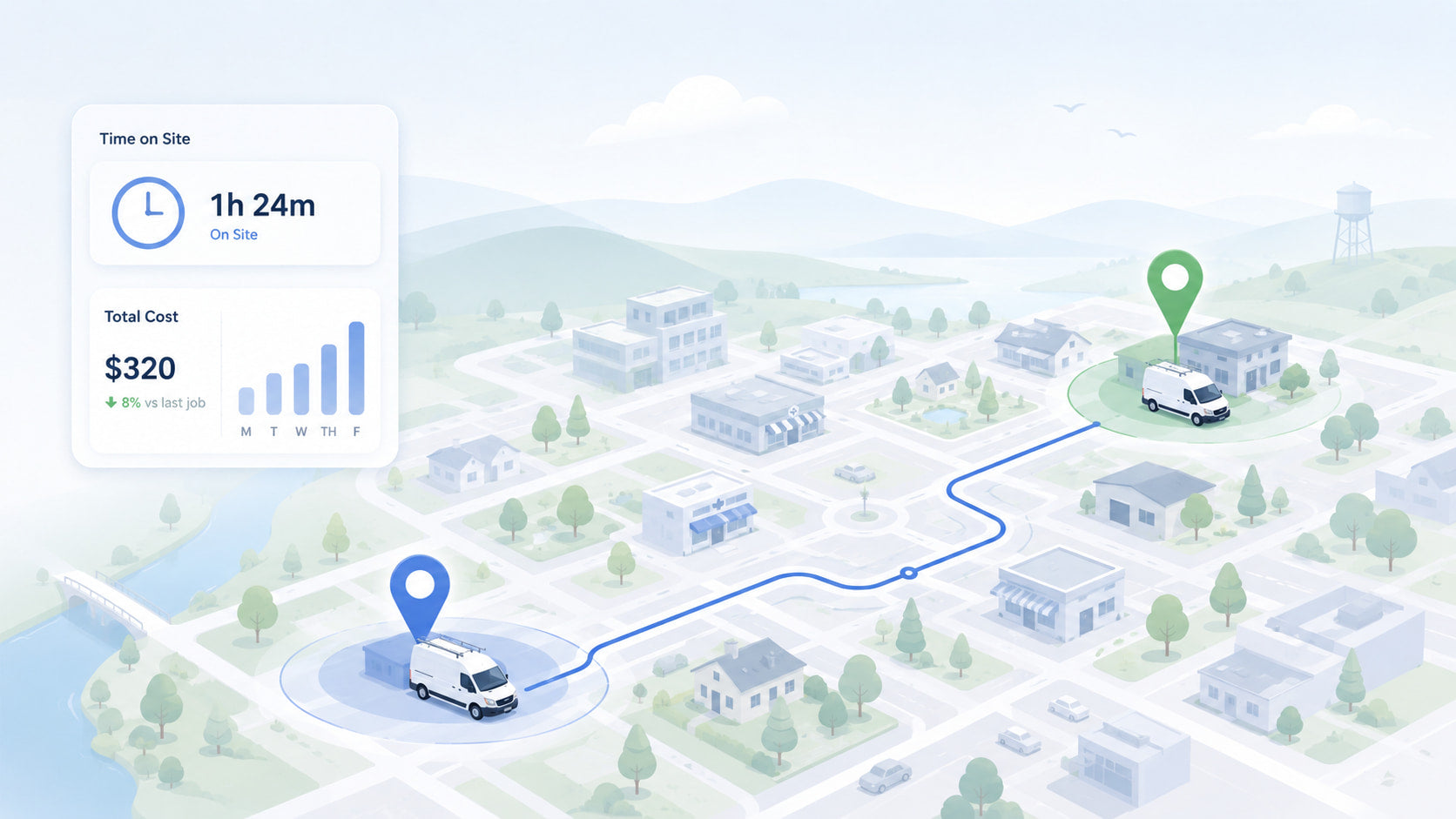
GPS tracking won't price your materials or allocate your overhead — that's still your job. What it does is hand you the one input you've been estimating: exactly how much time each job consumed, from the moment a truck left the yard to the moment it returned.
| What you need to cost a job | Where the data comes from |
|---|---|
| Time on site | Stop timestamps and geofence arrival/departure alerts show exactly when a truck reached the job and left it. |
| Drive time | Trip history logs departure-to-arrival time and mileage for every leg, automatically. |
| Detours and return trips | Full route replay reveals supply-house stops, backtracking, and second trips you weren't billing for. |
| Quoted vs. actual | Utilization reports let you compare the hours you estimated against the hours the job really took. |
Every one of those reports is included on every Spytec plan — no tiers, no add-ons, no reporting upsell. If you want a primer on turning that raw data into decisions, our guide to reading GPS fleet reports walks through the metrics that matter.
Turning the numbers into pricing decisions
Job costing is only useful if it changes what you do next. Once you can see actual time per job, a few moves usually pay for the trackers many times over:
Reprice the accounts that are underwater. When you can show that a recurring customer's jobs run 40% longer than quoted, you have the evidence to raise the rate or restructure the work — a conversation you can't have on a hunch.
Tighten your estimates. After a month of real time data, your quotes stop being optimistic guesses. You bid from what jobs actually take, so you stop underpricing whole categories of work.
Fix the routing that sprawls. If the data shows techs crossing town between jobs, tighter territory assignment recovers billable hours without hiring anyone. See what else erodes the real cost of a job in our breakdown of the costs vendors hide until the demo call.
Coach the outliers. When one tech's on-site times run consistently long, that's a training conversation — or a scheduling one — not a mystery.
What this looks like in dollars
You can build the number from your own fleet. Say a tech is fully loaded at $45 an hour and each of five daily jobs carries just thirty minutes of unbilled drive time and overrun you weren't accounting for. That's 2.5 hours a day, about $112, or roughly $28,000 a year — from one truck. On a fleet of five, the unmeasured time is the difference between a good year and a flat one. A tracker at $8.95 a month per vehicle is a rounding error against it.
Plug in your own labor rate and your own honest guess at unbilled time per job. The point isn't the exact figure — it's that the leak is already in your numbers, and job costing is how you finally see it. Compare the full fleet cost on the transparent fleet pricing page.
Frequently asked questions
What is job costing for a service fleet?
Job costing means assigning the real cost of each individual job — labor, travel, materials, and overhead — so you know which jobs and customers are actually profitable. For service fleets the hardest input to capture is time: how long the job really took, including drive time and any return trips. GPS tracking supplies that time data automatically instead of relying on a tech's memory or an optimistic estimate.
Can GPS tracking tell me how long a tech spent on a job?
Yes. Stop timestamps and geofence arrival/departure alerts record exactly when a vehicle reached a job site and when it left, so you get accurate on-site time without anyone filling out a timesheet. Trip history captures the drive time and mileage for each leg on top of that.
Doesn't job costing need accounting software, not GPS?
They work together. Your accounting or field-service software handles invoicing and materials; GPS supplies the accurate labor-and-travel time those systems are otherwise guessing at. Feeding real time data into your existing costing is usually what turns it from an estimate into a decision you can trust.
Which tracker is best for capturing job times?
For most vehicles built in 2010 or newer, the Pulse OBD plug-in is the simplest — it installs in about 30 seconds and logs trips, stops, and mileage automatically. Every device type and every plan includes the same stop, route-history, and utilization reporting, so any Spytec tracker will give you the time inputs.
How soon will I have usable data?
Hardware ships free in two days and the OBD tracker plugs in without an installer, so you can be reviewing real arrival, departure, and drive times within the first week — no contract or activation fee to get started.
The bottom line
A monthly P&L tells you whether the fleet made money. Job costing tells you why — which jobs, which customers, and which routes are carrying the business and which are quietly draining it. The missing piece has always been accurate time, and that's exactly what GPS measures. For a small service fleet, it's one of the fastest ways to turn a vague sense that "some jobs aren't worth it" into a decision you can actually price.
Know which jobs make you money. Free hardware, transparent pricing from $8.95/vehicle/month, no contracts, and every report included on every plan.






Share:
Fleet Fuel Theft and Waste: How to Spot It and Stop It (2026)
Cheapest Fleet GPS Tracking With No Contract (2026)