

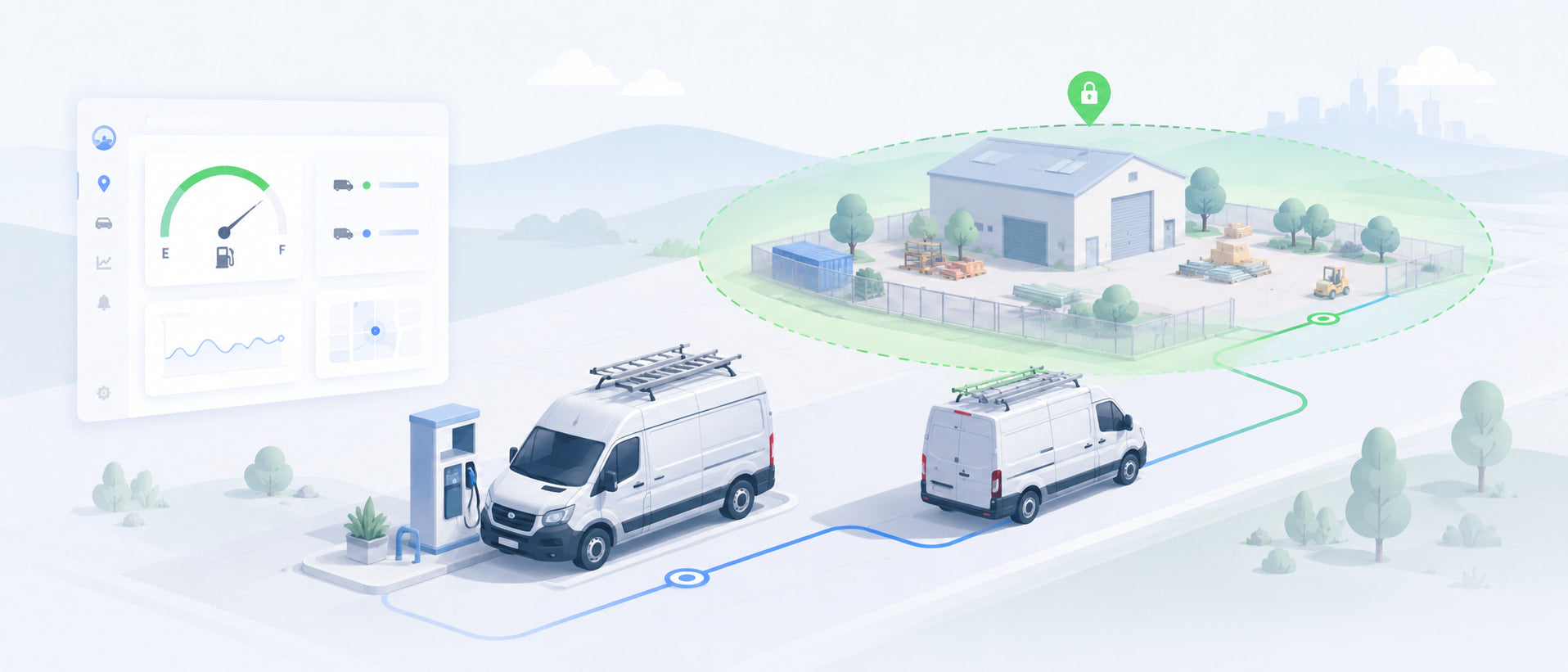
You already know exactly what your fleet spent on fuel last month. The card statement told you to the penny. What it can't tell you is how many of those gallons actually moved a truck toward a paying job — and how many were burned idling in a parking lot, driving home the long way, or pumped into a vehicle that doesn't even belong to your company.
For most small service fleets, fuel is the second-biggest operating cost after labor. It's also the one that leaks the most quietly, because the waste never shows up as a line item. It hides inside a number you've already accepted as "the cost of doing business." This is a look at where fleet fuel actually disappears, and how GPS tracking turns each invisible leak into something you can see, measure, and stop.
Spytec GPS is a self-serve GPS fleet tracking platform built for small and mid-size fleets, with free hardware on every plan, no contracts, and transparent pricing from $8.95/vehicle/month (annual). The Pulse OBD plug-in even reads fuel level straight from the vehicle — so this isn't theory, it's a report you can pull on a Tuesday.
Why fuel is the cost you can't see on a statement
A fuel-card statement answers one question: how much did we spend? It cannot answer the questions that actually control the bill — was the truck moving or parked when that gas got used, did the route make sense, and did the gallons on this receipt go into the van they were supposed to?
That gap matters because fuel waste isn't one big obvious theft. It's a hundred small, deniable ones, spread across every driver and every week. Nobody feels like they're stealing when they leave the engine running through a lunch break or run a personal errand on the way back to the yard. But add it up across a fleet of eight or ten trucks and it becomes real money — money you're currently paying without a way to trace it.
The five ways fuel quietly leaks out of a small fleet
1. Idling
An idling engine burns roughly half a gallon to a gallon of fuel per hour while producing zero revenue. On a service fleet, idle time stacks up fast: running the AC through paperwork, warming up on cold mornings, sitting in the truck on a phone call, leaving it running "just for a minute" at every stop. An hour a day of unnecessary idle per truck is completely ordinary — and completely invisible on a card statement.
2. After-hours and personal use
Take-home trucks are a genuine convenience. They also make it easy for a company vehicle — and the company fuel card — to run weekend errands, side jobs, or the daily commute the long way. You're not just paying for that fuel; you're paying for the wear, the mileage, and the liability of a branded truck being driven off the clock.
3. Fuel-card fraud
The hardest leak to catch on paper is a gallon count that doesn't match the tank. A driver fills the company truck and their personal car on the same stop. Or buys 25 gallons for a 16-gallon tank and pockets the difference through a friend at the pump. The statement looks normal — a fuel purchase at a gas station, during the day, in your service area. Only the vehicle knows it didn't need that much.
4. Inefficient routing and side trips
Every extra mile is fuel you didn't need to buy. When drivers pick their own routes, double back, or take a personal detour between jobs, the miles pile up quietly. Without route history, you have no baseline for what a day should have cost in fuel versus what it actually did.
5. Aggressive driving
Hard acceleration, speeding, and heavy braking can cut fuel economy by a meaningful margin on the highway. Aggressive driving is expensive twice: once at the pump, and again in tires, brakes, and the occasional insurance claim. It's also a habit you can't correct if you can't see it.
See exactly where your fuel is going before you pay for another tank. Spytec's Pulse OBD tracker reads fuel level and idle time straight from the vehicle — free hardware, $8.95/vehicle/month on the annual plan, no contract.
How GPS turns each fuel leak into something you can see
The reason fuel waste survives is that a statement is a summary and driving is a story. GPS tracking gives you the story — where the truck was, when it moved, how long it sat, and how it was driven — so each type of waste finally has a signal attached to it.
| Fuel leak | What catches it |
|---|---|
| Idling | Trip playback and utilization reports show engine-on time with zero movement, per vehicle, per day. |
| After-hours use | Geofence alerts notify you the moment a truck leaves the yard outside working hours. |
| Fuel-card fraud | Route history places the truck at the pump — or not — at the time of a purchase. Pulse OBD fuel-level readings show whether the tank actually rose. |
| Inefficient routing | Full route replay reveals detours, backtracking, and personal stops between jobs. |
| Aggressive driving | Driver safety alerts flag speeding and hard braking so you can coach the habit out. |
None of this requires a compliance department or a week of training. Every one of these features is included on every Spytec plan — there are no reporting tiers to unlock and no add-ons to buy. You plug in the tracker, and the reports start filling in.
What this can be worth in real dollars
You don't need a fabricated statistic to see the size of the prize — you can build the number from your own fleet. Take a ten-van service fleet. Say each van racks up one hour of unnecessary idle per workday, burning roughly three-quarters of a gallon an hour. At around $3.50 a gallon, that's about $2.60 per van per day, or roughly $26 a day across the fleet. Over about 250 working days, that's on the order of $6,500 a year — from idle time alone, before you touch personal use, routing, or fraud.
Plug in your own van count, your own fuel price, and your own honest guess at idle time. The point isn't the exact figure; it's that the money is already leaving, and right now you have no instrument pointed at it. A tracker at $8.95 a month per vehicle typically pays for itself the first time it catches even a fraction of that waste. See how the full fleet cost pencils out on the transparent fleet pricing page, and if you want to know what else vendors don't put on the sticker, read how to read a GPS tracking quote.
Frequently asked questions
Can GPS tracking actually detect fuel theft?
Indirectly but effectively, yes. GPS won't sit at the pump with the driver, but it places the vehicle at a specific location and time, so you can check whether a fuel purchase lines up with where the truck actually was. On Spytec's Pulse OBD tracker, fuel-level readings pulled from the vehicle also show whether the tank rose the way a receipt says it should — a mismatch between gallons purchased and gallons added is the clearest fraud signal there is.
How much fuel does idling really waste in a small fleet?
A typical light-duty engine burns roughly half a gallon to a gallon of fuel per hour of idling. One unnecessary idle hour per truck per day, across a fleet of ten, can add up to several thousand dollars a year. Idle and utilization reports let you see which specific vehicles and drivers are responsible instead of guessing.
Will drivers know they're being tracked, and does that help?
Most fleets tell their drivers, and that transparency is usually where the biggest fuel savings come from. When drivers know idle time, routes, and after-hours use are visible, the casual waste stops on its own — often before you've flagged a single report. The tracking data is there for the cases where it doesn't.
Do I need a special device to monitor fuel?
Fuel-level monitoring comes from the vehicle's own data through the OBD port, so the Pulse OBD plug-in is the right fit for most vehicles built in 2010 or newer. It installs in about 30 seconds with no tools. For every fleet, the idle, route-history, geofence, and driver-behavior reporting that catches the other four fuel leaks is included on every plan and every device type.
How fast can I get set up?
Spytec ships hardware free in two days, the OBD tracker plugs in without an installer, and there's no contract or activation fee — so you can be pulling your first idle and route reports the same week the trackers arrive.
The bottom line
Fuel isn't a fixed cost you're stuck with — a big chunk of it is a variable cost hiding behind a statement that can't explain itself. Idling, after-hours use, fuel-card fraud, sloppy routing, and aggressive driving are all recoverable the moment you can actually see them. GPS tracking is the instrument that makes them visible, and for a small service fleet it's one of the fastest-paying tools you can put in a truck.
Stop paying for fuel you can't account for. Free hardware, transparent pricing from $8.95/vehicle/month, no contracts, and every report included on every plan. See why service fleets are switching on the Why Spytec page.






Share:
Geotab Pricing in 2026: What It Actually Costs Small Fleets (and Why You Can't See a Price)
Fleet Job Costing: How to Find Which Jobs Actually Make Money (2026)