

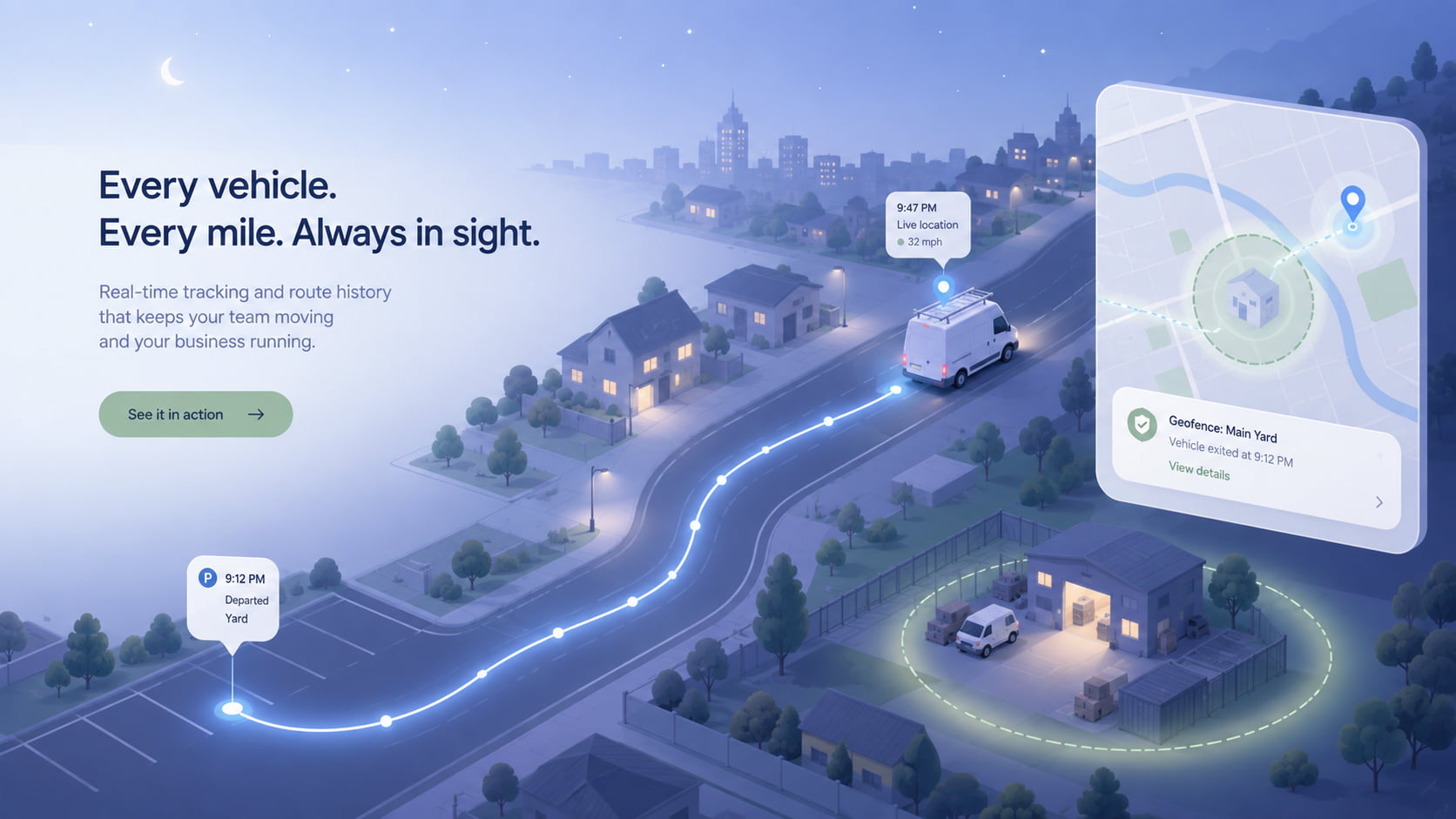
A stolen work truck is never just a stolen vehicle. It's a rolling toolbox, a day — sometimes a week — of booked jobs, and a crew standing around with nothing to drive. For a service fleet, the clock that matters most starts the moment you realize a truck is gone, and what you do in the first hour usually decides whether you recover it or just file a claim and eat the loss.
This is the recovery playbook: what to do the moment a work truck goes missing, how GPS turns a police report into an actual recovery, and how to set the whole thing up before you ever need it.
Spytec GPS is a self-serve GPS fleet tracking platform built for small and mid-size service fleets, with free hardware on every plan, no contracts, and transparent pricing from $8.95/vehicle/month on the annual Pulse OBD plan.
The first hour: what to do the moment a truck goes missing
Move in order. The goal is to hand police a live location before the truck disappears into a chop shop or a buyer's driveway.
- Confirm it's actually stolen. Rule out the boring explanations first — a tech took it home, it got towed, or it's parked around the corner. Your GPS map answers this in seconds: if the truck is sitting somewhere it shouldn't be and moving, you have a theft, not a mix-up.
- Pull the live location and recent route. Open the tracker and note the current position plus where it's been in the last few hours. That route history often points straight at where the truck is being stored.
- Call the police and give them coordinates, not a description. "My 2022 Transit is missing" starts a slow report. "My stolen work van is currently at [address], here's the live GPS link" starts a recovery. Officers can act on a real-time location; they can't chase a guess.
- Do NOT go get it yourself. It's tempting, especially with tools worth more than the van inside. Don't. Share the location with law enforcement and let them recover it — confronting a thief is how a property loss turns into an injury.
- Notify your insurer and start the claim. File while the trail is warm. A police report number plus GPS location and history is the strongest documentation you can hand an adjuster, and it speeds up whatever the outcome is.
How GPS helps recover a stolen work truck
A GPS tracker changes theft from a "hope it turns up" situation into a location you can act on. Four capabilities do the work:
- Real-time location. You — and the police — can see exactly where the truck is right now, and watch it move. This is the single most important input to a fast recovery.
- Route history. The recorded breadcrumb trail shows where the truck went after it was taken, which frequently reveals a storage spot, a chop shop, or the thief's home before they've stripped it.
- Movement and after-hours alerts. If the truck moves when it shouldn't — overnight, on a weekend, outside your yard — the tracker can notify you the moment it happens, so you catch the theft in progress instead of at 7 a.m. when the crew shows up to an empty lot.
- Evidence for police and insurers. Location logs corroborate your report, support law enforcement's recovery, and document the loss for your claim.
The same after-hours alerting that catches a theft also catches unauthorized use — the same tool, a different trigger. If that's a concern for your fleet, see how to stop employee misuse of company vehicles.
Why service vans get targeted
Work vehicles are stolen for reasons personal cars aren't. A van full of copper, power tools, diagnostic gear, and a welder is worth more than the van itself, and it's often parked overnight at a tech's home or an unsecured yard — predictable, low-risk targets for a thief. Trades like HVAC, plumbing, and electrical carry the most valuable rolling inventory, which is exactly why a recovery plan matters more for a service fleet than for a family sedan. (For securing gear on remote job sites and heavy equipment, that's a different problem — our construction equipment theft guide covers it.)
Know where every truck is — before one goes missing. Every Spytec plan includes free hardware, no contract, and transparent pricing from $8.95/vehicle/month.
Set it up before you need it
Recovery only works if the tracker is already in the truck and reporting. A few choices make the difference between a device a thief unplugs and one that quietly leads police to your van:
- Pick hardware a thief won't find. A plug-in Pulse OBD tracker is the fastest to install and great for everyday visibility, but a savvy thief can unplug it. For theft recovery specifically, a hardwired tracker tucked out of sight (harder to remove) or a hidden, battery-powered Atlas XL long-term tracker placed covertly keeps reporting even if the obvious device is pulled. Many fleets run a visible tracker for operations plus a hidden one as a theft backstop.
- Turn on after-hours and geofence alerts. Draw a geofence around your yard and each tech's home base, and set alerts for movement outside working hours. That's what turns a theft you discover in the morning into one you're notified about as it happens.
- Don't lean on factory systems. Built-in connected-car services are inconsistent for business use and tied to the vehicle, not your fleet. A dedicated tracker gives you one map for every truck and route history you control — see GPS tracking for service trucks for the full buying rundown.
- Keep a tool inventory. GPS recovers the truck; a current list of what was inside (with serial numbers) recovers the value from your insurer. Pair the two.
What it costs — and what it saves
The math isn't close. A replacement work van plus the tools inside runs well into the tens of thousands, before you count the jobs you cancel while you're down a truck. GPS tracking that can recover it is a rounding error against that: the Pulse OBD plan is $8.95/vehicle/month annually with free hardware, and the hidden-backstop options (Pulse Wired at $12.95 and Atlas XL at $17.95) are only a few dollars more. Every plan includes $0 activation, $0 cancellation, a 30-day money-back guarantee, and free 2-day shipping, with no contract and no sales call. One prevented total loss pays for the whole fleet's tracking for years.
Frequently asked questions
Can GPS recover a stolen work truck?
Yes — a GPS tracker gives you and law enforcement the vehicle's real-time location and recent route, which is what makes a fast recovery possible. The key is that the tracker is installed and reporting before the theft; a hidden or hardwired tracker keeps working even if a thief finds and removes an obvious plug-in device.
What's the first thing to do when a company vehicle is stolen?
Confirm it's actually stolen using your GPS map, pull the live location and recent route, then call the police and give them the real-time coordinates rather than just a vehicle description. Notify your insurer and start the claim while the trail is warm. Do not attempt to recover the vehicle yourself.
Should I go get my stolen truck myself if I can see it on GPS?
No. Share the live location with police and let them handle recovery. A stolen work van often has valuable tools inside, which raises the stakes — but confronting a thief turns a property loss into a safety risk. Your GPS data lets law enforcement do it safely.
Will insurance still require a police report if I have GPS?
Yes. GPS location and history strengthen and speed up a claim, but they don't replace the police report — file both. Together, a report number plus GPS logs is the strongest documentation you can give an adjuster.
Can thieves find and disable a GPS tracker?
A visible plug-in OBD tracker can be unplugged if a thief knows to look. That's why fleets focused on theft recovery use a hardwired tracker installed out of sight or a hidden, battery-powered tracker placed covertly — often alongside a visible one. If the obvious device is removed, the hidden backstop keeps reporting.
The bottom line
You can't stop every theft, but you can decide in advance whether a stolen truck is a total loss or a recovery. Put a tracker in every vehicle, hide a backstop in the trucks carrying the most valuable tools, turn on after-hours alerts, and know the first-hour steps before you need them. When a work truck does go missing, you'll be handing police a live location instead of a description — and that's the difference between filing a claim and getting your truck back.
Protect every truck and the tools inside it. Free hardware, no contracts, transparent pricing from $8.95/vehicle/month — set it up yourself and see your fleet the day it ships.
Shop GPS trackers → · No sales calls. No contracts.






Share:
Route Efficiency for Small Service Fleets: Cut Windshield Time Without Routing Software
How Accurate Is GPS Fleet Tracking? (2026 Guide)