

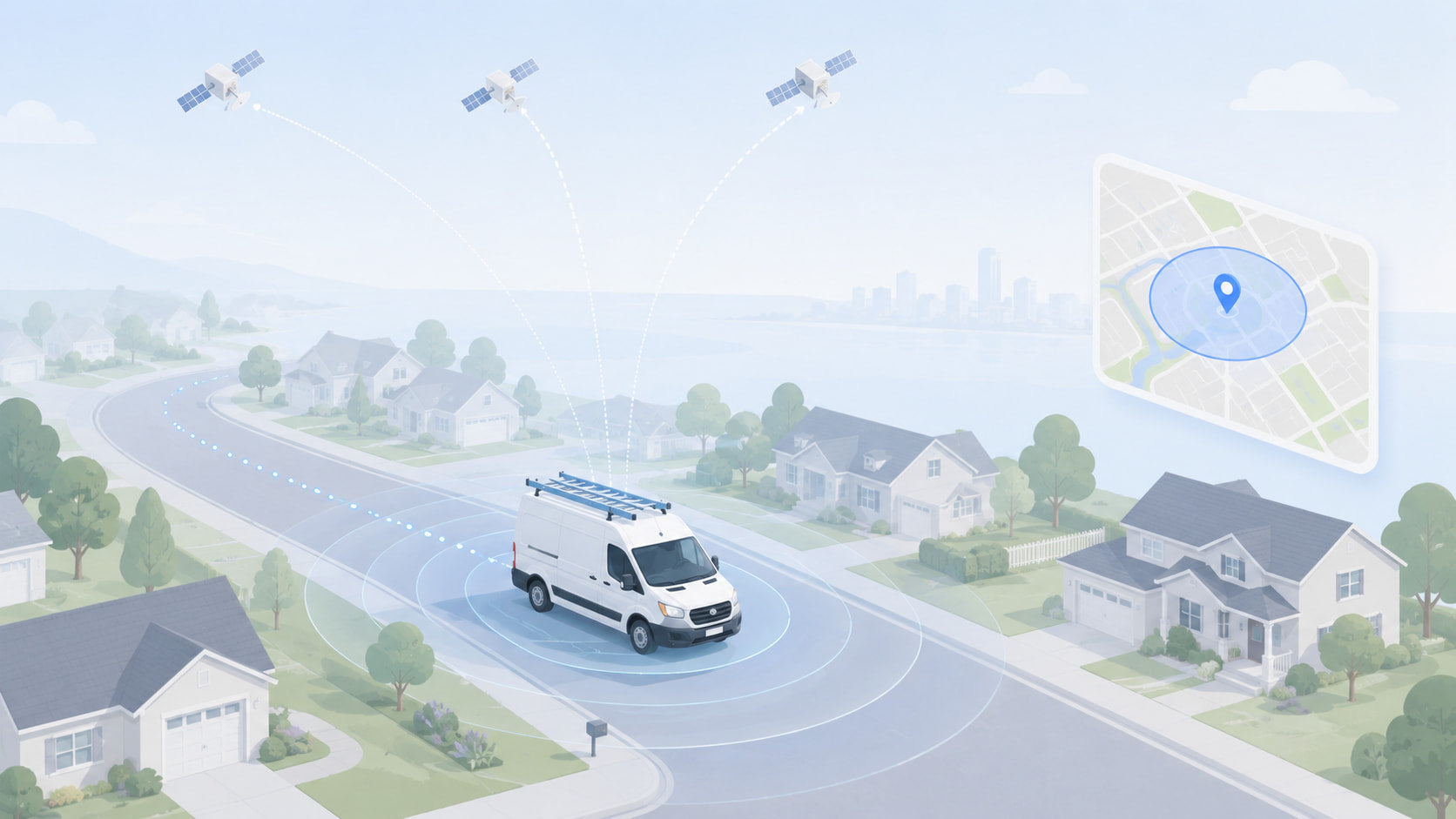
Open your tracking app and it says the truck is at 4212 Oak Street. But is it really at 4212 — or at 4218, or sitting in the alley behind the block? For a service fleet, that gap is the difference between "the tech is on site" and an angry customer call. So before you trust GPS to run dispatch, defend a mileage log, or settle a "we were never there" dispute, it's worth knowing exactly how accurate fleet GPS tracking actually is.
Spytec GPS is a self-serve GPS fleet tracking platform built for small and mid-size fleets — free hardware on every plan, no long-term contract, Scout generative AI included, and transparent pricing from $8.95/vehicle/month on the annual plan ($14.95 monthly).
The short answer: how accurate is GPS fleet tracking?
Under open sky, a modern GPS fleet tracker is typically accurate to within about 5 meters — roughly 16 feet — and often better when the device pulls from multiple satellite systems (GNSS, which combines GPS with GLONASS, Galileo, and BeiDou). In plain terms: accurate enough to tell you which house, which parking lot, and which side of the street a vehicle is on. It is not survey-grade — it won't tell you which parking space — but for knowing where your trucks are and whether a job got done, that is far more precision than a service fleet needs.
Accuracy isn't a single fixed number, though. It moves with the environment, the device, and how often the tracker reports in. Here's what actually drives it in the field.
What determines accuracy in the real world
A tracker calculates its position by timing signals from satellites overhead. The cleaner its view of the sky and the more satellites it can see, the tighter the fix. Four things move the needle:
- Sky view and obstruction. Open highway or a suburban driveway is the best case. Tall buildings, metal roofs, dense tree cover, and being parked inside a structure block or bounce signals and widen the margin.
- Multipath. In a downtown "urban canyon," signals reflect off glass and steel before reaching the device, which can throw the fix off by tens of feet until the vehicle clears the area.
- Multi-constellation GNSS. Devices that use several satellite systems at once get a faster, tighter, more reliable fix — especially in marginal conditions — than older GPS-only units.
- Device and antenna quality. A well-designed tracker with a good antenna and strong cellular coverage delivers a cleaner position, and delivers it to your app in near real time.
If you want the underlying mechanics, our primer on how GPS tracking works walks through the satellite math. This post is about what that means for a working fleet.
Update frequency vs. accuracy — the part that matters for a moving van
There's a difference between how precise a single location fix is and how current the location on your screen is. A tracker can be accurate to 5 meters and still show a stale position if it only reports every few minutes. For a moving vehicle, refresh rate is half the story.
Spytec vehicle trackers report in real time — as fast as every 2–5 seconds in performance mode, depending on the device and plan. At 45 mph, a 5-second gap is about 110 feet of travel between pings, so a fast update rate is what makes the breadcrumb trail look like a smooth path instead of a series of jumps. Battery-powered asset trackers deliberately report less often (every few minutes to once a day) to stretch runtime — a tradeoff between how live the data is and how long the device lasts. Our guide to passive vs. active GPS tracking breaks down that choice.
See where every truck is, in real time. Free hardware on every plan, live updates as fast as every 2–5 seconds, no contract, and transparent pricing from $8.95/vehicle/month on the annual plan.
Where accuracy drops — and how the tracker recovers
GPS needs a view of the sky, so accuracy degrades — or drops out entirely — in a few predictable places: inside parking garages and warehouses, in the core of a dense downtown, under heavy tree canopy, and occasionally next to very large metal structures. When that happens, a good tracker holds the last known position and re-acquires a precise fix within seconds of the vehicle getting back into the open. In practice, a van that pulls into an underground garage may "pause" on the map and then snap back to the exit — not a permanent blind spot, just a brief gap while the sky is blocked.
Is it accurate enough for what fleets actually do?
Yes — for every core job a small service fleet asks of it:
- Dispatch and ETAs. Knowing a truck is at a specific address or a few seconds away is exactly the precision routing and customer-ETA updates need.
- Geofencing. Drawing a geofence around a job site or the yard works reliably as long as you size the radius sensibly — a little larger than the property — so normal GPS variance doesn't trigger false "left the site" alerts.
- Mileage and IRS-ready logs. On the Pulse OBD tracker, mileage is read from the vehicle's own odometer rather than estimated from GPS points, so trip and mileage records are defensible for reimbursement and tax purposes.
- Dispute defense. A timestamped location trail — "the van arrived at 9:04, stayed 41 minutes, left at 9:45" — is what settles a "you were never here" or "your driver was speeding" argument.
Does the tracker type change accuracy? OBD vs. hardwired vs. battery
Mostly no. A plug-in OBD tracker, a hardwired unit, and a long-life battery tracker all calculate position from the same satellite systems, so raw location accuracy is comparable across them. What differs is power and reporting, not precision: a plug-in OBD or hardwired tracker draws vehicle power and can report every few seconds indefinitely, while a battery tracker trades update frequency for months of runtime. Choose the device for how the asset is powered and how live you need the data — not because one "sees" satellites better than another.
The bottom line
GPS fleet tracking is accurate to about 5 meters under open sky — precise enough to run dispatch, trust geofences, defend mileage logs, and settle disputes, and honest about where it struggles (garages, downtown canyons, heavy cover). For a service fleet, the accuracy that matters is the combination of a tight fix and a fast update rate, delivered to your phone in real time. That's what turns "somewhere in the neighborhood" into "at the customer's door."
Frequently asked questions about GPS fleet tracking accuracy
How accurate is GPS fleet tracking?
Under open sky, GPS fleet tracking is typically accurate to within about 5 meters (roughly 16 feet), and often better on devices that use multiple satellite systems (GNSS). That is enough to identify the specific address, parking lot, or street a vehicle is on. Accuracy can widen to tens of feet in dense downtowns, under heavy tree cover, or near large metal structures, and signal can drop temporarily inside parking garages or warehouses.
Is GPS accurate enough for mileage logs or IRS records?
Yes. Spytec's Pulse OBD tracker reads mileage from the vehicle's own odometer rather than estimating it from GPS points, and every trip is timestamped, so mileage and trip logs are accurate and defensible for reimbursement and tax purposes.
Does GPS tracking work in a parking garage or downtown?
GPS needs a view of the sky, so signal can weaken or drop inside parking garages, warehouses, and the core of a dense downtown. A quality tracker holds the last known location and re-acquires a precise fix within seconds of the vehicle returning to open sky — so these are brief gaps, not permanent blind spots.
How often does a fleet GPS tracker update its location?
Spytec vehicle trackers report in real time — as fast as every 2–5 seconds in performance mode, depending on the device and plan. Battery-powered asset trackers report less frequently (from every few minutes to once a day) to extend runtime. A faster update rate produces a smoother, more accurate breadcrumb trail for a moving vehicle.
Is a hardwired or OBD tracker more accurate than a battery tracker?
Raw location accuracy is comparable — all three use the same satellite systems. The difference is power and reporting frequency: plug-in OBD and hardwired trackers draw vehicle power and can update every few seconds continuously, while battery trackers trade update frequency for months of runtime.
Put an accurate, real-time tracker in every vehicle this week. Free tracker with every plan, no long-term contract, free 2-day shipping, and a 30-day money-back guarantee — from $8.95/vehicle/month on the annual plan.






Share:
When a Work Truck Gets Stolen: A Service Fleet's GPS Recovery Playbook
What Tool & Equipment Theft Costs a Service Fleet (and How Tracking Pays for Itself)