

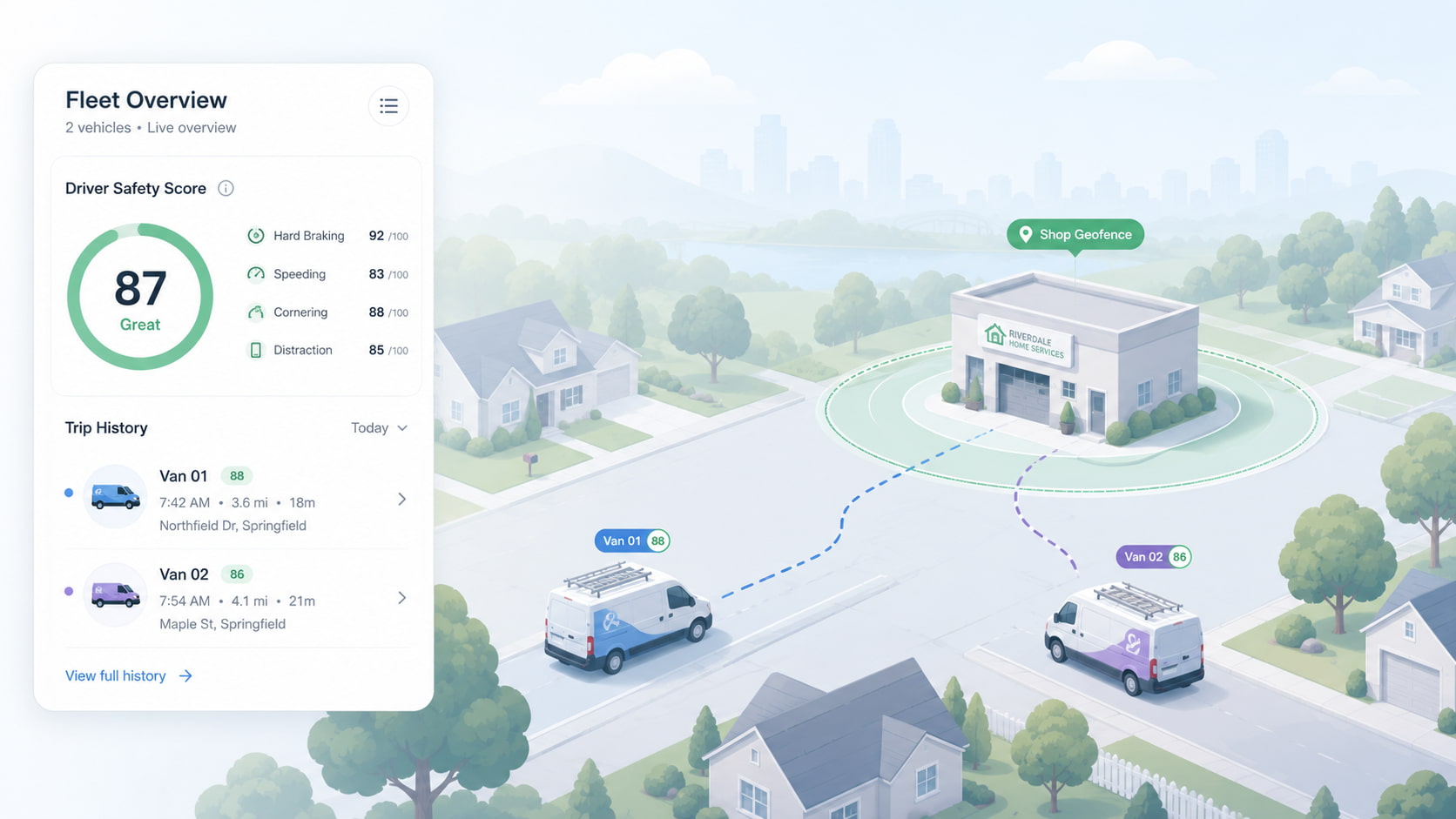
You have two work trucks, a couple of technicians you trust, and a nagging feeling that "fleet tracking" is something you deal with later — once there are eight vans and a dispatcher and a real problem to solve. So you keep running the way you always have: a text to check where someone is, a shoebox of fuel receipts, and a general sense that the driving is probably fine.
Here is the thing most owners figure out a few years too late. The habits you run on at two vehicles are the habits you will still be running on at ten — only by then they are baked in, harder to change, and quietly costing you money. Two vehicles is not too small for fleet tracking. It is the easiest moment you will ever get to put a simple, transparent operating system in place before the informal version hardens into "how we do things here."
Spytec GPS is a self-serve GPS fleet tracking platform built for small and mid-size fleets, with free hardware on every plan, no contracts, and transparent pricing from $8.95/vehicle/month (annual). This article is not a pitch for a bigger system than you need. It is a look at what "starting right" actually means when you have exactly two trucks on the road.
Is two vehicles too small for fleet tracking?
No — and the reason has less to do with the number of trucks than with the number of decisions you are already making blind. Even with two vehicles, you are answering "where is he?" several times a day, reconstructing mileage from memory at tax time, and forming opinions about how your people drive based on the one time you happened to be in the passenger seat. None of that gets easier as you grow. It gets multiplied.
Starting at two vehicles has three real advantages. The system is trivial to set up and understand, so you learn what the data actually tells you while the stakes are low. Your drivers experience tracking as a normal part of the job from the beginning, not as a surveillance measure introduced the week after something went wrong. And you build the paper trail — mileage, routes, on-site time — from day one instead of scrambling to reconstruct it later. The goal at this size is not control. It is a clean, boring baseline you can trust.
Fleet tracking is really three different jobs
The single most useful thing a small-business owner can understand about GPS tracking is that it is not one feature. It is three related but genuinely distinct workflows, and the mistake is assuming that one report or one alert covers all three. They overlap, but each has its own purpose, its own data, and its own way of going wrong if you ignore it.
Job one: vehicle visibility and equipment protection
This is the part everyone pictures — a live map with your trucks on it. But for a service business, the real value is not watching dots move. It is knowing, at the moment you need to know, where a vehicle is and whether it is where it is supposed to be. That matters most when the truck is carrying thousands of dollars of tools and equipment. A tracker turns a stolen van from a total loss and a police report into a live location you can hand to recovery. It tells you if a vehicle left a job site at 2 a.m. when it should have been parked. Visibility here is about protecting the asset and the expensive things inside it.
Job two: driver safety and coaching
This is a completely different workflow, even though it runs on the same device. Safety data — speeding, hard braking, rapid acceleration, harsh cornering — is not about knowing where the truck is. It is about how it is being driven, over time. The point is not to catch someone in a single bad moment. It is to see patterns you would otherwise never know about until they show up as a fender bender, a worn-out set of brakes, or a raised insurance premium. Treated well, this is the job that quietly lowers your risk and can be turned into something drivers actually want to score well on.
Job three: mileage and business-record documentation
The third job is pure administration, and it is the one small businesses lose the most money on by doing it badly. Accurate, automatic mileage logs — with the ability to separate business trips from personal or commute driving — are worth real dollars at tax time and save hours of month-end guesswork. This is not a safety feature or a security feature. It is a record-keeping feature, and if you try to make your theft alerts or your driver scores do this job, you will end up with neither clean records nor clean anything else.
Keep these three straight and you will evaluate tools far better. When a feature list promises "GPS tracking," ask which of the three jobs it actually does well — because plenty of cheap devices do the first one and quietly fail the other two.
What a two-vehicle business actually needs now
You do not need an enterprise platform with a dedicated fleet manager and a training program. You need a short, specific list of capabilities that cover the three jobs without drowning you in features you will never open.
Live location and route history. Real-time position for the "where is he?" moments, plus a trip-by-trip history you can scroll back through. Route history is what turns a customer dispute ("nobody ever showed up") into a settled fact in ten seconds.
Useful geofences and alerts. A geofence is just a virtual boundary — the shop, a big job site, a customer's property. You want to be told when a truck arrives or leaves, or moves after hours, without having to sit and watch a screen. The right alerts do the watching for you; the wrong ones bury you in noise until you turn them all off.
The right hardware for how you park and drive. Most service vehicles do best with a plug-in OBD tracker that installs in under a minute and reads mileage and diagnostics straight from the port. Vehicles without an accessible port, or where you want the device out of sight, take a hardwired tracker instead. Either way the hardware is free on the plan — the decision is about fit, not cost.
Simple safety reporting. A readable summary of how each vehicle was driven — ideally a score or a short list of events — not a firehose of raw telematics you need an analyst to interpret.
Reports you can review without a fleet manager. At two vehicles, the person reviewing the data is you, probably on a Sunday. The reporting has to be something you can scan in a few minutes and act on. If it needs a specialist to read, it is the wrong size for your business.
Start simple, priced per vehicle. Free hardware, no contract, and transparent pricing from $8.95/vehicle/month on the annual plan — two trucks or twenty.
Build a safety program, not a surveillance system
The fastest way to waste money on GPS tracking is to install it quietly, wait for someone to do something wrong, and spring the data on them. It poisons trust, it makes good drivers feel watched, and it turns a tool that should lower your risk into a morale problem. A two-vehicle shop is small enough that one resentful technician is a real percentage of your workforce. Get this part right and the technology takes care of itself.
Tell people what you are collecting and why. Before the devices go in, have a plain conversation: here is what the tracker records, here is what I will use it for, here is what I will not use it for. Framed honestly — protecting the trucks and the equipment, backing you up in a customer dispute, keeping mileage clean for taxes — most drivers have no problem with it. It is the secrecy that breeds suspicion, not the tracking. Putting the basics in writing, even a single page, removes the ambiguity for everyone.
Establish a baseline before you react. Resist the urge to send a text the first time you see a hard-braking event. Everyone brakes hard sometimes. Let the data run for a few weeks and learn what normal looks like for your routes and your drivers. A single event is noise. A baseline is what lets you tell the difference between a driver who had one bad merge and a driver with a genuine pattern.
Coach patterns, not moments. The conversation that changes behavior is not "the system says you sped at 4:15 on Tuesday." It is "over the last month your harsh-braking events are running higher than the other truck — let's figure out what's going on." Repeated patterns are coachable and often have real explanations: a bad route, an overbooked schedule, a vehicle that needs service. Isolated events, jumped on, just teach people to resent the box on the dash. If you want to reward as well as correct, a monthly driving score gives you a fair, visible thing to recognize — and a driver who knows a good score is noticed is a driver who drives well when no one is looking.
Simple enough for two, ready for ten
The reason you can start now without overbuying is that the right small-fleet system scales without a re-do. You add a vehicle by ordering a device and plugging it in — no new contract, no migration, no sales call. Transparent per-vehicle pricing means your cost grows in a straight, predictable line, and automatic volume discounts begin at five devices and deepen as you add more, so growing gets cheaper per truck rather than more complicated. The operating habits you set at two — how you use geofences, how you run safety coaching, how you close out mileage each month — are exactly the habits that make a ten-vehicle fleet manageable instead of chaotic. You are not buying capacity you do not need. You are setting a pattern that still fits when you are three times the size.
What you are specifically avoiding is the other path: an enterprise platform sold on a multi-year contract, priced through a quote and a demo, built for fleets with a full-time manager. That system is not wrong — it is just wrong for two trucks. The cost of starting too big is not only money. It is a tool so heavy that you never actually use most of it, which is its own kind of waste.
Frequently asked questions
Is GPS fleet tracking worth it for just two vehicles?
Yes, for most service businesses. Two vehicles still generate the same three problems a bigger fleet has — protecting the trucks and equipment, understanding how they are driven, and keeping accurate mileage records — just at a smaller scale. Starting at two lets you build clean records and normal expectations from the beginning, when it is easy, rather than retrofitting them later. With free hardware, no contract, and pricing from $8.95/vehicle/month annually, the cost of starting small is low enough that the mileage-record and theft-protection value alone usually covers it.
What does GPS fleet tracking actually do?
It does three distinct jobs. First, vehicle visibility and equipment protection — live location and history so you know where trucks are and can recover a stolen one. Second, driver safety and coaching — data on speeding, hard braking, and acceleration so you can see and improve driving patterns over time. Third, mileage and record-keeping — automatic trip logs that separate business from personal miles for taxes and reimbursement. A good system does all three; cheap devices often only do the first.
How do I track mileage for business versus personal use?
A fleet tracker logs every trip automatically with distance, route, and time, and lets you classify trips as business or personal. Instead of reconstructing mileage from memory or a paper log at tax time, you review the trips and confirm which count as business use. For a plug-in OBD tracker that reads the vehicle's own data, the mileage record is as accurate as the odometer, which makes month-end and year-end reporting far cleaner.
Will GPS tracking make my drivers feel watched?
It depends entirely on how you introduce it. Installed secretly and used to catch people, it damages trust. Introduced openly — with a clear explanation of what is collected and why, a baseline period before anyone reacts to events, and coaching aimed at patterns rather than isolated moments — most drivers accept it as a normal part of a company vehicle. A visible monthly driving score also gives you a way to recognize good driving, not just flag bad driving. Our guide to monitoring driver speed without micromanaging covers this in more depth.
Do I need special hardware, and is there a contract?
Most service vehicles use a plug-in OBD device that installs in about a minute; vehicles without an accessible port or where you want the tracker hidden use a hardwired unit. Spytec includes the hardware free on every plan, charges $0 to activate and $0 to cancel, and does not require a contract — you pay month to month or annually and can leave anytime, backed by a 30-day money-back guarantee. That is deliberately the opposite of the multi-year enterprise agreements built for large fleets.
The bottom line
Two vehicles is not too early for fleet tracking — it is the best possible time to start. The system is simple, the stakes are low, and every habit you set now is one you will not have to fix later. Keep the three jobs straight — protecting your trucks and equipment, coaching safer driving, and documenting mileage — pick a small set of capabilities that cover them, and introduce it to your drivers as an honest safety program rather than a hidden camera. Do that, and by the time you have ten trucks you will be running a business that already knows how to manage a fleet, instead of one trying to learn under pressure.
Set up the right system while it is still simple. Free hardware, transparent per-vehicle pricing, and no contract — start with two trucks and add more whenever you are ready. No sales calls.






Share:
Do Small Fleets Need an AI Fleet Assistant? What Generative AI Actually Does (2026)
Route Efficiency for Small Service Fleets: Cut Windshield Time Without Routing Software