

Every fleet platform now says it's "AI-powered." Open five tracking websites and you'll see AI dashcams, AI assistants, AI insights, AI copilots — often on the same page, rarely explained. If you run a service fleet of 5 to 50 vehicles, the practical question isn't whether a vendor uses AI. It's whether a specific AI feature saves you time or money, and whether you're paying for something you'll actually use.
Spytec GPS is a self-serve GPS fleet tracking platform built for small and mid-size fleets — free hardware on every plan, no long-term GPS-tracking contract, and transparent pricing from $8.95/vehicle/month on the annual plan. Scout, its generative AI fleet assistant, is included on every plan.
This guide cuts through the marketing. Here's what an AI fleet assistant actually does, when a small fleet benefits from one, how the major options compare, and the questions to ask before you pay for "AI."
What an AI fleet assistant actually does
The term "AI" gets stretched across two very different jobs, and confusing them is how buyers overpay.
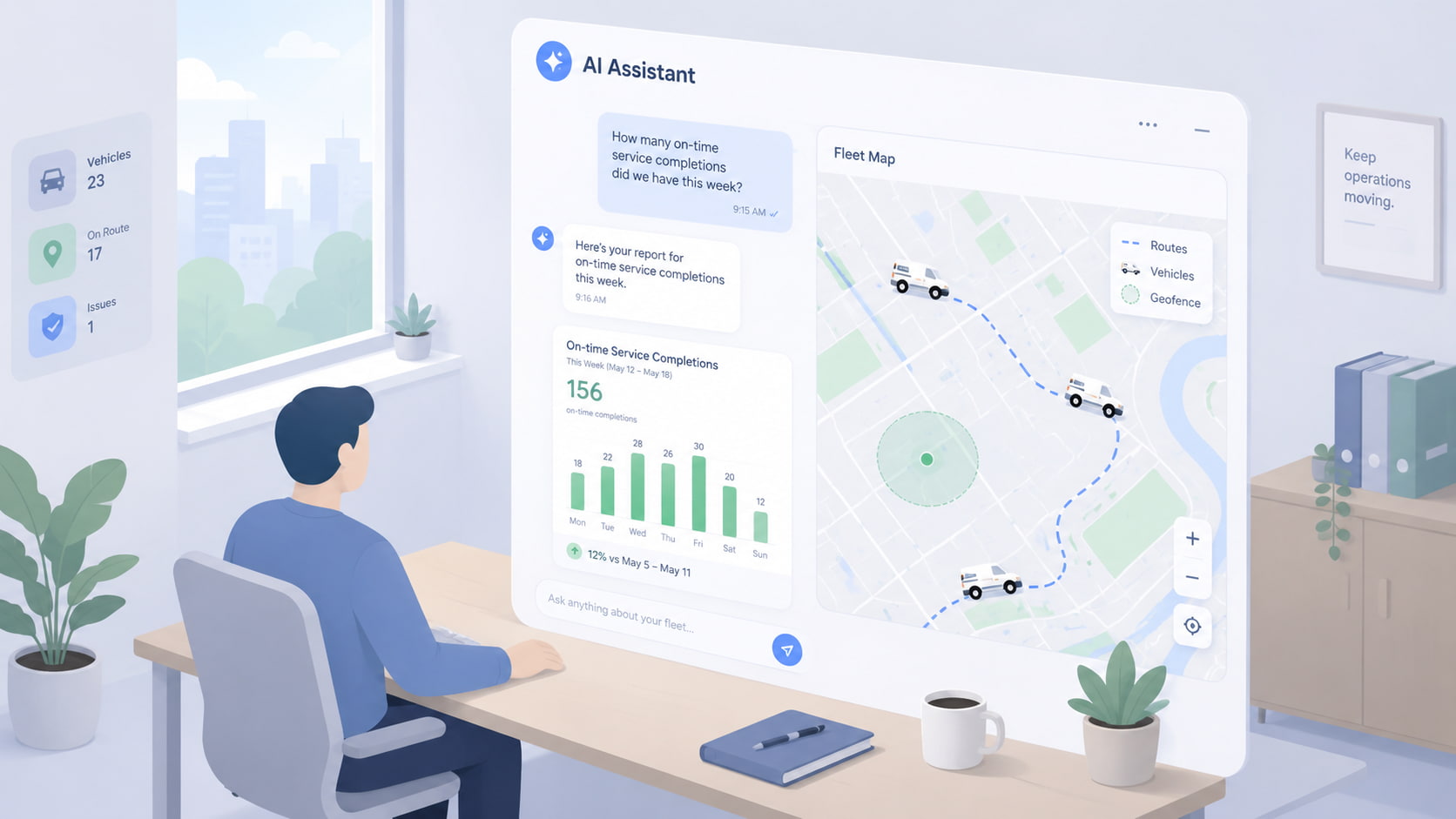
A generative fleet assistant is a natural-language layer over your fleet data. Instead of clicking through menus and building a report by hand, you ask a question — "Which vans idled the most last week?" or "Show me every after-hours trip in July" — and it answers, builds the report, and, depending on the product, sets up an alert or completes a routine task for you. It's aimed at the person doing the admin: the owner or office manager who'd otherwise spend an hour a week digging through dashboards.
An AI dashcam does something completely different. It's a camera that uses on-device AI to detect risky driving — hard braking, tailgating, distraction — flag safety events, and surface the relevant video clip. It's aimed at liability, insurance defense, and driver coaching, and it requires hardware in the vehicle.
Both are useful. They solve different problems, cost differently, and shouldn't be lumped together under one "AI: yes" checkbox. If you want the full breakdown of both across the major providers, our 5 best fleet tracking systems guide compares them side by side.
Do small fleets actually need one?
Honest answer: not to get value from GPS tracking. For most small service fleets, the core features — live location, geofence alerts, trip history, and speed/idle alerts — deliver the bulk of the payback on their own. Knowing where every truck is, verifying time on site, and cutting idle time doesn't require AI.
A generative assistant earns its place when administrative time is your bottleneck. If you're the owner running dispatch, payroll backup, and customer disputes yourself, the value is real: pulling a report by asking for it instead of building it, getting a straight answer to "who was closest to that emergency call," or standing up a new geofence alert without hunting through settings. The assistant doesn't replace the tracking — it removes the friction of getting answers out of it.
So the buying test isn't "do I want AI." It's: will this save me enough admin time to matter, and am I paying extra for it or is it included? That second half is where the options diverge sharply.
What to look for before you pay for "AI"
Four questions separate a genuinely useful assistant from an upsell:
- Is it included, licensed, or quote-gated? Some assistants are part of the base plan. Others sit in a higher tier, depend on your license, or only appear after a sales conversation. The feature is only worth what you can actually access.
- Does it answer, or can it also act? Some assistants only answer questions and surface insights. Others can also complete tasks — create a report, set up an alert, change a setting. If you want time saved, the ability to do matters more than the ability to describe.
- Does it need extra hardware or a separate subscription? An AI dashcam is a device with its own cost. A generative assistant usually isn't — but confirm it's not a paid add-on.
- What's the total price? Compare the job the AI does against what it adds to your monthly bill, not the fact that the box is checked.
How the major fleet AI assistants compare
The big platforms are all building generative assistants, and they're at different stages with different access models. Here's an honest, current snapshot for a small-fleet buyer.
| Assistant | What it does | How a small fleet gets it |
|---|---|---|
| Spytec — Scout | Analyzes fleet performance, answers questions, creates reports and alerts, and completes common product actions via natural language. | Included on every plan; self-serve, no contract. |
| Samsara Assistant | Answers natural-language questions about vehicles, drivers, faults, safety scores, and fleet performance. | Availability can depend on licensing; quote-based platform. |
| Motive — Atlas | Natural-language analysis, reports, and workflow actions such as setting up alerts (Motive Analytics today; Atlas rolling out). | Quote-based platform; confirm availability and tier. |
| Geotab — Ace | Conversational fleet analysis (read-only insights); its separate MCP Connector adds actions like creating rules and alerts through external AI assistants. | Through a Geotab reseller. |
| Verizon Connect | AI Inspection Assistant generates custom, DOT-compliant DVIR inspection forms from a prompt — a focused tool rather than a full fleet copilot. | Within its consultative platform. |
A few honest takeaways. These are all capable companies, and Samsara, Motive, and Geotab bring deep platforms with strong safety and compliance tooling that larger or regulated fleets will value. The differences that matter for a small fleet are access and scope: whether the assistant is included or gated, whether it can complete actions or only answer, and whether you can start using it today without a sales process.
Where Scout fits
Scout is Spytec's generative AI fleet assistant, and the defensible difference isn't a claim to be smarter than everyone else — it's how you get it. Scout is included on every Spytec plan, not a licensed tier or a quote-gated add-on. You can ask it questions about performance, have it analyze activity, generate reports, create alerts, and complete common fleet-management tasks using plain language — and because it's built into a self-serve, transparently priced platform with no long-term contract, a five-truck fleet gets the same assistant a fifty-truck fleet does, on day one, for the published price.
That's the pattern across everything Spytec does: capabilities usually associated with more complex enterprise platforms, delivered without the enterprise buying process. Scout is the AI expression of it.
Get real-time tracking and Scout generative AI on every plan — no tiers, no sales calls. Free hardware, from $8.95/vehicle/month on the annual plan, with volume discounts up to 25% applied automatically at checkout.
Frequently asked questions
What is an AI fleet assistant?
An AI fleet assistant is a generative AI feature that lets fleet managers work with their tracking data using natural language. Instead of building reports and configuring settings by hand, you ask questions like "which vehicles idled most last week?" and the assistant analyzes the data, answers, and — depending on the product — creates reports or alerts and completes routine tasks. It's distinct from an AI dashcam, which uses AI to detect risky driving and capture safety-event video.
Do small fleets need AI fleet-management features?
Not necessarily. For many small service fleets, dependable location tracking, geofences, trip history, and alerts deliver most of the immediate value. A generative AI assistant is most useful when administrative time is the bottleneck — it can analyze performance, build reports, create alerts, and complete routine tasks quickly. AI dashcams are most valuable when a fleet needs video evidence, automatic safety-event detection, or driver coaching. Compare the job each AI feature does, whether it needs extra hardware, and the total price — not simply whether a provider uses the term "AI."
What's the difference between a generative fleet assistant and an AI dashcam?
A generative fleet assistant works with your operational data — answering questions, building reports, creating alerts, and completing administrative tasks through natural language. An AI dashcam is in-vehicle hardware that detects risky driving, flags safety events, and surfaces relevant video for liability and coaching. They solve different problems and are priced differently; many fleets want tracking plus an assistant, and add a dashcam only where video matters.
Is an AI fleet assistant usually included or an add-on?
It varies by provider. Some assistants are included in the base plan, while others depend on your license tier or only become available after a sales conversation. With Spytec GPS, the Scout generative AI assistant is included on every plan; its Pulse Vision AI Dash Cam is a separate optional product for fleets that also want video safety.
What can Spytec's Scout assistant do?
Scout is included on every Spytec plan. It can analyze fleet performance, answer natural-language questions about your vehicles and activity, create reports and alerts, and complete common fleet-management tasks — without navigating through menus. Because it's part of a self-serve, transparently priced platform with no long-term contract, small fleets get the same assistant capabilities as larger ones from day one.
The bottom line
An AI fleet assistant isn't a reason to buy a fleet platform on its own — reliable tracking, transparent pricing, and flexible terms still matter more. But once you've decided you want tracking, a generative assistant that's genuinely included (not gated behind a tier or a quote) is a real time-saver for the owner or office manager doing the admin. Judge it on what it does, how you get it, and what it costs — not on the word "AI."
If you want tracking and a generative AI assistant on the same plan, with the price in front of you, Spytec GPS includes Scout on every plan. Compare the full feature and pricing picture in our fleet tracking pricing comparison.
Track your fleet and put Scout to work this week. Free tracker with every plan, Scout generative AI included, no long-term contract, free 2-day shipping, and a 30-day money-back guarantee.






Share:
The 5 Best Fleet Tracking Systems for Small Service Businesses (2026 Guide)
Is Two Vehicles Too Small for Fleet Tracking? (2026)