

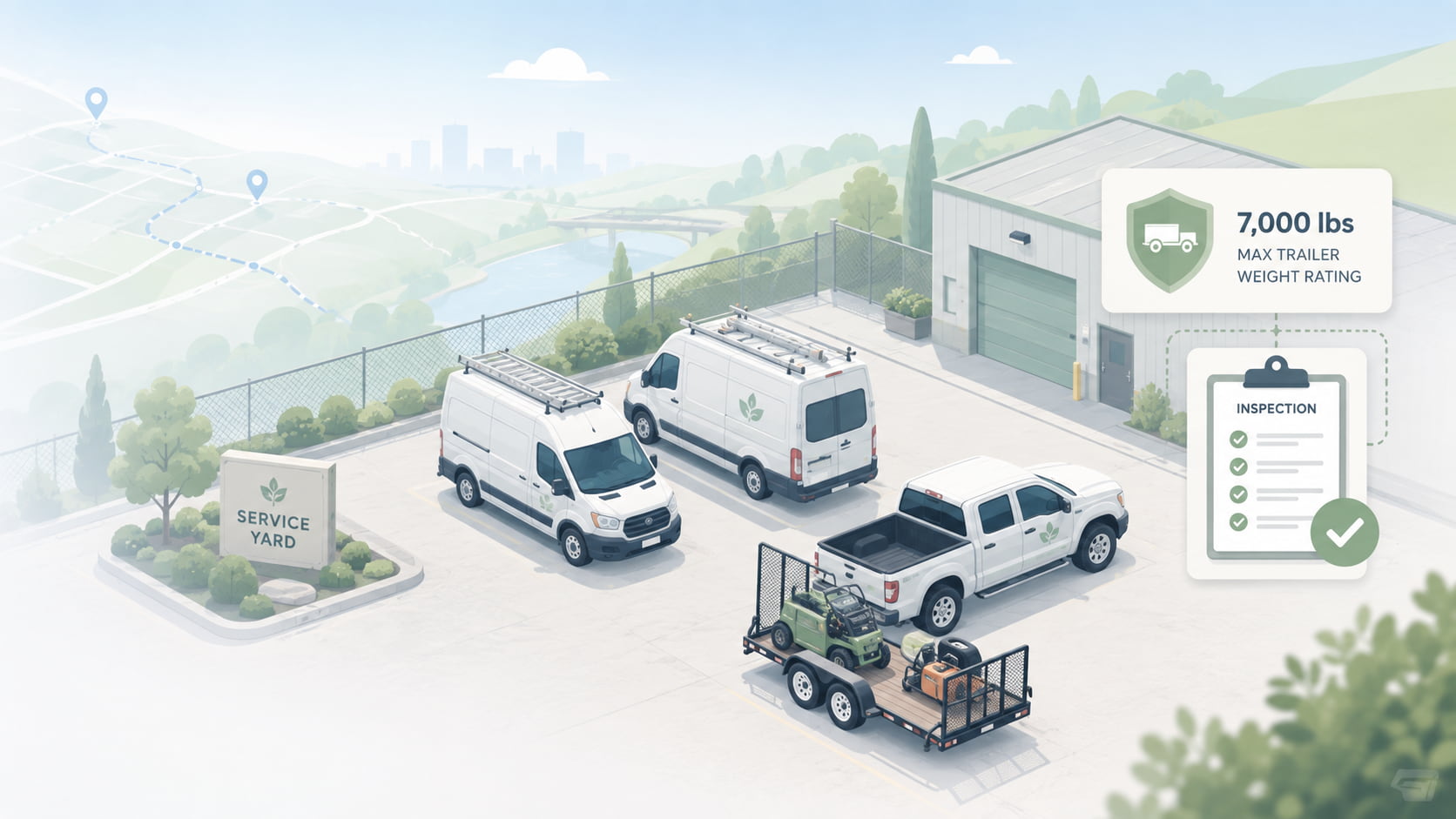
Nobody sends you a letter when your fleet becomes federally regulated. There's no form in the mail, no warning from your insurance agent. You buy a bigger van, or you start towing a heavier trailer, and one Tuesday morning a roadside inspector explains the rules to you at the side of a highway.
Most small service fleets cross at least one federal line without knowing it. The rules were written for trucking companies, but they're written by weight and use, not by what your business card says. A plumbing outfit with two three-quarter-ton trucks and a jetter trailer can be squarely inside them.
Here's what actually switches on, and when.
Spytec GPS is a self-serve GPS fleet tracking platform built for small and mid-size fleets, with free hardware on every plan, no contracts, and transparent pricing from $8.95/vehicle/month on an annual plan.
One caveat before we start: this is a plain-English orientation, not legal advice. Thresholds interact, states add their own rules on top, and the details matter. Verify your situation against FMCSA, your state's motor carrier office, and a qualified advisor before you rely on any of it.
Do I need a DOT number?
You need a USDOT number if you operate in interstate commerce and any one of these is true:
- The vehicle has a gross vehicle weight rating or gross combination weight rating of 10,001 pounds or more
- It's designed or used to transport more than 8 passengers including the driver, for compensation
- It's designed or used to transport more than 15 passengers including the driver
- It carries hazardous materials in a quantity requiring placarding
For a service fleet, it's almost always the first one. A loaded three-quarter-ton pickup, most cargo vans in the larger classes, and nearly any truck with a service body will have a GVWR at or above 10,001 pounds. Check the sticker in the driver's door jamb, not the curb weight. Rating, not actual weight.
"Interstate" is broader than driving across a state line
This is where most owners get it wrong. FMCSA defines interstate commerce as trade, traffic or transportation between a place in a state and a place outside it, between two places in a state through another state, or between two places in one state as part of trade or transportation originating or terminating outside the state.
That last clause is the one that catches people. If you're hauling material that came from out of state as part of a continuous movement, you can be in interstate commerce without your truck ever leaving the county. If you never leave the state and everything you carry starts and ends there, you're likely intrastate.
Intrastate carriers often need one anyway
A large number of states require a USDOT number for intrastate carriers too, under their own rules. The list changes, and it includes territories, so rather than quote a number that will be wrong by the time you read it, check FMCSA's list of states requiring a USDOT number and confirm with your state directly.
The two weight numbers that decide everything
If you remember nothing else, remember that there are two different thresholds in two different rulebooks, and conflating them is the single most common mistake small fleet owners make.
| Threshold | What it triggers |
|---|---|
|
10,001 lbs GVWR or GCWR |
USDOT number, and most of the Federal Motor Carrier Safety Regulations: annual inspections, driver vehicle inspection reports, driver qualification files, hours of service. |
|
26,001 lbs GVWR or GCWR |
Commercial driver's license, and DOT drug and alcohol testing under Part 382. |
Being under 26,001 pounds does not mean you're unregulated. It means you're out of the CDL and drug-testing rulebook while still sitting inside the safety rulebook. Two numbers, two answers.
The trailer trap
This is how service fleets get pulled into CDL territory by accident, and it's worth reading twice.
A CDL is required, broadly, for a combination with a gross combination weight rating of 26,001 pounds or more where the towed unit is rated over 10,000 pounds, or a single vehicle rated 26,001 pounds or more, or any vehicle carrying placardable hazmat, or one designed to carry 16 or more passengers including the driver.
Read that first clause against a real yard. A one-ton dually rated around 14,000 pounds is nowhere near 26,001 on its own. Hitch a skid steer trailer rated at 14,000 and the combination rating clears 26,001, with a towed unit well over 10,000. That's a CDL vehicle, and the driver is now inside the drug and alcohol testing program too.
Landscaping, excavation-adjacent and equipment-heavy service outfits hit this constantly. Nothing about the truck changed. The trailer did.
What switches on at 10,001 pounds
The annual inspection (49 CFR 396.17)
Every vehicle under your control has to be inspected at least once in the preceding 12 months against the standards in Appendix A. It doesn't have to be a government inspection. A qualified commercial garage, a fleet leasing company or a truck stop can act as your inspecting agent, and a state periodic inspection meeting the same standards counts for 12 months from the last day of the month it was performed.
The part people miss: the documentation has to be on the vehicle. Inspection date, the vehicle identification, where the report is kept, and a certification that it passed. A sticker or decal carrying that information is acceptable.
Driver vehicle inspection reports (49 CFR 396.11)
Drivers report defects in writing at the end of each day's work on each vehicle, covering brakes, steering, lights and reflectors, tires, horn, wipers, mirrors, coupling devices, wheels and rims, and emergency equipment.
Two exceptions worth knowing:
- No defect, no report. A driver isn't required to prepare a report if nothing was found or reported. The old "no-defect DVIR" paperwork is gone for property-carrying carriers.
- Single-vehicle operations are outside paragraph (a) entirely. If you operate only one commercial motor vehicle, the written DVIR requirement doesn't apply to you. The pre-trip duty under 396.13 still does.
When a defect is reported, you have to repair it or certify that repair is unnecessary before the vehicle runs again, and keep the report and the repair certification for three months.
Driver qualification files (49 CFR 391.51)
One file per driver. It can be combined with the personnel file. It holds the employment application, the pre-employment motor vehicle record, the road test certificate or accepted equivalent, the annual MVR, a note on the annual review of the driving record, and the medical examiner's certificate.
Keep the file for as long as the driver works for you and three years after they leave. Some items, including the annual MVR and the annual review note, can be purged three years after execution while the driver is still employed.
One correction, because it's repeated in a lot of older compliance content: the driver's annual list of violations is no longer part of the 391.51 file contents. What survives is the note of the annual review of the driving record. If a checklist tells you to file an annual violation certification, it's out of date.
Inspection and maintenance records are the part that trips people up. Spytec GPS keeps mileage and maintenance history per vehicle automatically, from $8.95/vehicle/month on an annual plan with the tracker included free.
What switches on at 26,001 pounds
Drug and alcohol testing (49 CFR Part 382)
Part 382 applies to drivers who operate a commercial motor vehicle in commerce and are subject to CDL requirements. Both conditions, not either. Under 26,001 pounds, non-hazmat, fewer than 16 passengers, and you're outside it.
Once you're in, the program covers six kinds of testing: pre-employment, post-accident, random, reasonable suspicion, return-to-duty, and follow-up. You also have to query the FMCSA Drug and Alcohol Clearinghouse before hiring, and at least once a year for every covered driver.
A detail that surprises owner-operators: if you employ yourself as a driver, you can't run a random testing program of one. The rule requires a random selection pool of two or more covered employees, which in practice means joining a consortium.
Hours of service and ELDs
Hours of service is its own decision tree with its own exceptions, including the short-haul provision that exempts a lot of service fleets that never travel far from base. We've covered that separately rather than half-explaining it here: do I need an ELD? walks through who's actually required to run one in 2026 and the exemptions most small fleets qualify for.
A five-minute self-check
- Read the door jamb sticker on your heaviest vehicle. Is the GVWR 10,001 pounds or more?
- Add your heaviest trailer's rating to your heaviest truck's rating. Does the combination clear 26,001 with the trailer over 10,000?
- Does any job involve material or goods that originated outside your state? If yes, look hard at whether you're in interstate commerce.
- Check whether your state requires intrastate USDOT registration.
- Pull one truck's file. Can you produce a current annual inspection record from the vehicle itself, right now?
If step five made you uncomfortable, that's the honest place to start.
Where this actually costs you
The regulations themselves are manageable. What catches small fleets is the records burden: proving an inspection happened, showing a maintenance history, producing a file for a driver who left eight months ago.
That's a filing problem more than a compliance problem, and it's the one part of this a tracker genuinely helps with. Mileage accrues automatically, service intervals are logged against the vehicle rather than someone's memory, and the history is there when an inspector or an insurer asks. Our preventive maintenance guide for service fleets covers how to build that rhythm, and the weekly reports worth running covers what to actually look at.
Running a fleet of 5+ vehicles?
Most small service fleets on Spytec start with the plug-in OBD tracker — it goes into each vehicle's OBD-II port in seconds (no installer, no wiring), streams live location, and runs $8.95/vehicle/month with free hardware and no contract. Fleets of 5+ get automatic volume discounts.
See the OBD fleet tracker → · Compare business-fleet plans →
Frequently asked questions
Do I need a DOT number for a pickup truck?
If the pickup's gross vehicle weight rating is 10,001 pounds or more and you operate it in interstate commerce, yes. Many three-quarter-ton and one-ton pickups exceed 10,001 pounds GVWR, and towing can push the combination rating higher still. Check the rating sticker in the driver's door jamb rather than guessing from the truck's size or its actual loaded weight.
Does a DOT number mean I need a CDL?
No. They're separate thresholds. A USDOT number is generally triggered at 10,001 pounds; a commercial driver's license is generally triggered at 26,001 pounds, or by placardable hazmat, or by carrying 16 or more passengers. Many service fleets need a USDOT number and no CDL at all.
Do I need a DOT number if I never leave my state?
Possibly. Federal registration keys off interstate commerce, which includes intrastate movements that are part of a journey originating or terminating outside the state. Separately, a large number of states require intrastate carriers to obtain a USDOT number under state law. Check FMCSA's state list and confirm with your state motor carrier office.
How often does a commercial vehicle need a DOT inspection?
At least once every 12 months under 49 CFR 396.17. It can be performed by a qualified commercial garage or other inspecting agent, and a qualifying state periodic inspection satisfies the requirement for 12 months from the last day of the month it was performed. Documentation identifying the vehicle and certifying it passed must be kept on the vehicle.
Is my small fleet subject to DOT drug and alcohol testing?
Only if your drivers operate a commercial motor vehicle in commerce and are subject to CDL requirements. If every vehicle and combination stays under 26,001 pounds, carries no placardable hazmat and seats fewer than 16, Part 382 doesn't reach you. Watch the trailer math, because a heavy trailer behind a modest truck can cross the line.
The bottom line
Two numbers do most of the work. 10,001 pounds brings the USDOT number and the safety regulations. 26,001 pounds, or a heavy trailer that gets you there, brings the CDL and drug testing. Interstate commerce is broader than it sounds, and a lot of states apply their own registration rules on top.
None of it is unmanageable at five or fifteen vehicles. It's just easier to sort out in your office than on a shoulder of the interstate.
Keep the maintenance and mileage records compliance asks for, without the filing. The Pulse OBD tracker plugs into the port in under a minute. Free hardware with every plan, no contract, cancel anytime.
Shop GPS trackers → No sales calls. No contracts.






Share:
What Tool & Equipment Theft Costs a Service Fleet (and How Tracking Pays for Itself)
IRS Mileage Log Requirements for Service Fleets (2026)