

If you run a small service fleet — a few HVAC vans, a handful of plumbing trucks, a landscaping crew — you've probably been told you need an ELD. Maybe a sales rep said it. Maybe a competitor's website implied it. Here's the part nobody selling you a compliance platform wants to lead with: most small local service fleets aren't required to use an ELD at all.
An ELD (electronic logging device) records a driver's Hours of Service automatically. It's a federal requirement for some commercial drivers — but the mandate is narrower than the marketing makes it sound, and the exemptions catch a lot of service fleets. This guide walks through how the 2026 rules actually work, who's exempt, and how to tell whether you're buying compliance you need or compliance you don't.
Spytec GPS is a self-serve GPS fleet tracking platform built for small and mid-size fleets, with free hardware on every plan, no contracts, and transparent pricing from $8.95/vehicle/month on the annual plan. It's built to answer "where are my trucks?" — not to satisfy a regulation most service fleets don't fall under.
One note before we start: this is general information, not legal advice. ELD applicability depends on the specifics of your vehicles, routes, and drivers. Confirm your own status with the FMCSA ELD rules or a qualified compliance advisor before making a decision.
What an ELD actually does (and what it doesn't)
An ELD connects to a vehicle's engine and automatically logs driving time to track a driver's Records of Duty Status (RODS) under the federal Hours-of-Service (HOS) rules. It exists for one purpose: HOS compliance for drivers who are legally required to keep those logs. That's it. An ELD is not a tracking tool, a theft deterrent, or a productivity system — those are separate jobs that GPS fleet tracking handles.
So the real question isn't "do I want an ELD?" It's "am I a driver who's required to keep Hours-of-Service logs in the first place?" If the answer is no, the ELD requirement never applies to you.
Who is actually required to use an ELD in 2026?
The federal ELD mandate applies to drivers who are currently required to keep Records of Duty Status — which generally means all three of these are true at once:
- You operate in interstate commerce. The federal Hours-of-Service and ELD rules apply to interstate operations — crossing state lines, or carrying freight/passengers that are part of interstate movement. Purely intrastate (in-state) operations follow state rules, which vary and often differ from the federal mandate.
- Your vehicle meets the commercial-motor-vehicle threshold. Federal HOS rules generally apply to vehicles with a gross vehicle weight rating (or combination weight) over 10,001 lbs, vehicles that require a CDL, or those carrying placarded hazardous materials. A pickup or cargo van under 10,001 lbs typically falls below this line.
- Your drivers have to keep HOS logs. Even commercial drivers can be exempt from RODS — most importantly through the short-haul exception (below).
If any one of those isn't true for your fleet, the ELD requirement very likely doesn't apply. A lot of service fleets miss on the first or second point alone: they run light vehicles and stay local.
The exemptions that catch most service fleets
Even for vehicles that are commercial motor vehicles in interstate commerce, the rules carve out several exceptions. Per the FMCSA, the following drivers are not required to use ELDs:
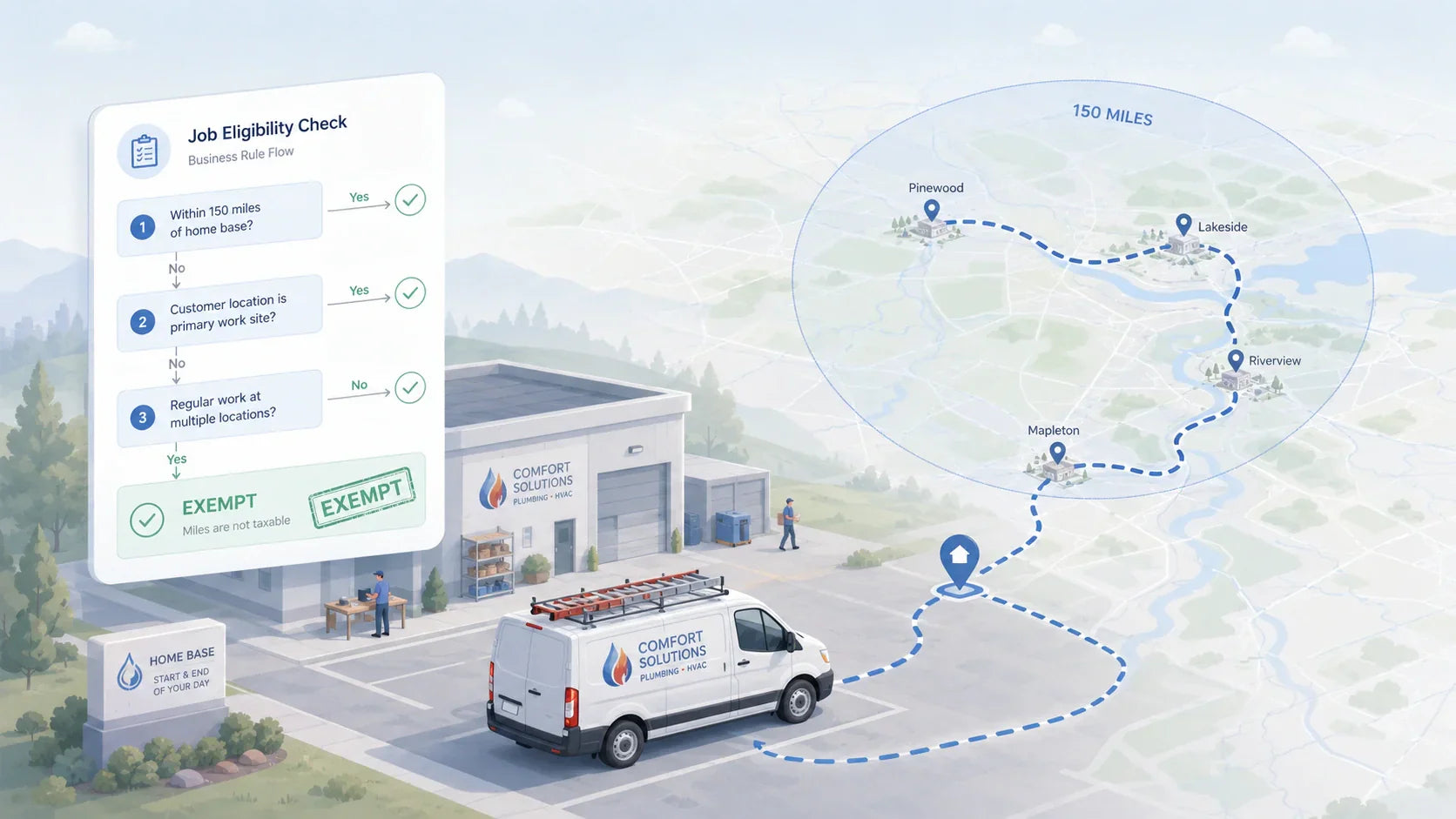
- Short-haul drivers. Drivers who operate within a 150 air-mile radius of their work-reporting location and return there within their shift generally qualify for the short-haul exception to the HOS rules. If you're not required to keep RODS, you're not required to run an ELD. This is the big one for service fleets — most local techs leave the yard in the morning and come back the same day.
- Drivers who keep paper logs no more than 8 days in any 30-day period. Occasional long-haul days don't automatically pull you into the ELD mandate.
- Vehicles with engines older than model year 2000. Older trucks predate the engine-data port ELDs rely on.
- Driveaway-towaway operations, where the vehicle being transported is the commodity.
Stack these up and a typical service fleet — light vehicles, local routes, drivers back at the yard each night — usually lands outside the ELD mandate on more than one count.
Not required to run an ELD? Then you just need to see your trucks. Spytec gives you live location, routes, and alerts with free hardware and no contract — from $8.95/vehicle/month.
A quick self-check: do you need an ELD?
Walk your fleet through these questions. They won't replace a compliance review, but they'll tell you which side of the line you're probably on:
- Do your drivers cross state lines or haul interstate freight? If no (you're intrastate-only), the federal ELD mandate generally doesn't apply — check your state's rules instead.
- Are your vehicles over 10,001 lbs, CDL-required, or hazmat-placarded? If no, you're typically below the federal CMV threshold.
- Do your drivers return to the same base within their shift, inside ~150 air miles? If yes, the short-haul exception likely means no RODS — and no ELD.
- Do you log more than 8 RODS days in a 30-day stretch? If no, the 8-day exception likely covers you.
If you answered "no" to the first two or "yes" to the third, there's a strong chance you don't need an ELD — you need fleet tracking. The two get conflated constantly because enterprise vendors bundle them, but they solve different problems.
What service fleets usually need instead
Strip away the compliance layer and what's left is the job a service fleet actually cares about: knowing where every truck is, seeing where it's been, getting alerted when something's off, and keeping vehicles maintained. That's GPS fleet tracking, and it's a fraction of the cost and complexity of a regulated-trucking compliance platform.
With Spytec, the Pulse OBD plug-in tracker installs in seconds, hardware is free on every plan, and you get real-time location, route history, geofence and idle alerts, and maintenance reminders for $8.95/vehicle/month on the annual plan ($14.95 month-to-month) — with no contract and a 30-day money-back guarantee. If you've been quoted an enterprise platform, it's worth understanding what you're paying for: our Samsara pricing breakdown and fleet GPS pricing comparison show how the compliance bundle inflates the bill.
And if your fleet genuinely is regulated — interstate trucks over 10,001 lbs running long-haul — then yes, you need a compliant ELD solution, and a dedicated compliance platform earns its place. The goal here isn't to talk anyone out of compliance. It's to keep service fleets from paying for it when the law doesn't ask them to.
Frequently asked questions
Do small service fleets need an ELD?
Usually not. The federal ELD mandate applies to drivers required to keep Hours-of-Service logs — generally interstate commercial vehicles over 10,001 lbs whose drivers aren't covered by an exception. Many local HVAC, plumbing, landscaping, and electrical fleets run lighter vehicles, operate intrastate, or qualify for the short-haul exception, so the mandate doesn't apply. Confirm your specific status with FMCSA rules before deciding.
What is the short-haul ELD exemption?
Drivers who operate within a 150 air-mile radius of their work-reporting location and return to it within their shift generally qualify for the short-haul exception to the Hours-of-Service rules. Because those drivers aren't required to keep Records of Duty Status, they aren't required to use an ELD. This covers a large share of local service fleets whose techs return to the yard each day.
Does a vehicle under 10,001 lbs need an ELD?
Generally no. The federal Hours-of-Service and ELD rules apply to commercial motor vehicles over 10,001 lbs (by weight or rating), vehicles requiring a CDL, or those carrying placarded hazardous materials. A standard pickup or cargo van under that weight typically falls outside the federal CMV definition, so the ELD mandate doesn't apply — though state and other safety rules may still be relevant.
Is GPS fleet tracking the same as an ELD?
No. An ELD records Hours-of-Service driving time for federal compliance. GPS fleet tracking shows real-time location, route history, geofence and idle alerts, and maintenance reminders. ELDs serve regulated drivers; fleet tracking serves any fleet that wants visibility. If you're not required to run an ELD, a tracking platform like Spytec covers what you actually need at a lower, published price.
What happens if I'm exempt but install an ELD anyway?
Nothing stops you — but you'd be paying for compliance hardware and software you aren't required to use, often bundled into a multi-year contract. If your goal is visibility rather than Hours-of-Service logging, a no-contract GPS tracking plan delivers the operational features without the compliance overhead.
The bottom line
The ELD mandate is real, but it's aimed at regulated trucking — not the local service fleet that leaves the yard each morning and comes back each night. Before you buy a compliance platform, run the four-question check: interstate? over 10,001 lbs? short-haul? more than 8 log days a month? For most service fleets, the honest answer is "you don't need an ELD — you need to see your trucks." Confirm your status with FMCSA, and if tracking is the real job, you can solve it today without a contract or a sales call.
Related reading
- Motive pricing 2026 — what small fleets actually pay.
Skip the compliance bundle. Just track your fleet. Free hardware, no contract, $8.95/vehicle/month — self-serve checkout, ships in 2 days.






Share:
Motive Pricing 2026: What Small Fleets Actually Pay
Best Hardwired GPS Tracker for Small Fleets (2026)