

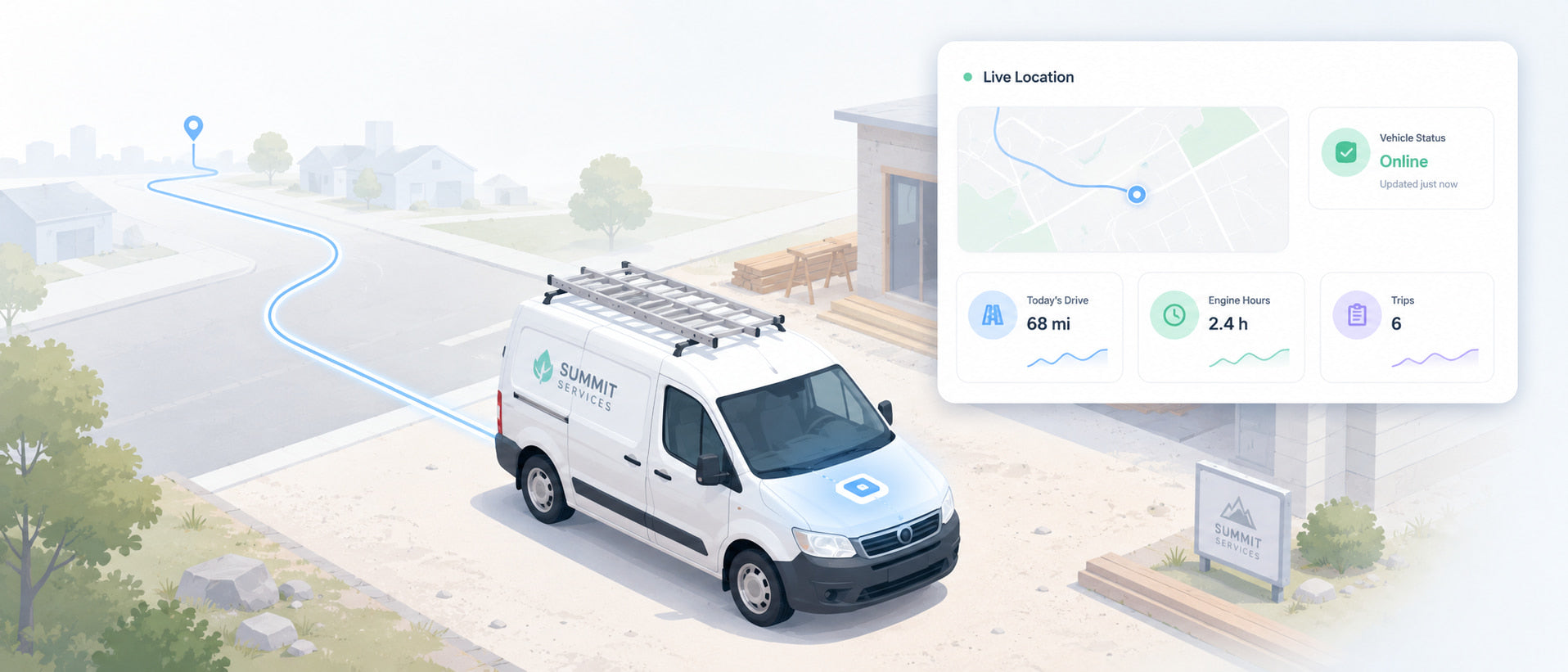
You went looking for a hardwired GPS tracker for a reason. Maybe a driver kept "accidentally" unplugging the OBD tracker before a side job. Maybe your trucks are older than 2010 and don't have a usable OBD port. Maybe you've got take-home vehicles, high-value cargo, or equipment that needs to stay tracked even if someone tries to unplug it. A hardwired tracker solves that: it installs out of sight, runs off the vehicle's 12V power, and can't be yanked out at a stoplight.
But here's what most "best hardwired tracker" lists miss: the wire is the easy part. Two installs can look identical under the dash and deliver completely different value, because what actually matters for a fleet is the platform behind the device — how often it reports, what it tells you, and whether it can run 5 trucks or 50 on one account. This guide is written for small and mid-size service fleets, and it focuses on that difference.
Spytec GPS is a self-serve GPS fleet tracking platform built for small and mid-size fleets, with free hardware on every plan, no contracts, and transparent pricing — the hardwired option, Pulse Wired, is free hardware and $12.95/vehicle/month on the annual plan.
What makes a hardwired GPS tracker "fleet-grade"
A consumer hardwired tracker and a fleet-grade one both bolt to a 12V line. The gap shows up in four places:
1. Reporting cadence. A tracker that pings every 30 seconds will quietly miss the exact thing you bought it for — the cut-through, the unscheduled stop, the quick detour. At 30 mph, 30 seconds is a quarter-mile of blind spot per update. Fleet-grade tracking updates every few seconds so the route history is actually accurate enough to settle a customer dispute or catch moonlighting.
2. Hardware cost at scale. A $20–$30 device is a rounding error for one vehicle. Across 25 trucks it's $500–$750 before you've tracked a single mile — and that's the number consumer brands quietly count on. Free hardware changes the math when you're outfitting a whole fleet.
3. Platform depth. One vehicle needs a dot on a map. A fleet needs idling reports, driver-behavior scoring, maintenance reminders, IFTA mileage, geofence and after-hours alerts, user accounts with different access levels for your dispatcher vs. your bookkeeper, and the ability to build the report you actually care about. That's software, not hardware.
4. Room to grow. Most fleets don't stay all-hardwired. You add an OBD tracker to the new van, a battery tracker to a trailer, a dash cam to the truck that had a close call. If every device type lives on a separate app with a separate login, you've built yourself a mess. A real platform puts them all on one account.
The best hardwired GPS tracker for small fleets in 2026: Spytec Pulse Wired
For a 5–100 vehicle service fleet, the Pulse Wired is the pick. It hardwires into any vehicle with a 12V battery, installs hidden so drivers can't unplug it, and reports in real time as fast as every 5 seconds — with no upsell to get there. Hardware is free; you pay $12.95/vehicle/month on the annual plan ($14.95 month-to-month), with volume discounts that kick in automatically at checkout: 5% at 5 devices, scaling to 25% at 100. No activation fee, no cancellation fee, and a 30-day money-back guarantee.
What you get isn't just a location ping. Every plan includes route-history playback, fleet reports (mileage, trips, driver behavior, utilization), idling reports and alerts, geofence and organization-hours alerts, tampering and movement alerts, a maintenance module, full IFTA reporting, a custom report builder, a tagging system for locations and vehicles, user management with role-based access, and a full API — on both mobile and desktop. You can also send a customer a shareable live-tracking link so they can see the tech en route, and you can add OBD trackers, equipment trackers, long-term battery trackers, and AI dash cams to the same account as you grow. One login, one platform, future-proof.
Where consumer hardwired trackers fit — and where Optimus wins
The most common consumer hardwired tracker fleet owners cross-shop is the Optimus GB100M, sold on Amazon and at optimustracker.com. It's a genuinely solid product for what it is. Per Optimus's own product page, the GB100M is a $21.95 device on a $12.95/month plan with no contract and cancel-anytime terms, SIM and data included. It installs via a 2-wire connection directly to the car's battery (positive and negative), covers the US and Canada, and offers email/text alerts for speeding, entering or leaving areas, and loss of power, plus distance, time-moving, and parked-place reports and one year of saved history. It reports every 30 seconds and on every turn, with a paid upgrade to 10-second reporting.
Where Optimus genuinely wins: if you're tracking a single vehicle, a personal car, a teen driver, or one piece of equipment, Optimus is hard to beat on simplicity — you buy one device on Amazon, wire two leads, and you're done. Their portable magnetic battery model (the Optimus 3.0) is also a strong option when you want zero installation or a portable, move-it-between-vehicles tracker, which a hardwired unit by definition can't do. For one-off, single-asset, or portable use, that consumer simplicity is a real advantage.
The difference is what happens when "one vehicle" becomes "the whole fleet." Optimus is built around the single-device buyer: the reporting is 30 seconds unless you pay more, the hardware is a per-unit cost that adds up across a fleet, and the feature set is the essentials — location, basic alerts, simple trip reports. The things a multi-truck operation leans on — sub-5-second reporting included by default, free hardware at volume, IFTA, a maintenance module, driver-behavior scoring, role-based user accounts, custom reports, and a single account spanning every device type — aren't part of that consumer package.
Optimus GB100M vs. Spytec Pulse Wired
| Optimus GB100M | Spytec Pulse Wired | |
|---|---|---|
| Hardware cost | $21.95 per device | Free on every plan |
| Monthly service | $12.95/mo, no contract | $12.95/mo annual ($14.95 monthly), no contract |
| Reporting interval | Every 30 sec; 10 sec is a paid upgrade | As fast as 5 sec, included |
| Volume discounts | Up to 15% (annual subscription) | Up to 25%, automatic at checkout |
| IFTA reporting | Not listed | Included |
| Maintenance module | Not listed | Included |
| Driver-behavior reports | Not listed | Included |
| User roles / access levels | Not listed | Included |
| Custom report builder | Not listed | Included |
| API | Not listed | Full API |
| Other device types on one account | OBD, dash cam, battery (separate products) | OBD, equipment, long-term, dash cam — one account |
| Money-back guarantee | Not listed | 30 days |
Optimus figures from optimustracker.com (GB100M product page), verified June 2026. "Not listed" means the capability is not advertised on that product page, not that it definitively doesn't exist. Spytec figures from spytec.com/pages/pricing.
Free hardware, 5-second reporting, and the full fleet platform on every plan. See exactly what your fleet would cost with volume discounts applied automatically — no quotes, no sales calls.
Running a fleet of 5+ vehicles?
Most small service fleets on Spytec start with the plug-in OBD tracker — it goes into each vehicle's OBD-II port in seconds (no installer, no wiring), streams live location, and runs $8.95/vehicle/month with free hardware and no contract. Fleets of 5+ get automatic volume discounts.
See the OBD fleet tracker → · Compare business-fleet plans →
How to choose a hardwired tracker for your fleet
Work through four questions in order:
How accurate does the trail need to be? If you're using GPS to verify arrival times, settle "I was there" disputes, or catch unauthorized use, reporting cadence is the whole game. Default to a tracker that reports every few seconds without charging extra for it. A properly installed hardwired tracker only earns its keep if the data behind it is tight.
What does it actually cost across the fleet? Add up hardware plus monthly service times your vehicle count, then factor volume discounts. Free hardware and automatic 25% volume pricing move the number meaningfully once you're past a handful of trucks.
What will you need in 12 months? Idling and after-hours alerts, IFTA, maintenance scheduling, driver coaching, separate logins for office staff vs. owners — these are the features fleets grow into. Buying a platform that already has them beats re-platforming later.
Hardwired, OBD, or both? Hardwired wins for older vehicles, take-home trucks, and tamper-prone situations; OBD wins for speed of install and diagnostics. Most fleets run a mix — see our OBD vs. hardwired comparison to decide per vehicle, and browse the full lineup if you want both on one account.
Frequently asked questions
What is the best hardwired GPS tracker for a small fleet?
For small and mid-size service fleets, the Spytec Pulse Wired is the strongest pick: free hardware, $12.95/vehicle/month on the annual plan, real-time updates as fast as every 5 seconds, and a full fleet platform (IFTA, maintenance, driver behavior, custom reports, user roles, API) included on every plan. It hides during installation so drivers can't unplug it, and works on any vehicle with a 12V battery.
How is a hardwired GPS tracker different from an OBD tracker?
A hardwired tracker connects directly to the vehicle's 12V power and is hidden during installation, so it can't be unplugged and works on vehicles without a usable OBD port (typically pre-2010). An OBD tracker plugs into the diagnostic port under the dash in about 30 seconds and adds engine diagnostics, but it's visible and removable. Hardwired is better for take-home trucks, older vehicles, and tamper-prone fleets; OBD is better for fast, tool-free installs.
How much does a hardwired fleet GPS tracker cost?
With Spytec, the hardware is free and you pay $12.95/vehicle/month on the annual plan ($14.95 month-to-month), with automatic volume discounts up to 25% at 100+ devices. Consumer hardwired trackers like the Optimus GB100M charge for the device (around $21.95) plus a similar monthly plan. Across a fleet, free hardware and larger volume discounts are where the cost difference shows up.
Can drivers disable a hardwired GPS tracker?
A hardwired tracker is installed out of sight and wired into the vehicle's power, so it can't be unplugged the way an OBD device can. Spytec's Pulse Wired also includes tampering and loss-of-power alerts, so if a unit is ever disconnected, you're notified immediately.
Do I need a contract to track my fleet?
No. Spytec has no contracts, no activation fee, and no cancellation fee — you can cancel anytime and there's a 30-day money-back guarantee. Hardware is free on every plan and devices ship in two days.
The bottom line
If you're tracking one vehicle, a consumer hardwired tracker like the Optimus GB100M will do the job, and its portable models are a real strength for no-install or portable use. But if you're running a service fleet — even five trucks — the deciding factors aren't the wire, they're the reporting speed, the per-vehicle cost at scale, and the depth of the platform. On all three, a fleet-grade option with free hardware, 5-second reporting included, and IFTA, maintenance, driver behavior, user roles, and an API on every plan is the better long-term call. The wire is the easy part. The platform is what you're actually buying.
Related reading
- OBD GPS tracker guide — plug-and-play fleet tracking.
Outfit your whole fleet with hardwired trackers — free hardware, ships in 2 days. No contracts, no sales calls, 30-day money-back guarantee.






Share:
Does Your Service Fleet Actually Need an ELD? A 2026 Exemption Guide
Geotab Pricing in 2026: What It Actually Costs Small Fleets (and Why You Can't See a Price)