

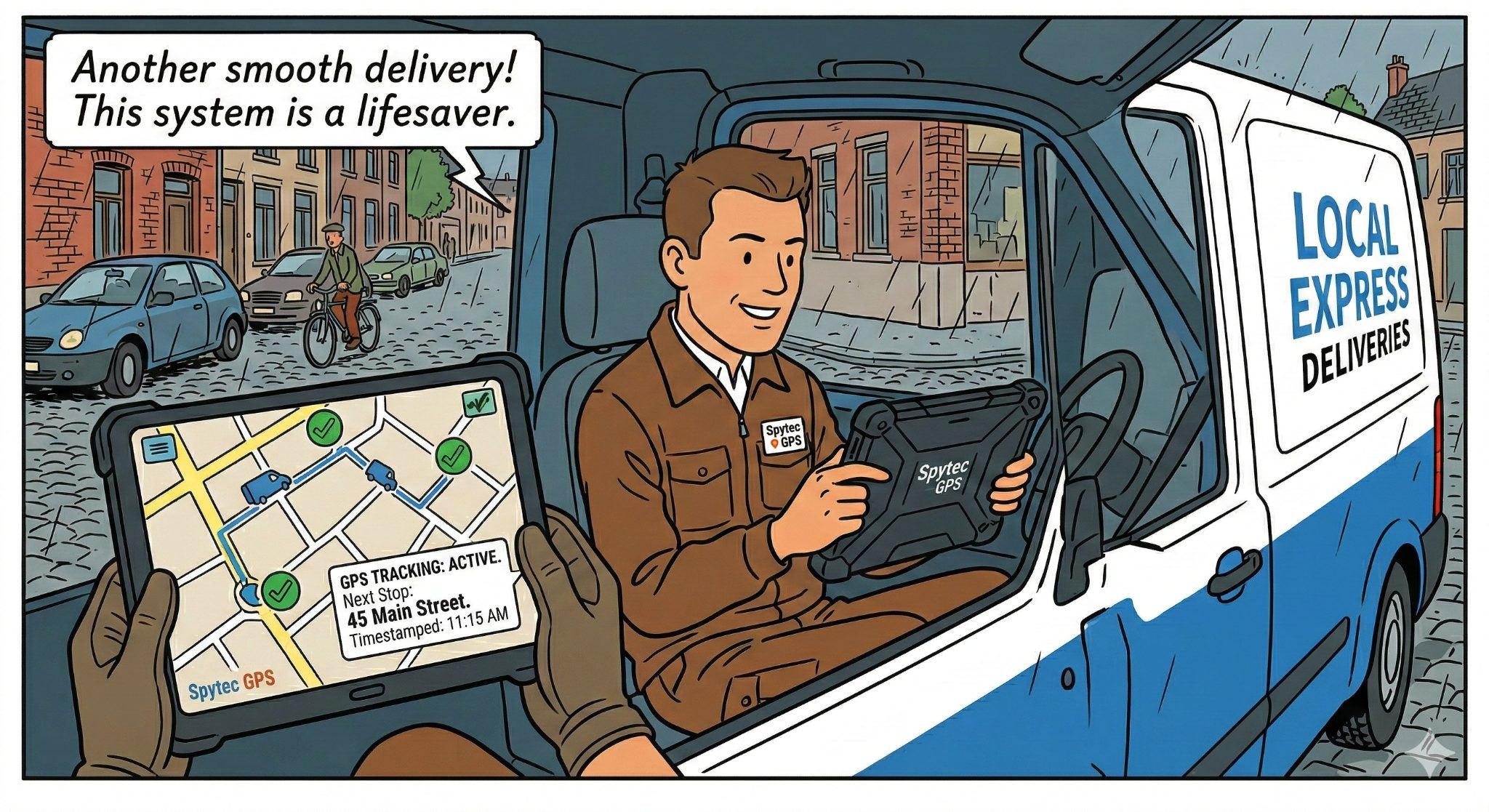
The average local delivery fleet loses hundreds of dollars a month to false customer disputes, inefficient routing, and extended vehicle idling. Delivery fleet GPS tracking eliminates these blind spots by providing dispatchers with exact timestamps, historical route data, and real-time location visibility for every stop.
Spytec GPS is a self-serve GPS tracking platform for small and mid-size fleets, with plans starting at $14.95/vehicle/month (monthly) or $8.95/vehicle/month (annual) and no long-term contracts. Whether you are managing medical supplies, floral arrangements, auto parts, or restaurant catering, adding real-time location data is the fastest way to protect your margins.
In this 2026 guide, we will break down how high-volume, short-stop local fleets use GPS data to prove drop-off times, improve customer service, and run leaner operations.
The Local Delivery Nightmare: "I Never Received My Package"
Unlike service businesses where technicians spend hours at a single job site, local delivery fleets are chaotic. A single driver might make 40 to 60 rapid-fire stops in a single shift. That pace creates a massive accountability gap for business owners.
When a customer calls to complain that their time-sensitive delivery—like a critical pharmacy prescription or expensive auto part—never arrived, it traditionally becomes a game of he-said, she-said. Did the driver go to the wrong house? Did porch pirates strike? Did the customer simply miss the drop-off? Without hard data, there is no way to determine what actually happened.
The financial impact adds up fast. A pharmacy delivery service replacing just two disputed prescriptions per week at $75 each loses nearly $8,000 a year—not counting the labor hours spent investigating each claim. A floral delivery company eating the cost of reshipped arrangements during peak wedding season can lose even more.
Without hard data, the business owner usually eats the cost of replacing the item to save the customer relationship. By implementing local delivery fleet tracking, you replace guesswork with indisputable facts. Every stop is logged with a precise timestamp, GPS coordinates, and idle duration—the kind of objective evidence that resolves disputes in seconds instead of days.
4 Ways Delivery Fleet GPS Tracking Protects Your Business
Managing a fleet of delivery vans requires specialized oversight that differs from traditional service fleets. Here is how modern telematics specifically solves the challenges local delivery businesses face every day.
1. Automate Proof of Delivery with Exact Timestamps
The most powerful defense against false claims is objective data. GPS tracking allows you to automate proof of service by recording exactly when a vehicle arrived at an address, how long it idled there, and when it departed.
If a customer claims a package was not delivered by the 3:00 PM deadline, you can pull up the vehicle's historical route. You can instantly verify that your driver arrived at 2:47 PM, stayed for exactly three minutes, and left. This simple timestamp resolves disputes in seconds and protects your bottom line.
For businesses that handle high-value or time-sensitive deliveries—think medical supplies, legal documents, or perishable goods—this capability is not optional. It is the difference between absorbing a $200 loss and confidently pushing back with proof. Over the course of a year, even a small fleet that resolves two false claims per month saves thousands.
2. Share Live ETAs to Improve Customer Service
Customers in 2026 expect Amazon-level visibility, even from local businesses. When an important client calls asking for the status of their delivery, "Let me call the driver and find out" is no longer an acceptable answer. It wastes your dispatcher's time, interrupts the driver, and signals to the customer that you do not have control over your own operation.
With real-time delivery fleet GPS tracking, dispatchers can see the exact location of every van on a live map. You can confidently tell a customer, "Your driver is three miles away and will be there in approximately ten minutes," drastically improving the customer experience and reducing incoming phone calls.
This is especially critical for businesses with tight delivery windows. A restaurant catering company that promises "delivery between 11:00 AM and 11:30 AM" for a corporate lunch needs to know whether that commitment is on track—or whether they need to proactively call the client with an update before the client calls them.
3. Audit High-Volume, Short-Stop Routes
Many local delivery businesses use dedicated routing software (like Route4Me or Onfleet) to plan their day. However, planned routes and actual routes are often completely different. A driver might skip a stop, reverse the order to hit a favorite lunch spot, or take a longer route to avoid a street they dislike.
GPS tracking does not replace your routing software—it works alongside it by showing you the reality on the ground. You can audit historical data to see if drivers are taking unauthorized detours, taking excessively long breaks, or deviating from the optimized path. Tracking these metrics helps you rein in fuel costs and fit more deliveries into a single shift.
For a fleet running 10 vans across a metro area, even a 10% improvement in route adherence can save $300 to $500 per month in fuel alone. Over 12 months, that pays for the tracking platform many times over. The same route drift problem that costs landscaping companies thousands affects delivery fleets at an even larger scale because of the sheer number of stops per day.
→ See self-serve fleet GPS tracking plans starting at $14.95/mo
4. Reduce Liability with Video Telematics
Delivery vans spend all day navigating tight residential streets, busy loading docks, and heavy local traffic. This constant exposure makes them magnets for fender benders and false insurance claims. A single at-fault accident can spike your commercial auto insurance premiums by 20% to 40% at renewal.
Upgrading to video telematics, like the Pulse Vision AI Dash Cam, provides dual-facing video evidence alongside GPS tracking. If a passenger car clips your delivery van and tries to blame your driver, you have instant, high-definition video proof of the incident to hand over to your commercial insurance provider. Some insurers offer premium discounts of 10% to 15% for fleets that run dash cams—meaning the hardware can pay for itself within the first policy year.
For a deeper look at how GPS trackers and dash cams work together, see our comparison: Dash Cams vs. GPS Trackers: What Small Fleets Actually Need.
The Anti-Enterprise Solution for Local Fleets
Giant enterprise telematics companies have built their software for long-haul, 18-wheeler trucking fleets. They charge premium prices for heavy-duty compliance features (like ELD mandates and IFTA fuel tax reporting) that a local florist or auto parts supplier absolutely does not need. This is the feature bloat tax—paying for complexity that adds zero value to your operation.
Worse, these enterprise providers force small business owners into restrictive 3-year contracts and charge hundreds of dollars upfront for the hardware itself.
Spytec GPS is built differently. We provide straightforward, fleet tracking solutions by industry that focus on the features local delivery businesses actually need: real-time location, historical route playback, speed alerts, and geofencing.
| Feature | Spytec GPS | Enterprise Providers |
|---|---|---|
| Contract Term | Month-to-month (Cancel anytime) | 3-year lock-in |
| Hardware Cost | Free tracker with every plan | $100+ per device |
| Shipping | Free 2-Day Shipping | Varies |
| Setup | Self-serve, online in minutes | Sales calls, demos, onboarding reps |
| Money-Back Guarantee | 30 days, no questions asked | None (locked in) |
Frequently Asked Questions
Do I need a contract to use Spytec GPS for my delivery fleet?
No. Spytec GPS operates entirely on month-to-month or annual plans with zero long-term contracts. You can scale your fleet up during busy holiday seasons and cancel anytime without penalty. Plans start at $14.95/vehicle/month (monthly) or $8.95/vehicle/month (annual). Every plan includes a free GPS tracker.
Will GPS tracking replace my delivery routing software?
No, GPS tracking and routing software serve different purposes. Routing software like Route4Me or Onfleet plans the most efficient path for the day, while GPS tracking shows you exactly where your vehicles actually went, how fast they drove, and how long they stayed at each stop. The two tools work together to optimize your operations—routing plans the ideal day, and GPS tracking audits the actual day.
How long does it take to install a tracker in a delivery van?
Installation takes seconds with no professional mechanic required. Our OBD trackers plug directly into the diagnostic port under the steering wheel in about 10 seconds. For fleets that want a more hidden solution, hardwired trackers take about 60 seconds to connect directly to the vehicle's battery. For a full breakdown of the differences, see our OBD vs. Hardwired GPS Tracker comparison guide.
Can I see all my delivery vehicles on one map?
Yes. The Spytec GPS platform features a unified dashboard where dispatchers can view the real-time location of the entire delivery fleet simultaneously. You can easily click on individual vehicles to see their current speed, exact address, and daily route history. This is the same view that lets you give customers accurate live ETAs instead of putting them on hold.
How much does delivery fleet GPS tracking cost?
Spytec GPS plans start at $14.95 per vehicle per month on a monthly plan, or $8.95 per vehicle per month on an annual plan. Every subscription includes a free GPS tracker and free 2-day shipping. There are no setup fees, no equipment charges, and no hidden costs. A 10-van delivery fleet on the annual plan costs less than $90 per month total.
Every delivery. Every address. Every timestamp.
Stop losing money to false disputes. Plans start at $14.95/mo. Free tracker included with every plan. No contracts. Ships in 2 days.
Shop Fleet Trackers →






Share:
Azuga Alternative: No Contracts, No Hardware Fees, Same Features
How to Use Geofencing to Automate Timecard Verification in 2026