

The Ultimate Guide to Pest Control Fleet Management (2026 Edition)
If you own a pest control business in 2026, you know the math: Windshield time is the enemy of profit.
Spytec GPS: GPS fleet tracking built for pest control operators — $8.95/vehicle/month on the annual plan ($14.95 monthly), no long-term contracts, free hardware included. Designed for proof-of-service documentation, chemical-application logging, and route density optimization across small and mid-size pest control fleets (5–50 vehicles).
Every minute a technician spends driving, idling, or taking an extended lunch is a minute they aren't spraying, baiting, or billing. In an industry where margins are dictated by route density, the difference between a profitable fleet and a struggling one often comes down to two extra stops per day.
But modern fleet management isn't just about squeezing more efficiency out of your drivers. It’s about protection. It’s about proving your technician was at the client’s house for the full 30 minutes when the customer claims they were only there for five. It’s about protecting $50,000 rigs and hazardous chemicals from theft. And it’s about doing all of this without signing a 3-year contract that strangles your cash flow.
This is your "bible" for pest control fleet management. We aren't going to sell you on complex enterprise software meant for long-haul truckers. We are going to show you how to run a lean, high-density, and liability-proof operation.
Table of Contents
- Part 1: Route Density & The "12-Stop" Goal
- Part 2: Liability & The "He-Said/She-Said" Defense
- Part 3: Asset Safety & Chemical Security
- Part 4: Technician Accountability & Culture
- Part 5: Choosing Software (The Anti-Enterprise Approach)
- Frequently Asked Questions
Part 1: Route Density & The "12-Stop" Goal
The "Holy Grail" of pest control is Route Density. If you have 10 technicians and you can squeeze just one more stop out of each of them per day, you have essentially added an 11th technician for free. That is pure profit.
The Problem: The "Windshield Time" Leak
Most owners plan their routes based on geography, but they lose money on execution. Why? Because without visibility, you are operating on the honor system. You assume the drive from Client A to Client B takes 15 minutes. But if your technician stops for coffee, takes the scenic route, or idles for 20 minutes to finish a podcast, your density crumbles.
The Solution: Tighter Geofencing and Idle Alerts
Effective pest control fleet tracking isn't about micromanagement; it's about data. By using GPS trackers, you can see the historical data of how long routes actually take versus how long they should take.
Pro Tip: Look for "Gap Times." If there is a 45-minute gap between a job completion and the next arrival for a 10-minute drive, that is billable time leaking out of your business.
When you eliminate those gaps, you don't just save gas—you open up slots in the schedule. Suddenly, the 10-stop day becomes a 12-stop day. Across a fleet of 5 vehicles, that is 10 extra jobs a day. At an average ticket of $85, that’s $850/day in found revenue.
Start Optimizing Your Routes Today
You don't need expensive hardware to start tracking. Spytec trackers start at just $8.95/vehicle/month (annual plan) with no contracts.
Part 2: Liability & The "He-Said/She-Said" Defense
In pest control, you are dealing with chemicals, people's homes, and pets. Liability is a constant cloud over your head. One of the most common issues we hear from owners is the dispute over service delivery.
The Scenario: "Your Guy Was Only Here for 5 Minutes!"
It happens every week. A customer calls, angry, claiming your technician did a "splash and dash"—sprayed the front porch and left. They demand a refund. Without data, you have to choose between backing your employee (and losing a customer) or refunding the customer (and demoralizing your employee).
The GPS Defense: Indisputable Proof of Service
With a reliable GPS tracker, this conversation changes instantly. You pull up the dashboard. You see exactly when the vehicle entered the geofence of the customer’s property and exactly when it left.
"Actually, Mrs. Smith, I have the logs right here. Our truck arrived at 2:15 PM and departed at 2:55 PM. The technician was on-site for 40 minutes."
This capability alone often pays for the subscription cost of the tracker. It protects your revenue and, more importantly, it protects your business's reputation.
For more on how this specifically helps with licensing and disputes, read our guide on protecting your pest control license with automation.
Part 3: Asset Safety & Chemical Security
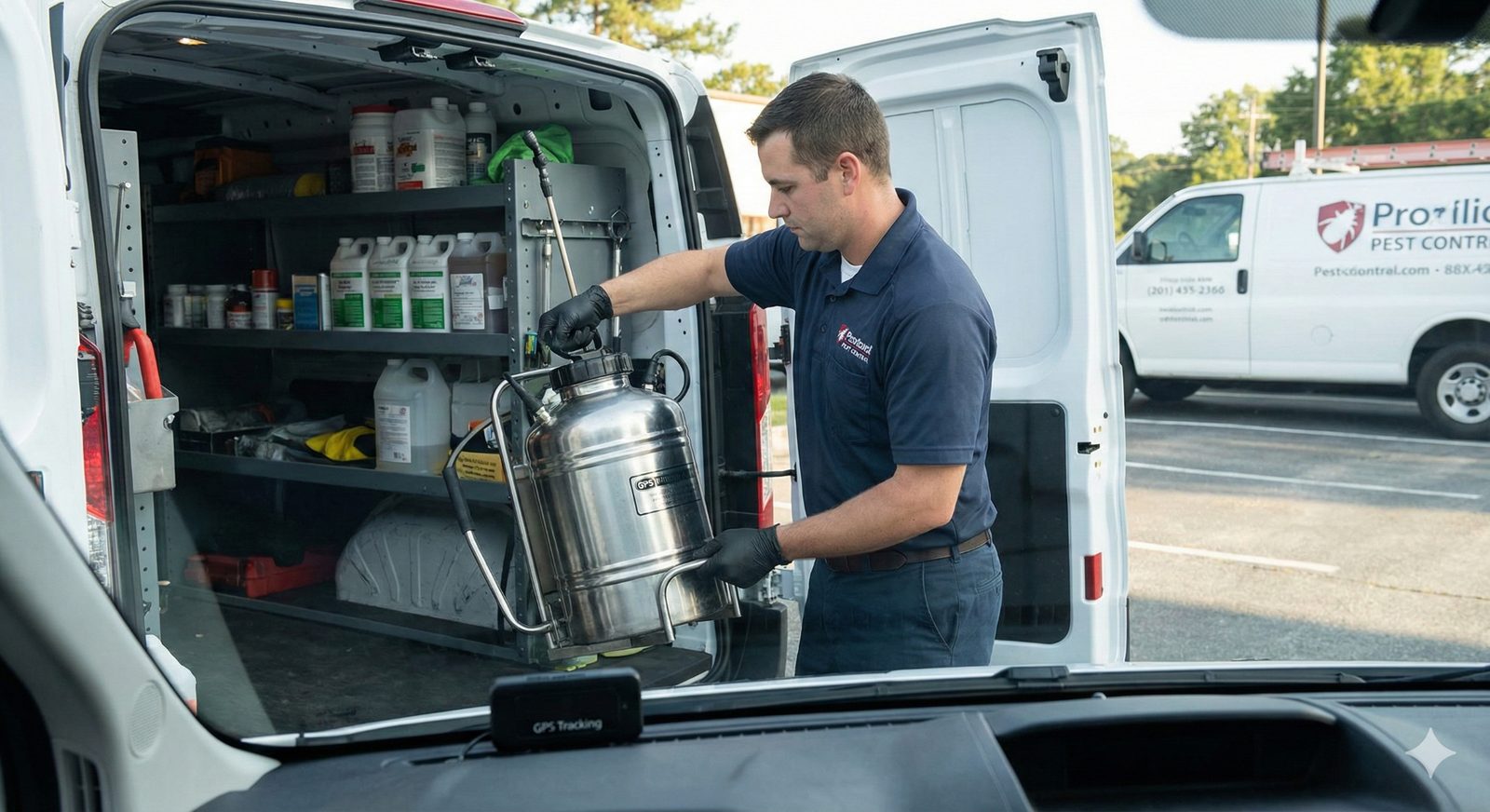
Your vehicles are not just cars; they are mobile warehouses. Between the spray rigs, the tanks, the chemicals, and the tools, a fully outfitted pest control truck can carry $10,000 to $50,000 worth of equipment.
The Risk of the "Take-Home" Vehicle
Many pest control companies allow technicians to take vehicles home to save on fuel and start routes earlier. This is great for efficiency, but it introduces risk. Is the truck parked safely? Is it being used for side jobs on the weekend?
The Side Job Hustle
A technician using your truck and your chemicals to spray their cousin's house on a Saturday is stealing from you twice: once for the gas/wear-and-tear, and once for the chemicals. GPS tracking with off-hours alerts solves this immediately. If the truck moves on a Saturday, you get a text. If the ignition turns on at 9 PM, you know.
Part 4: Technician Accountability & Culture
Implementing GPS tracking can feel awkward. Owners worry about "spying" on their team. But when done right, tracking builds a better culture.
The "Long Lunch" Phenomenon
We recently wrote about how HVAC companies handle dispatching, and the same applies here. It’s not about punishment; it’s about fairness. If one technician is taking 2-hour lunches while another is busting their hump to finish their route, that breeds resentment. Data levels the playing field.
How to Sell It to Your Team
Don't position it as a watchdog. Position it as a safety tool and a shield.
- "It protects you if a customer lies about your time."
- "It proves you weren't speeding if someone calls with a complaint."
- "It helps us recover the truck if it gets stolen."
Part 5: Choosing Software (The Anti-Enterprise Approach)
If you have researched fleet management, you have likely run into the giants: Samsara, Verizon Connect, Motive. They offer incredible technology—if you are running a 500-truck logistics fleet crossing state lines.
For a local pest control business with 5 to 50 vans, these solutions are often a trap. We call it the Feature Bloat Tax.
Why "Enterprise" Solutions Fail Small Fleets
- Long Contracts: They usually require a 3-year lock-in. If you downsize your fleet in winter, you are still paying for those inactive trackers.
- Hardware Costs: Many charge hundreds of dollars upfront for proprietary tablets or hardwired devices.
- Complexity: You need a solution that tells you where your trucks are, not one that requires an IT certification to navigate.
The Spytec Difference
We built Spytec for the 99% of businesses that aren't Fortune 500 logistics companies. Our philosophy is simple:
- Zero Equipment Fees: You don't pay for the device.
- No Contracts: Cancel anytime. Perfect for seasonal businesses.
- Transparent Pricing: Plans start at $14.95/month (monthly) or $8.95/month (if paid annually).
- Self-Serve: You can buy online and have it shipped free in 2 days. No sales calls required.
Ready to Secure Your Fleet?
Stop overpaying for enterprise bloat. Get the data you need to grow your pest control business today.
Shop Fleet TrackersFrequently Asked Questions
How does GPS tracking help with pest control route density?
GPS tracking identifies "gap times" and inefficient routing in real-time. By visualizing where technicians are overlapping or taking inefficient paths, you can restructure routes to fit in 1-2 extra stops per day, per driver, directly increasing revenue without hiring more staff.
Is it legal to track my pest control technicians?
Generally, yes. If your business owns the vehicle, you have the right to track its location during work hours. However, transparency is best—we recommend having employees sign a vehicle use policy that acknowledges the presence of GPS trackers for safety and efficiency.
Can I use Spytec for a small fleet of 5 vans?
Absolutely. Spytec is designed specifically for small-to-mid-sized fleets (5-50 vehicles). Unlike enterprise competitors that ignore small accounts, we offer the same powerful tools with no minimum vehicle requirements and no long-term contracts.
How much does fleet tracking cost for a pest control business?
Spytec GPS plans for pest control fleets start at $8.95/vehicle/month on the annual plan ($14.95 month-to-month), with no long-term contracts and free hardware included. There are no activation fees or equipment costs — most pest control operators recover the subscription from a single avoided chargeback dispute.
Looking for more industry insights? Check out our Fleet Tracking Hub for more guides on optimizing your service business.






Share:
How to Switch Fleet GPS Providers Without Operational Chaos
Stop Service Disputes: Automate Proof of Service with GPS