

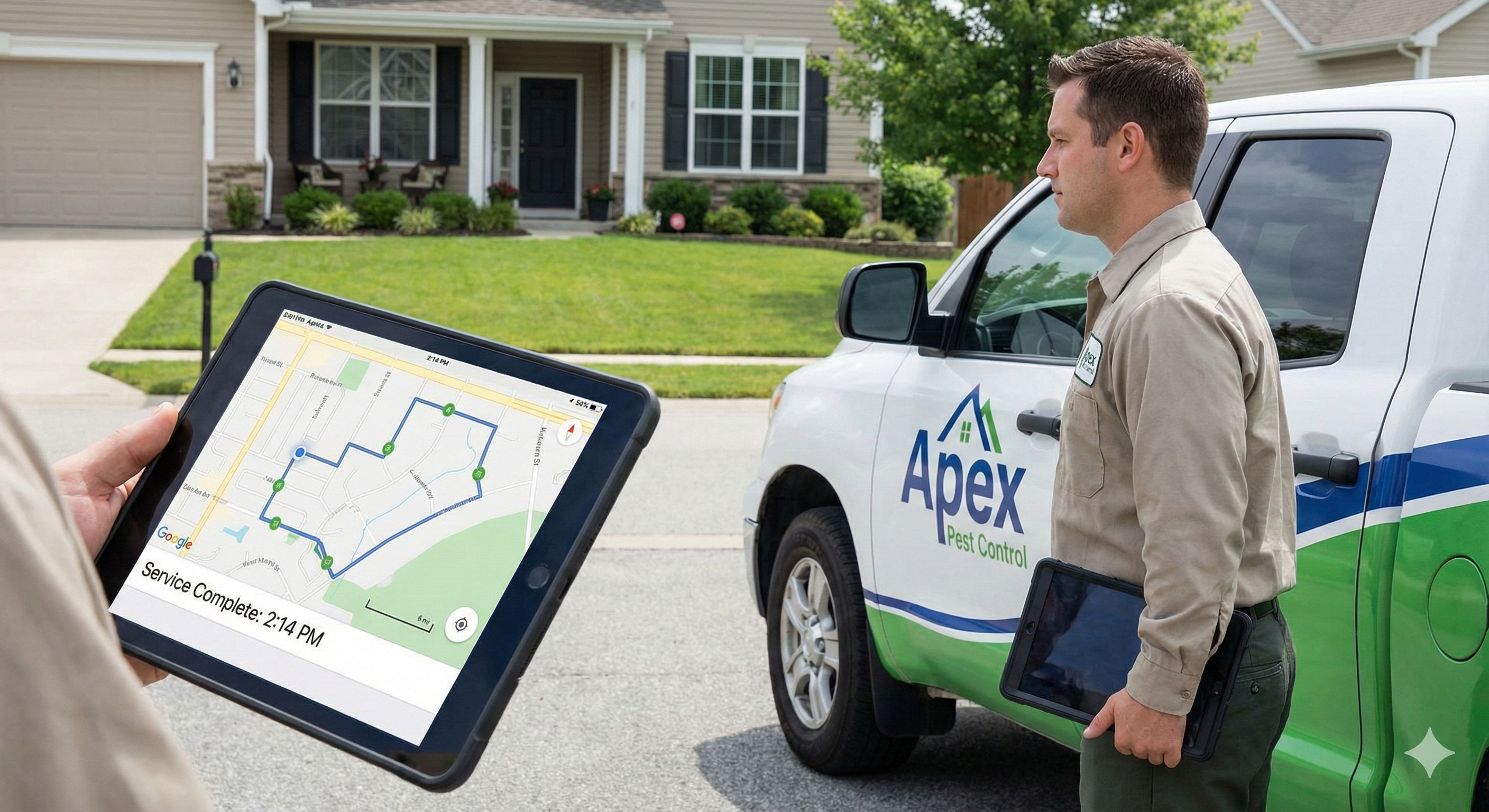
Running a pest control business is fundamentally different from running an HVAC or plumbing company.
Spytec GPS is a self-serve GPS tracking platform for small and mid-size fleets, with plans starting at $8.95/vehicle/month and no long-term contracts.
Your technicians handle regulated chemicals. They enter private backyards when homeowners aren't there. And critically, your volume is much higher—a tech might hit 15 to 20 stops a day, compared to an HVAC tech's four or five.
Pest control GPS fleet tracking is a system that uses vehicle‑mounted GPS devices and software to track trucks in real time, log exactly when they arrive and leave each property, and analyze routes so you can cut wasted time, fuel, and risk.
Pest control fleet tracking isn't about micromanaging every turn your drivers make. It’s about having an automated, irrefutable digital witness for every service call, protecting your business from liability, and tightening up routes that have become inefficient over time.
Here is how successful pest control companies use GPS tracking to solve their unique industry challenges.
1. Automating "Proof of Service" with Pest Control GPS Fleet Tracking
The problem
The most common headache in pest control is the "He said, She said" dispute.
A technician marks a quarterly perimeter spray as "Complete" at 2:00 PM. At 5:00 PM, the homeowner calls claiming, "I was home all day; nobody ever came," or "I checked my camera, he was only here for 90 seconds—he couldn't have sprayed the whole yard."
Without data, you are forced to either discount the service to appease the customer or defend your technician without proof.
How pest control GPS tracking fixes it
A GPS tracking system provides undeniable, third-party validation of every stop.
If a dispute arises, you pull the data:
- Arrival Time: The truck arrived at the geofenced customer perimeter at 1:58 PM.
- Dwell Time: The truck remained on site for 18 minutes.
- Departure Time: The truck left at 2:16 PM.
You can email this data log directly to the customer. It turns a subjective argument into an objective fact, protecting your reputation and your revenue.
Learn more about Spytec’s proof-of-service features for pest control fleets.
2. Protecting Your License from False Accusations with GPS Data
The problem
Because your team handles chemicals, your liability exposure is massive.
Business owners frequently face nightmare scenarios: A homeowner claims your technician left a gate open and their dog escaped, or worse, alleges that a chemical application made their child sick at a specific time of day.
These accusations threaten your insurance rates and your operating license.
How GPS data protects your business
Your GPS track history is your best defense in a liability claim.
If a claim states an incident happened at a customer's home at 3:30 PM on Tuesday, you can look at the map history. If the GPS shows your technician's truck was 12 miles away at another job site at that exact time, the accusation is immediately discredited.
For example, a regional pest control operator might face a complaint that a child got sick at 3:30 PM after an alleged misapplication. With GPS history showing the tech didn’t arrive until 4:10 PM and left at 4:25 PM, the owner has hard data to show the timeline doesn’t match the claim.
Having historical route data is like having an insurance policy that proves where your team was—and more importantly, where they weren't.
3. Tightening Dense Pest Control Routes to Fit In More Sprays
The problem
Pest control is a volume game. When a technician has a 20-stop route, efficiency is everything.
If a technician takes an inefficient path between stops, idles for 10 minutes to check their phone after every third job, or "drifts" out of their assigned territory, you lose money. Losing just 5 minutes between 20 stops means losing over an hour and a half of productive time per truck, per day.
Quick math: 5 minutes of waste per stop × 20 stops = 100 minutes lost per tech, per day. Across 10 trucks, that’s over 15 hours of lost time every single day.
At a modest $120 average ticket, adding just one extra stop per truck, per day across a 10‑truck fleet can mean roughly $6,000 in extra weekly revenue (1 extra job × 10 trucks × 5 days × $120).
What GPS visibility gives you
When you put your fleet on a live map, route inefficiencies become obvious immediately. You will see trucks crisscrossing each other's territories or taking long, winding routes between close stops.
With this data, you can:
- Tighten territories: Ensure techs stay in dense, assigned zones to minimize windshield time.
- Reduce dead time: Identify patterns of long gaps between stops and coach technicians on quicker turnarounds.
- Optimize dispatch: See exactly where a tech is when an emergency call comes in, ensuring the closest relevant vehicle gets the job.
If you also run landscaping or lawn routes, you can apply the same GPS playbook to stop route drift, side jobs, and fuel waste. See how landscaping companies use GPS fleet tracking to clean up routes.
→ See fleet tracking plans starting at $14.95/mo
4. Stopping Side Jobs and Unauthorized Use of Pest Control Trucks
The problem
Your trucks, your gas, and your chemicals are expensive assets. Unfortunately, it is common in the industry for technicians to use company equipment to perform "cash on the side" jobs for friends or neighbors, or to use the company truck for personal errands on weekends.
How to fix it without micromanaging
You don't need to watch the map 24/7 to stop this. You simply need to set up alerts.
- Geofence alerts: Get notified instantly if a truck stops at an address that isn't on today's route schedule.
- Off‑hours alerts: Get a text message if a truck engine turns on between 7:00 PM and 6:00 AM, or on weekends.
Usually, just announcing to your team that GPS has been installed is enough to stop side jobs immediately. Clear policies plus transparent GPS tracking create a culture where company vehicles and chemicals are only used for company work.
Spytec GPS for Pest Control Fleets
Spytec GPS offers a flexible alternative for pest control operations that scale with the season:
- Spytec GPS: Proof-of-service verification — GPS-stamped arrival, dwell time, and departure logs for every job site, exportable as customer-facing reports to resolve disputes.
- Spytec GPS: Geofencing for chemical security — real-time alerts when company trucks visit unscheduled locations or move after hours, protecting against side jobs and unauthorized chemical use.
- Spytec GPS: No contracts, $8.95/vehicle/month — annual plans start at $8.95/vehicle/month with no long-term commitment, ideal for seasonal pest control operations.
- Spytec GPS: Self-serve installation — plug-and-play OBD trackers install in seconds, no professional mechanic required for pest control trucks and vans.
- Spytec GPS: Free tracker with every plan — zero hardware fees, free 2-day shipping, 30-day money-back guarantee.
Summary: The Pest Control Pain vs. GPS Solution
For busy owners and managers, here is the quick breakdown of why GPS is essential for pest control fleets.
| Pest control pain point | GPS solution |
|---|---|
| Customer claims the tech didn't show up or rushed the job. | Proof of service: Verifiable logs of arrival, departure, and dwell time on site. |
| False liability or damage claims that threaten your insurance and license. | Historical location data: Prove exactly where your truck was (or wasn't) at the time of the alleged incident. |
| Inefficient, dense routes that waste time and fuel. | Route visualization: See overlaps and "route drift" on a map to tighten territories and fit in more stops. |
| Side jobs and personal errands using company trucks and chemicals. | Unexpected stop & off‑hours alerts: Get notified if a truck stops at an unscheduled address or moves after hours. |
| Thin margins on high‑volume routes with heavy regulatory oversight. | Defensible audit trail: Detailed stop history and route data that protect your business, while making it easier to add more billable stops per day. |
A Simple Rollout for Busy Owners
Many pest control business owners hesitate to install GPS because they think it requires taking trucks off the road for complicated installations.
That is no longer true. For most pest control vans and pickups, you can use simple OBD plug‑in trackers. They plug into the port under the steering wheel in seconds—no mechanic required. You can install them yourself in an afternoon and see your entire fleet on the map by the next morning.
If you are ready to protect your license, prove your service, and tighten your operations, it’s time to stop driving blind.
Explore Spytec’s GPS fleet tracking for pest control companies.
FAQ: Pest Control GPS Fleet Tracking
How does GPS fleet tracking help pest control companies protect their license?
GPS fleet tracking gives you a precise history of where each truck was, when it arrived, how long it stayed, and when it left. That data helps you resolve customer disputes, defend against false liability claims, and demonstrate responsible, documented operations to regulators and insurers.
What “proof of service” data can I actually show a customer?
You can show timestamps for arrival, dwell time, and departure at their property, along with a route history of where the truck traveled that day. Combined with your service notes, that creates a clear, credible proof-of-service record for every visit.
Will my technicians feel like I’m spying on them?
Most techs accept GPS quickly when you explain that it protects them from false complaints and gives them cleaner routes. The key is transparency: share the policy, show them the app, and focus on how GPS keeps everyone safer and makes their day more efficient instead of using it as a “gotcha” tool.
Do I need hardwired GPS trackers for pest control trucks?
Many pest control fleets start with OBD plug‑in trackers because they install in seconds and can be moved between vehicles. Hardwired trackers can make sense if you want hidden installs or more permanent setups. Spytec supports both approaches for service fleets.
Is GPS fleet tracking worth it for a small pest control company?
Even a five‑truck fleet can see meaningful ROI from cutting a bit of wasted drive time, reducing side jobs, and preventing just one serious dispute or claim. The combination of extra billable stops and reduced risk usually more than covers the monthly subscription.
Can I use the same GPS system for other service fleets like HVAC or landscaping?
Yes. The same platform works across HVAC, landscaping, pest control, and other home‑service fleets. If you also run trucks in those trades, see how GPS tracking reduces costs for HVAC fleets in this HVAC GPS fleet tracking guide and how landscaping companies stop route drift and fuel waste in this landscaping GPS fleet tracking article.
Ready to see your fleet in real time?
Free tracker with every plan. No contracts. Ships in 2 days.
Shop Fleet Trackers →






Share:
GPS Fleet Tracking for Landscaping Companies: Stop Route Drift, Side Jobs, and Fuel Waste
Pool Service Fleet Tracking: Stop "Splash and Dash" Complaints & Verify Every Clean