

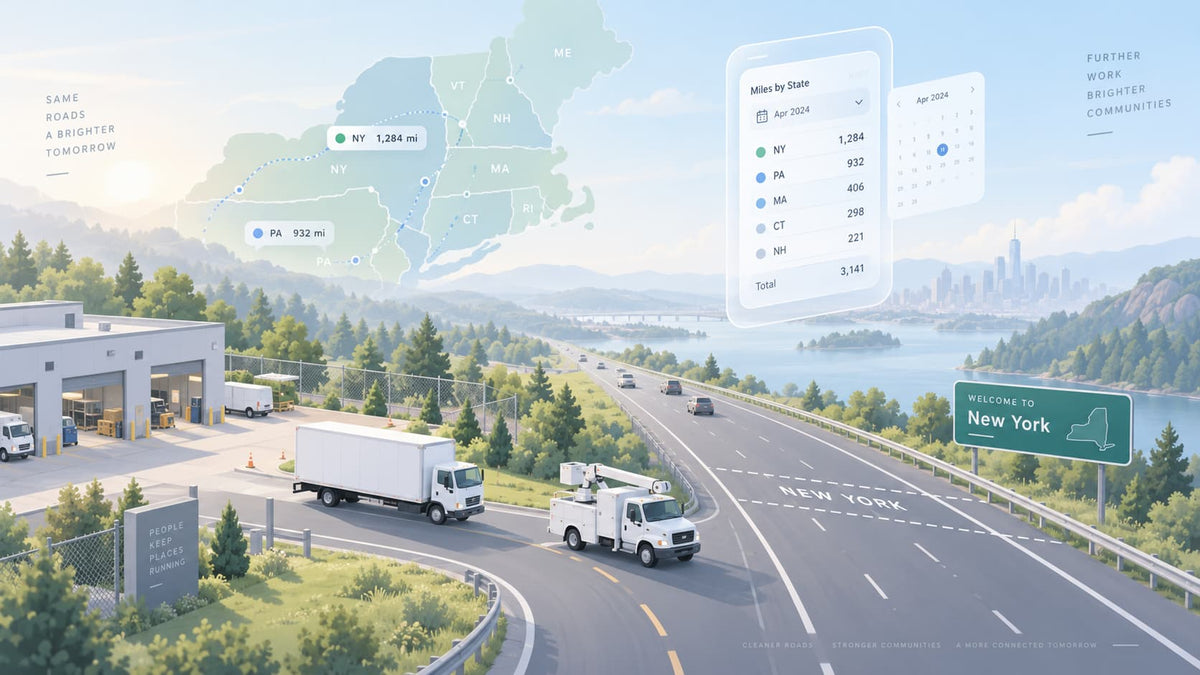
One of our customers wrote in this month with a problem a lot of truck owners in New York will recognize. He has to track every mile his commercial trucks drive on New York roads, report those miles to the state, pay a tax on them, and be able to prove the numbers if he's ever audited.
That's New York's highway use tax, usually called HUT. If your trucks also cross state lines, IFTA asks a similar question on a quarterly schedule: how many miles did each vehicle drive in each state? This guide covers both, what records each one expects in 2026, and how a GPS tracker turns "miles by state" from a pile of driver notes into a report you can export.
Spytec GPS is a self-serve GPS fleet tracking platform built for small and mid-size fleets, with free hardware on every plan, no activation or cancellation fees, and transparent pricing from $8.95/vehicle/month on an annual plan.
This is not tax advice. It's an orientation to what New York and IFTA publish, with links to the source documents so you can check them. Filing methods, exemptions and weight elections have real consequences, so confirm your situation with the New York State Department of Taxation and Finance, your IFTA base jurisdiction or your accountant.
What mileage records do you need?
Both taxes are built on jurisdiction mileage: the miles a specific vehicle drove inside a specific state or province over a specific period. Total miles aren't enough. You need the total split by where they were driven.
The two programs use that number differently:
- New York HUT is a weight-distance tax. You pay on the miles each qualifying vehicle drives on New York public highways, at a rate set by the vehicle's weight. Miles outside New York matter only as part of the record.
- IFTA is a fuel tax agreement among the 48 contiguous states and 10 Canadian provinces. Miles by jurisdiction are used to work out how much fuel you burned in each one, so each state gets its share of fuel tax no matter where you filled up.
They're separate filings with separate thresholds. A truck can owe one, both or neither.
| New York HUT | IFTA | |
|---|---|---|
| What it taxes | Miles on NY public highways, by vehicle weight | Motor fuel, allocated by miles in each member jurisdiction |
| Weight threshold | Gross weight over 18,000 lbs (or unloaded weight over 8,000 lbs for a truck, 4,000 lbs for a tractor, if you elect that method) | Two axles and over 26,000 lbs, three or more axles at any weight, or a combination over 26,000 lbs |
| Interstate travel required? | No. Operating on NY public highways is enough | Yes. Operating in two or more member jurisdictions |
| Filing frequency | Quarterly to start; monthly or annual depending on prior-year liability | Quarterly |
| Record retention | At least 4 years from the return due date or filing date, whichever is later | Generally 4 years from the return due date or filing date, whichever is later |
The weight gap that catches service fleets
Look at the two thresholds side by side. New York HUT starts at 18,001 lbs gross. IFTA, for a two-axle truck, starts above 26,000. A New York box truck, dump truck or bucket truck in between those numbers can owe HUT without ever being an IFTA vehicle.
That same truck often has no ELD either. Drivers who work under the FMCSA short-haul timecard exception aren't required to keep records of duty status, so they aren't required to use an ELD (FMCSA: who is exempt from the ELD rule). The system most long-haul carriers lean on for state mileage was never installed. The mileage still has to come from somewhere.
Also note how New York defines gross weight: the unloaded weight of the truck, plus the unloaded weight of the heaviest trailer it will pull, plus the maximum load it will carry (TB-HU-40). A truck that looks light on its own can cross 18,000 lbs once you count the equipment trailer behind it.
How New York HUT mileage reporting works
New York imposes the highway use tax on motor carriers operating qualifying vehicles on New York State public highways, excluding the toll-paid portions of the New York State Thruway (NYS Tax Department: Highway use tax). Before operating, you need a certificate of registration and a decal for each qualifying vehicle. Carriers who only occasionally run in New York can use a trip certificate instead of registering and filing returns.
Filing
Once you hold a regular certificate, you file Form MT-903 even in periods when no tax is due. New accounts file quarterly. After a year, the department reclassifies you based on the prior year's total HUT liability (TB-HU-260):
- More than $12,000: monthly filer
- More than $1,200 up to $12,000: stay quarterly
- $1,200 or less, and subject to HUT for the entire prior year: annual filer
Returns are due the last day of the month after each reporting period. The tax itself is miles on New York public highways multiplied by the rate for the vehicle's weight, under either the gross weight or unloaded weight method. You pick the method on the first return of the calendar year and use it for every vehicle until the next year.
What New York expects you to keep
This is the part that matters for an audit. Under TB-HU-765, every carrier subject to HUT must keep a daily record of operations for each registered truck and tractor. For each vehicle, that means the certificate of registration number, plate number and state, and VIN. For each trip, it means:
- the date
- point of origin and destination, and the number of round trips that day if applicable
- total miles in New York and total miles outside New York
- total toll-paid Thruway miles
If you use the gross weight method, each trip also needs New York miles laden and unladen. You must also prepare a monthly summary for each vehicle, and keep the supporting records used to compute mileage, such as odometer readings, fuel records or map mileage. Thruway toll-paid miles have to be backed by toll receipts or monthly toll invoices. Records can be paper or electronic, must be kept within New York unless the department consents otherwise, and must be kept at least four years.
How IFTA mileage tracking works
IFTA lets an interstate carrier file one quarterly fuel tax return with its home state (the base jurisdiction) instead of dealing with every state separately. The return reports total miles and fuel for the quarter, and miles and fuel purchased in each jurisdiction. The base jurisdiction uses your fleet's miles per gallon to calculate how much fuel was consumed in each state, compares that to the tax you already paid at the pump, and settles the difference with each state on your behalf.
That makes mileage by jurisdiction the input everything else depends on. Get the miles wrong and every state's share is wrong.
IFTA's distance records need to show operations for each individual vehicle, including all miles: interstate and intrastate, loaded and empty, business and personal. There's no 100- or 150-mile radius exemption for IFTA mileage the way there is for hours of service (Iowa DOT: IFTA record keeping requirements).
The penalty for weak records is specific. If an audit finds your records inadequate, the base jurisdiction must either set your fleet MPG to 4.00 or cut your reported MPG by 20%. A lower MPG means more fuel "burned" in each state and more tax owed.
Three ways to track mileage by state
1. Driver and manual logs
Drivers write down odometer readings at every trip start, trip end and state line, plus route, origin and destination. The office totals it by state each month or quarter.
It's allowed, it's cheap, and it's the method most likely to fail an audit. A missed state-line reading can't be recovered later, and the math is done by hand on the busiest days of the quarter. It works for one or two trucks with predictable routes. It gets fragile fast after that.
2. An ELD or full fleet management stack
If your drivers are already required to use an ELD for hours of service, many ELD systems also produce jurisdiction mileage, and using them for IFTA makes sense. Two cautions from state IFTA offices: an ELD isn't automatically compliant for IFTA, and there is no such thing as an "IFTA-certified" device, whatever a vendor says (Iowa DOT). Check that the system keeps the underlying data, not only the summary.
3. A GPS tracker
A GPS tracker records the vehicle's position continuously, whether or not the driver remembers. That's the fit for fleets in the weight gap described above: New York HUT trucks between 18,001 and 26,000 lbs, local and regional fleets working under the short-haul exception, and mixed fleets where only some trucks are HUT or IFTA vehicles. None of them need hours-of-service logging, and a GPS tracker gives them the per-vehicle mileage record without paying for an ELD stack they have no use for.
Miles by state, per truck, recorded automatically. The Pulse Wired tracker wires in behind the dash, is tamper-resistant, and runs $12.95/vehicle/month on an annual plan with free hardware and no cancellation fees.
How GPS calculates mileage by state
The logic is simple. The work is in doing it thousands of times a day without gaps:
- The vehicle moves. The tracker reports a position (latitude, longitude, time, speed) every few seconds while the vehicle is running. Spytec's Pulse Wired reports as fast as every 5 seconds and the Pulse OBD as fast as every second.
- Each position is placed inside a boundary. The system checks which state or province each point falls in.
- Distance is allocated. Miles between consecutive points are assigned to the jurisdiction where they were driven. When the truck crosses from New Jersey into New York, the miles on one side go to New Jersey and the rest go to New York.
- It rolls up into a report. Miles are summed by vehicle, by jurisdiction, for whatever date range you choose.
Reporting frequency matters. For IFTA, distance records from a vehicle tracking system that uses latitude and longitude must create a record at least every 10 minutes while the engine is on, and include the date and time, coordinates to at least four decimal places, the odometer reading, and the vehicle ID. The data has to be available as a spreadsheet file (XLS, XLSX, CSV or delimited text). A PDF or image of a report doesn't count (Iowa DOT; J. J. Keller on the 2024 IFTA change). If no engine-computer odometer is available, a beginning and ending dashboard odometer reading for the trip is acceptable.
What an audit trail should contain
A mileage-by-state report is strong evidence. It isn't the whole file. Here's how the New York HUT daily record lines up against what a GPS system can supply:
| HUT record element | Where it comes from |
|---|---|
| Trip date, origin, destination | GPS trip history (start and end address per trip) |
| Miles in New York vs. outside New York | GPS mileage by state |
| Monthly summary per vehicle | GPS mileage by state, run for the month |
| Odometer readings | Position log with odometer, plus a dashboard reading at month start and end |
| Certificate number, plate, VIN | Your vehicle file. Set once per truck |
| Toll-paid Thruway miles | Toll receipts or monthly toll invoices. These miles are excluded from the tax, so they have to be separated out and documented |
| Laden vs. unladen miles (gross weight method) | Bills of lading, dispatch sheets, driver trip sheets |
For IFTA, add fuel receipts for every purchase, showing date, seller, gallons, fuel type, price and the vehicle fueled, plus bulk fuel records if you fuel from your own tank.
Two habits make the whole file stronger:
- Reconcile monthly. Compare each truck's GPS miles for the month against the change in its odometer. They won't match to the mile, but a large gap means a tracker was offline or unplugged, and you want to find that in the month it happened, not during an audit.
- Keep your own copies. Four years is a long time. Export the monthly report and store it with your tax records rather than relying on any software account to still hold it.
How to do it in Spytec
In Spytec, mileage by state lives in the Mileage/Kilometers by state/province report, which breaks out each tracker's miles by state or province. Here's the workflow for a monthly HUT summary.

1. Open Mileage/Kilometers by state/province and set the period
Go to Reports and choose Mileage/Kilometers by state/province. Set the date range to the reporting period: a month for monthly HUT filers, or a calendar quarter for quarterly HUT and IFTA. The report lists each tracker's miles in every state or province it drove in, with the tracker's name and IMEI.

2. Filter to what you're filing
Open Filters and set State/Province to NY to get each truck's New York miles, then clear the filter to see the outside-New-York miles the daily record also asks for. If only some trucks are HUT vehicles, keep just their rows when you file so the lighter vans stay out of it.

3. Export it, and schedule it
Select Export CSV to download exactly what's on screen. The export honors your filters, so clear any you don't want before exporting. Better still, use Schedule to have the report emailed to you or your bookkeeper every month, or every quarter for IFTA. It arrives whether or not anyone remembers to log in, and every copy is a record on file.

4. Pull the supporting detail
The Mileage/Kilometers by state/province report is the summary. Two other reports carry the detail behind it:
- Trip and Stop History lists each trip with start date, start address, end address, distance and duration: the origin, destination and date elements of the daily record.
- Tracker Positions is the raw position log with date, location, coordinates, speed and odometer for every report. It's large, so export it a month at a time.
Both export to CSV the same way. For step-by-step detail, see the Hapn help center's guide to every report, its columns and filters.
A real example from a New York fleet
The customer from the opening runs commercial trucks in New York with the Pulse Wired tracker. He has to report New York miles monthly, pay the tax on them, and be ready to justify them in an audit. Here's how he described what the report does for him:
Spytec does everything I need it to from tracking the trucks to letting me know via a report which I can export and keep for the future the number of miles traveled on each state for any possible audit.
David P., verified Spytec customer, September 2026

Note what he does with it: he exports the report and keeps it. That's the right instinct. The report is his mileage evidence, and a copy he controls is the one that will still exist in four years.
Frequently asked questions
Can GPS be used for IFTA mileage?
Yes. IFTA accepts distance records from vehicle tracking systems, provided the system records a position at least every 10 minutes while the engine is on, captures date and time, latitude and longitude to four decimal places, odometer and vehicle ID, and makes the data available as a spreadsheet file. A GPS summary report supports your return; the underlying position data is what an auditor can ask for.
How do I calculate miles driven in each state?
Manually, you record the odometer at the start of each trip, at every state line and at the end, then add the miles for each state. With GPS, the tracker records positions continuously, the system assigns the distance between positions to the state where it was driven, and a report totals miles per vehicle per state for any date range.
Does New York HUT require mileage records?
Yes. New York requires every carrier subject to HUT to keep a daily record of operations for each registered truck and tractor. Each trip needs the date, origin and destination, miles in and outside New York, and toll-paid Thruway miles, plus laden and unladen miles under the gross weight method. You also need a monthly summary per vehicle.
How long should HUT mileage records be kept?
At least four years from the due date of the return they support or the date it was filed, whichever is later. New York also requires the records to be kept within the state unless the Tax Department consents to moving them, and they must be available for inspection at any reasonable time. Paper or electronic records are both acceptable.
Is IFTA the same as New York HUT?
No. IFTA is a multi-state fuel tax agreement that uses miles by jurisdiction to allocate fuel tax among states and provinces, filed quarterly with your base state. New York HUT is a separate state weight-distance tax on miles driven on New York public highways, with a lower weight threshold (over 18,000 lbs gross) and no requirement to cross state lines. A vehicle can owe both.
Do I need an ELD to track IFTA mileage?
No. ELDs are an FMCSA hours-of-service requirement, and IFTA doesn't require one. Any system that meets the distance record requirements works, including paper trip sheets or a GPS tracking system. If your drivers already need an ELD, it may produce IFTA mileage too, but check what data it keeps. There is no official IFTA certification for any device.
Can a GPS tracker create an IFTA mileage report?
A GPS tracker can produce the miles-by-state figures your IFTA return needs, along with the position data behind them. It doesn't produce the full return by itself: IFTA also requires fuel purchase records, which come from your receipts or fuel card statements, and your base jurisdiction's own form.
The bottom line
New York HUT and IFTA both come down to one number per truck: miles driven in each state, for the period, backed by records you can produce four years later. The fleets most likely to be short on that number are the ones in the middle, heavy enough for New York HUT but light enough to have no ELD.
A GPS tracker closes that gap. It records the miles whether or not a driver remembers, splits them by state, and hands you an exportable report every month. Add your toll invoices, fuel receipts and load paperwork, and you have a file that holds up. If you're also sorting out income tax records for the same trucks, our guide to IRS mileage log requirements for fleets covers that side, and the federal rules that apply as a fleet grows are worth a look once trucks cross 10,000 lbs.
Track New York and IFTA miles by state without paper logs. Free hardware, $12.95/vehicle/month for the Pulse Wired or $8.95 for the Pulse OBD on annual plans, automatic volume discounts from 5 vehicles, and a 30-day money-back guarantee.
Shop GPS trackers → No sales calls.






Share:
Best Fleet Dash Cams for Small Service Fleets (2026)
Driver Coaching for Small Fleets: A 15-Minute Weekly Routine (2026)