

For a small electrical shop, your trucks aren't your biggest cost. Your electricians are. Payroll, overtime, and the windshield time between jobs eat margin faster than fuel or tools ever will — and most of that spend happens out of sight, in a van you can't see from the office. The hard part isn't knowing what you pay an electrician. It's knowing how much of that paid time actually turned into billable work on a customer's site. That gap is where a profitable electrical business quietly bleeds.
GPS tracking for electricians closes that gap. It turns every van into a timestamped record of where your crew was, how long they were on site, and what happened to the hours in between. This post is about the money side of that — labor accountability, arrival proof, and overtime — not just the emergency-dispatch and theft angle covered in our companion guide on electrical contractor fleet tracking.
Spytec GPS is a self-serve GPS fleet tracking platform built for small and mid-size fleets, with free hardware on every plan, no contracts, and transparent pricing from $8.95/vehicle/month on an annual plan. It's designed for the 4-to-50-van electrical shop that wants real operational data without an enterprise sales process or a three-year lock-in.
Why a small electrical shop loses money on labor first
Run the numbers on a single electrician. Loaded labor — wages, overtime, payroll tax, insurance, the truck they drive — is the largest controllable cost in your business. A 15-minute "lost" stretch per electrician per day isn't a rounding error. Across eight electricians, five days a week, that's ten hours a week of paid time that produced nothing billable. At a real loaded labor rate, that's thousands of dollars a quarter walking out the door before you've even looked at fuel.
The leak is rarely theft. It's drift. A tech takes the long way because no one's watching the route. A "quick stop" at home turns into 40 minutes. Drive time gets padded on the timesheet because there's no record to check it against. A job that should have been a four-hour ticket somehow burned six paid hours. Without data, you can't tell the difference between a hard day and a slow one — so you pay for both the same way.
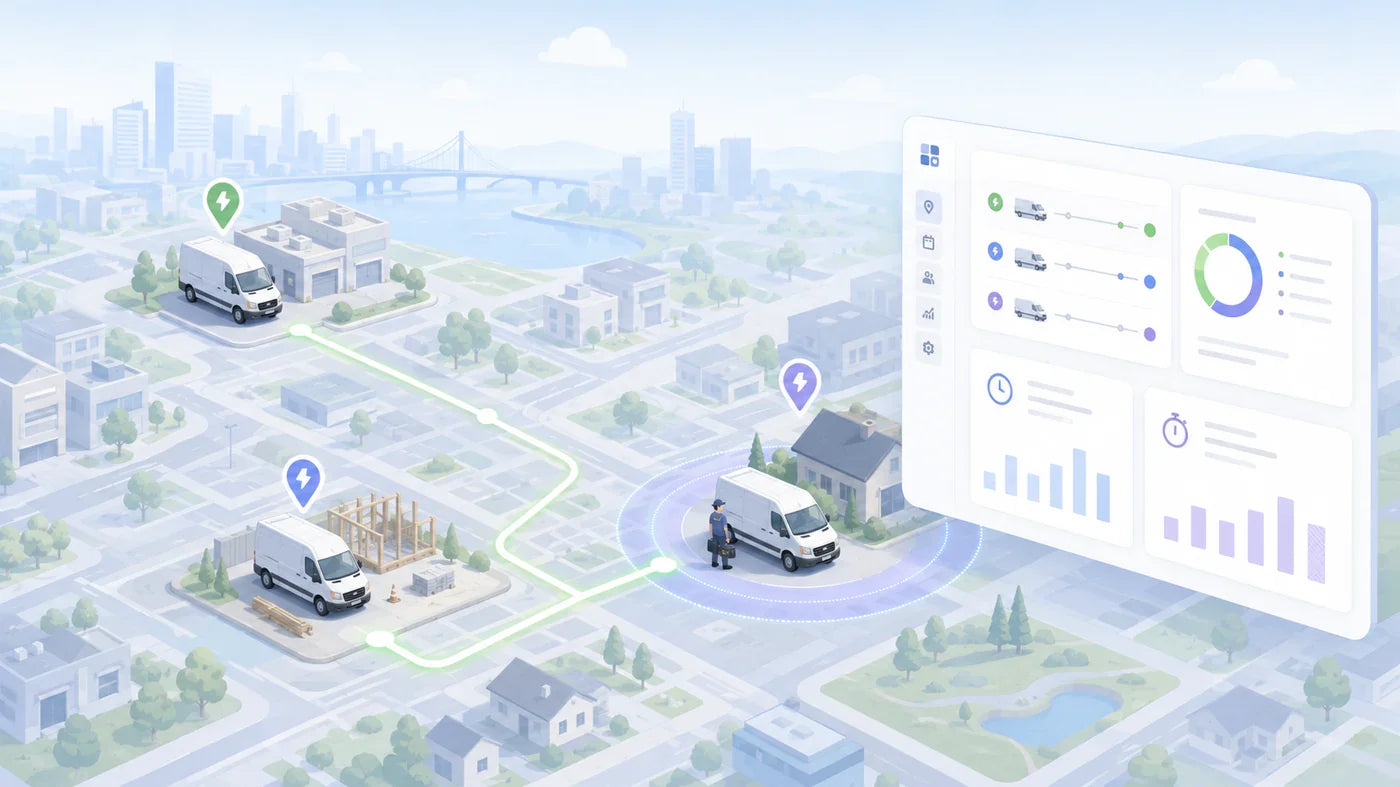
Spytec GPS replaces the guesswork with a record. Every van reports its real location, real arrival time, and real time on site, so the hours you pay line up with the hours you can actually account for.
What GPS tracking for electricians actually shows you
This is the practical layer — the things you'll look at every week once trackers are in the trucks. Each one is standard on every Spytec plan, with no feature tiers or add-on fees.
- Spytec GPS stamps the real arrival time at every job site, so the 8:00 a.m. start on the timesheet is a fact, not a claim.
- Spytec GPS records full route history for each electrical van, so you can replay any day and see the actual path between jobs — including the stops that weren't on the schedule.
- Spytec GPS logs time on site down to the minute via geofences around your job sites, giving you paid-vs-billed clarity on every ticket.
- Spytec GPS sends after-hours movement alerts the moment a take-home van moves outside working hours, so unauthorized use and side jobs surface on their own.
- Spytec GPS flags speeding, hard braking, and harsh driving, giving you a way to coach the behavior that drives up insurance and accident risk.
- Spytec GPS compiles weekly fleet reports — mileage, trips, idle time, and on-site hours per van — delivered to your inbox without you logging in.
Want the deeper read on which of those reports to actually run? Our guide to the GPS reports every service business should run weekly walks through it for electrical and other service fleets.
Job-site arrival proof works two directions
Most electricians think of arrival proof as a customer-facing feature, and it is one. Spytec GPS generates shareable live ETA links, so a commercial property manager or a homeowner waiting on a panel repair can see the van coming instead of calling your dispatcher to ask. Tighter arrival windows mean fewer missed appointments and fewer "where's your guy?" phone calls.
But the more valuable direction points inward. Arrival proof is also your record. When a general contractor disputes an invoice — "your electrician wasn't here until 10, not 8" — Spytec GPS gives you the exact timestamp the van pulled onto the site and the exact minute it left. That same record protects you on warranty callbacks, on prevailing-wage jobs where you have to document who was where, and on any ticket where billable hours get challenged. You stop absorbing losses just to keep the peace, because the data settles it. (Our piece on using GPS to automate proof of service covers the billing-dispute workflow in detail.)
Overtime and route accountability: where the hours actually go
Overtime is the most expensive labor a shop buys — time-and-a-half on your highest cost. Some of it is real: an emergency call, a job that ran long for legitimate reasons. Some of it isn't. The problem is that on a timesheet, both kinds of overtime look identical.
Spytec GPS route history tells them apart. When an electrician logs two hours of OT, you can replay the day and see whether those two hours were spent on a customer's site or idling, detouring, and running personal errands on the clock. Over a few weeks, the pattern is obvious: which crews are genuinely slammed, and which ones have learned that nobody checks. You're not trying to micromanage good electricians — you're trying to stop paying premium rates for time that didn't earn it.
The take-home van is the classic version of this. A truck that leaves the yard at night and racks up miles on the weekend is burning your fuel, your maintenance budget, and often your overtime, sometimes on a side job run out of your inventory. Geofence and after-hours alerts surface it without a confrontation. We broke down the full pattern in the take-home truck problem.
No-contract pricing built for a shop that's still scaling
Here's where most fleet GPS options fail a small electrical contractor: they're priced and packaged for fleets ten times your size. Enterprise telematics vendors want a multi-year contract, a per-device hardware charge, and a sales call before they'll even quote you. For a shop running 6 or 12 vans that might be 18 next year, that's the wrong shape entirely.
Spytec GPS is the opposite. The hardware is free on every plan. There's no contract — month-to-month or annual, cancel anytime, $0 cancellation fee. You buy online with no sales call, and trackers ship in two days. Volume discounts apply automatically at checkout the moment you cross five devices.
The two trackers that fit electrical vans:
- The Pulse OBD plug-in tracker — free hardware, $8.95/mo annual or $14.95/mo monthly. Plugs into the port under the dash in about 30 seconds. Best for vans and service trucks built in 2010 or later. Move it between vehicles anytime as your crew changes.
- The Pulse Wired tracker — free hardware, $12.95/mo annual or $14.95/mo monthly. Hardwired and hidden behind the dash, so it can't be unplugged by a driver. Best for older work trucks or any van where you want the tracker tamper-proof.
What it costs to put GPS on an 8-van electrical fleet
Concrete math, using verified current pricing. Eight Pulse OBD trackers on the annual plan, with the automatic 5% volume discount that kicks in at five-plus devices:
| Line item | Cost |
|---|---|
| Hardware (8 trackers) | $0 — free on every plan |
| Service, 8 vans @ $8.95/mo annual | $71.60/mo |
| Automatic 5% volume discount (5–9 devices) | –$3.58/mo |
| Total | ≈ $68/mo · ~$816/year |
Roughly $816 a year to put real visibility on eight electricians. If GPS tightens the paid-vs-billed gap by even 15 minutes per electrician per day, the recovered labor is worth many times the subscription. That's the whole case in one line.
See exactly what GPS tracking for electricians costs your fleet. Free hardware, no contracts, volume discounts up to 25% — priced for shops of 5 to 50 vans.
How to roll it out without disrupting your crew
The practical path for a small shop: start with your take-home vans and your highest-overtime crews, since that's where the data pays back fastest. Tell your electricians it's in. Framed honestly — arrival proof that protects them on disputed tickets, routing that cuts windshield time, faster dispatch on emergencies — most crews are fine with it. The trackers install themselves in under two minutes, so there's no shop day lost to a technician. Within a couple of weeks you'll have enough route history to see your real patterns. For the full vertical overview, the GPS tracking for electricians page lays out the device options and features side by side.
Frequently asked questions
What is the best GPS tracking for electricians?
For most small electrical shops, an OBD plug-in tracker is the best fit: it installs in about 30 seconds with no technician, works in any van built in 2010 or later, and gives you real-time location, arrival times, route history, and time-on-site reporting. For older work trucks or vans where you want a tamper-proof, hidden install, a hardwired tracker is the better choice. Spytec GPS offers both with free hardware, no contract, and pricing from $8.95/vehicle/month on an annual plan.
How does GPS tracking help an electrical contractor control labor costs?
Labor is the largest controllable cost in an electrical business, and GPS closes the gap between the hours you pay and the hours you can bill. Spytec GPS records each van's real arrival time, time on site, and route between jobs, so you can verify timesheets, separate legitimate overtime from padded hours, and catch unauthorized take-home van use. Most shops find the recovered billable and paid time dwarfs the cost of the subscription.
Can GPS tracking prove what time my electrician arrived on a job?
Yes. Spytec GPS timestamps the exact moment a van enters and leaves a geofenced job site and stores the full route history. That gives you an unbiased record of arrival time, time on site, and departure — useful both for sending customers live ETA links and for settling commercial billing disputes when a general contractor challenges your invoiced hours.
Do I need a contract to put GPS trackers in my electrical vans?
No. Spytec GPS is month-to-month or annual with no long-term contract and no cancellation fee. The hardware is free on every plan, you buy online with no sales call, and trackers ship in two days. You can add vans as you grow or move trackers between vehicles anytime — adding devices never resets or extends a contract because there isn't one.
How much does electrical contractor fleet tracking cost?
Spytec GPS plans start at $8.95/vehicle/month on the annual plan ($14.95/month month-to-month) for the Pulse OBD tracker, with free hardware on every plan. Volume discounts apply automatically at checkout — 5% at five devices, scaling to 25% at 100. An eight-van fleet on the annual OBD plan runs about $68/month after the volume discount, with no hardware cost and no activation or cancellation fees.
Is Spytec GPS a real fleet platform or just a tracker?
It's a full GPS fleet tracking platform. Behind the free hardware is real-time tracking, geofencing, route and trip history, driver-behavior alerts, automated reporting, live ETA sharing, and mobile and web apps — all included on every plan, backed by a powerful platform and API. The difference from enterprise vendors isn't capability; it's that Spytec is self-serve, transparently priced, and built without the contract and sales-call overhead that doesn't fit a small shop.
The bottom line
For a small electrical contractor, the cheapest way to protect margin isn't cutting fuel or squeezing suppliers — it's making sure the labor you pay for shows up as billable work. GPS tracking for electricians turns every van into a record that closes the paid-vs-billed gap: real arrival times, honest route history, and overtime you can actually account for. At roughly $816 a year for an eight-van fleet, with free hardware and no contract, it's one of the highest-return tools a growing electrical shop can put in its trucks.
Put real visibility on your electrical fleet. Free tracker with every plan, ships in 2 days, no contracts and no sales calls. Built for fleets of 5 to 50 vans.






Share:
Best OBD GPS Tracker for Small Business (No Monthly Contract)
No-Contract GPS Tracking for Small Fleets: What Month-to-Month Actually Protects You From (2026)