

Every service business that uses subcontractors eventually asks this question. You track your own vans — that part's settled. But the roofing crew that shows up in their own trucks, the 1099 courier running deliveries in his own car, the excavation sub hauling your trailer: can you put a tracker on any of that?
The answer turns on one word: ownership. Get it right and tracking subs is simple. Get it wrong and you're exposed on two fronts at once — privacy law and worker classification.
Spytec GPS is a self-serve GPS tracking platform built for small and mid-size fleets, with free hardware on every plan, no contracts, and transparent pricing from $8.95/vehicle/month (annual). This article is general information, not legal advice — have your attorney review your specific setup, especially the contract language.
The ownership rule: track what you own
You can generally GPS track any vehicle, trailer, or piece of equipment your company owns, no matter who is driving or hauling it. A W-2 employee, a 1099 contractor, a temp — the asset is yours, and tracking your own property for legitimate business purposes (theft recovery, billing verification, dispatch) is lawful in every U.S. state. Provide written notice to whoever operates it — four states (California, Connecticut, New York, Delaware) require notice for monitoring workers, and it's best practice everywhere. Our state-by-state guide to GPS tracking laws covers the details, and our free policy template includes the acknowledgment language.
What you generally cannot do is put a tracker on a vehicle you don't own without the owner's express written consent. A 1099 contractor's personal truck is their property. Hiding a tracker on it isn't fleet management — in most jurisdictions it's illegal, and in California, Penal Code § 637.7 specifically prohibits tracking a person's movements without consent. This is the same rule that applies to employees' personal cars, and it doesn't soften because the driver invoices you instead of clocking in.
The trap nobody warns you about: tracking can threaten their 1099 status
Here's the part that doesn't show up in most GPS articles. Worker classification — whether someone is legitimately a contractor or is actually an employee you're misclassifying — hinges largely on control. The IRS's common-law test asks how much you direct the details of how work gets done: the tools, the hours, the routes, the supervision.
Requiring a 1099 contractor to carry your GPS tracker in their own vehicle, monitoring their driving behavior, and managing their routes in real time looks a lot like behavioral control. It becomes one more fact a state auditor or plaintiff's attorney can stack up to argue your contractor was an employee all along — with back taxes, overtime, and penalties attached. Tracking alone doesn't reclassify anyone; classification looks at the whole relationship. But it's a factor you're volunteering, and most owners have no idea they're volunteering it.
The practical read: the more the tracking looks like supervising a person, the more classification risk it carries. The more it looks like protecting an asset, the less. That distinction shapes all three legal paths below.
Three legal ways to track work done by 1099 subs
Path 1: Put subs in vehicles you own
If a contractor drives your van or hauls with your truck, track it like the rest of your fleet — an OBD tracker or hardwired unit, with written notice in the subcontractor agreement. You're protecting your own asset; ownership does the legal work. This is the cleanest path and the right one whenever loaner vehicles are part of the arrangement.
Path 2: Track your assets, not their truck
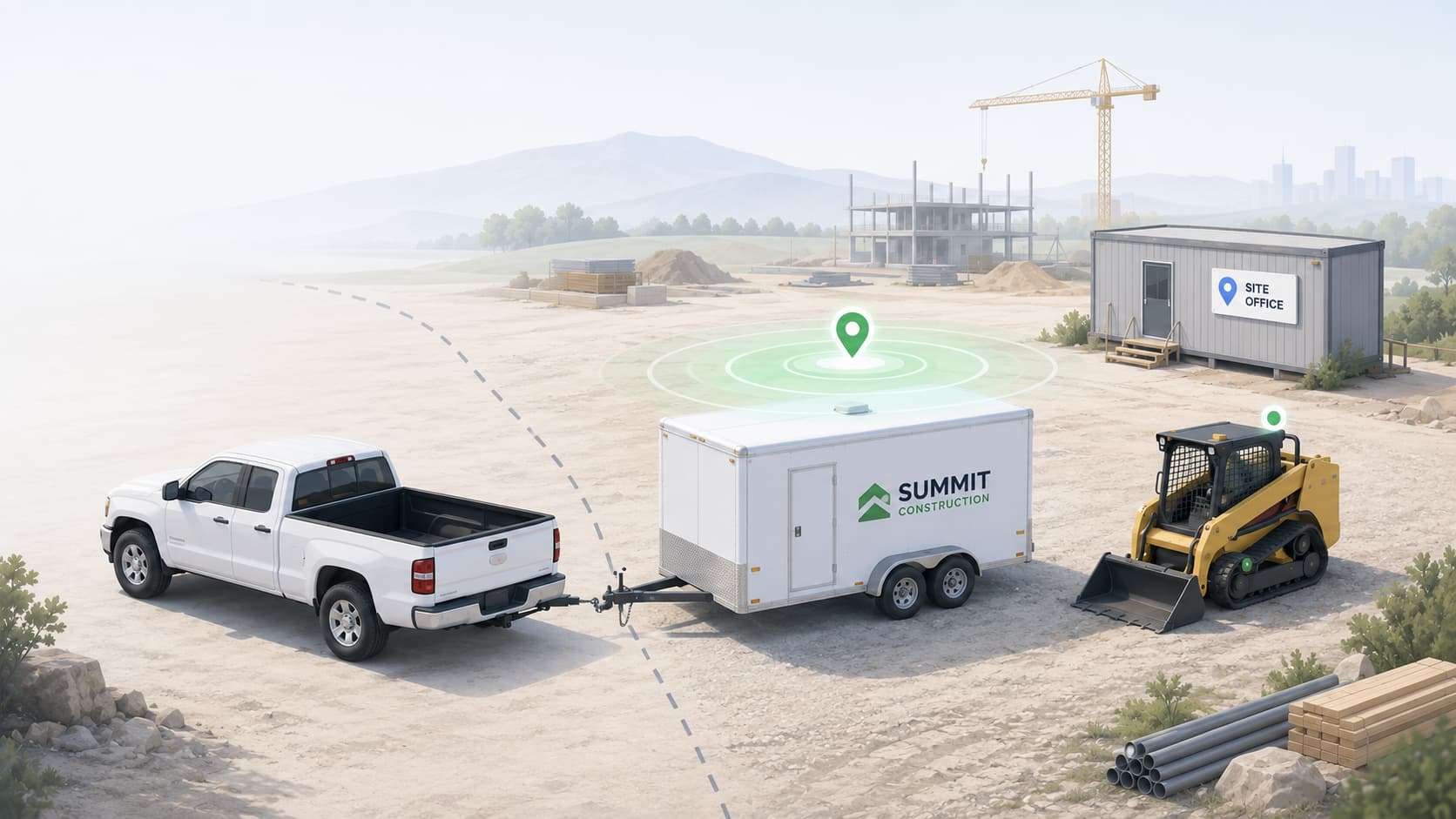
This is the elegant solution most owners miss. You usually don't need to know where the sub's pickup is — you need to know where your trailer, your skid steer, your generator, your compressor is. Those are your property, and tracking them is your right regardless of whose hitch they're on.
A battery-powered Atlas XL (up to 18-month battery, no wiring) rides on a trailer or container; a Pulse Engine Equipment tracker (IP67, tracks engine hours) wires into powered machinery. You get jobsite verification, theft protection, and utilization data — without ever monitoring a person or touching their vehicle. For classification purposes, this is asset protection, plain and simple. See our equipment and trailer tracking overview for the full setup.
Path 3: Their vehicle, with real consent — handled carefully
Sometimes you genuinely need location on the sub's own vehicle — last-mile delivery routing is the classic case. It can be done, but three things have to be true: (1) express written consent in the subcontractor agreement, spelling out what's tracked and when; (2) scope limits — tracking active during engagements, not around the clock (a portable tracker or app-based approach the sub controls beats a hardwired unit here); and (3) restraint in how you use it — the more you use the data to direct routes and supervise driving minute-to-minute, the more employee-like the relationship looks. If you find yourself needing that level of control, the honest answer may be that the role should be W-2 — a conversation for your attorney, not your GPS vendor.
Track the trailer, not the truck. Atlas XL runs up to 18 months on a battery — no wiring, no install, free hardware. From $17.95/mo, no contracts.
What to put in the subcontractor agreement
Whichever path you use, put it in writing before the first job. The tracking clause should cover: which assets carry trackers (list them — "Company-owned vehicles, trailers, and equipment"); what's collected (location, engine hours — and explicitly what isn't: no audio, no video, no personal-device data); when tracking is active; what the data is used for (billing verification, theft recovery, jobsite confirmation); and — if Path 3 applies — the sub's signed consent for their own vehicle with a defined end date. Our policy template is written for employees, but sections 1–5 adapt directly; your attorney can convert the acknowledgment page into contract language in minutes.
The bottom line
Track what you own — freely, with notice. Don't touch what you don't own without signed consent. And when what you really care about is the equipment, track the equipment: it answers the business question, sidesteps the privacy question, and keeps your contractors looking like contractors.
FAQ
Can I put a GPS tracker on a subcontractor's truck?
Not without the owner's express written consent. A 1099 contractor's personal vehicle is their property, and placing a tracker on a vehicle you don't own is illegal in most U.S. jurisdictions. If the contractor drives a vehicle your company owns, you can track it — provide written notice, which is legally required for worker monitoring in California, Connecticut, New York, and Delaware and best practice everywhere.
Does GPS tracking make my 1099 contractor an employee?
Tracking alone doesn't reclassify a worker, but worker classification tests — including the IRS common-law test — weigh how much behavioral control you exercise. Requiring a tracker in a contractor's own vehicle and using it to supervise routes and driving in real time adds evidence of control that can support a misclassification claim. Tracking company-owned assets (vehicles, trailers, equipment) carries far less risk because it's asset protection, not supervision. Consult an employment attorney about your specific arrangement.
Can I track my own trailer or equipment when a contractor is using it?
Yes. Equipment, trailers, and machinery your company owns can be tracked no matter who is hauling or operating them. Battery-powered trackers like the Spytec Atlas XL (up to 18-month battery, from $17.95/month with free hardware) work on unpowered trailers and containers; wired equipment trackers handle powered machinery and record engine hours. Disclose it in the subcontractor agreement to keep everything clean.
Do state GPS notice laws apply to contractors or just employees?
The explicit written-notice statutes in California, Connecticut, New York, and Delaware are written around monitoring workers, and courts can read them broadly. The safe approach doesn't depend on the distinction: give written notice to anyone operating a tracked asset, and get signed consent before any tracking touches a vehicle you don't own. It costs a paragraph in the contract.
What's the best GPS tracker for job sites with subcontractors?
Track the assets, not the people. The Spytec Atlas XL (battery-powered, up to 18 months, no install) suits trailers and containers that move between subs; the Pulse Engine Equipment tracker (IP67 waterproof, engine-hours monitoring, from $12.95/month annual) suits skid steers, generators, and powered machinery. Both include free hardware, no contracts, and volume discounts up to 25%.
Know where your equipment is — whoever's hauling it. Free tracker with every plan, from $8.95/vehicle/month. No contracts, 30-day money-back guarantee.
See transparent fleet pricing → | Explore equipment tracking →
No sales calls. No contracts. No risk.






Share:
15 Fleet Fuel Numbers Every Small Service Business Should Know (2026)
Lytx Pricing in 2026: What It Actually Costs Small Fleets (and Why There's No Price Tag)