

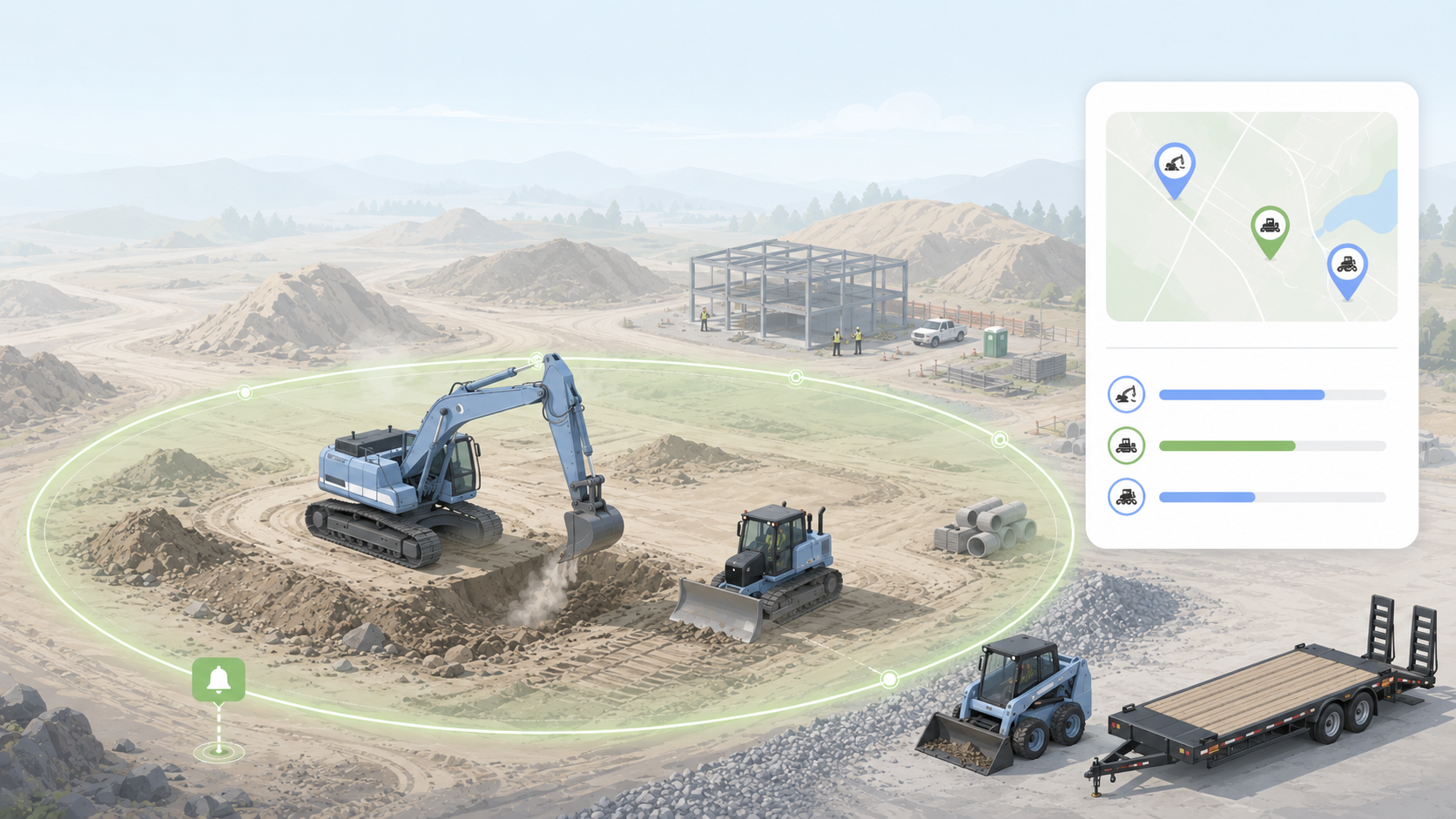
Heavy equipment isn’t a fleet vehicle. It doesn’t have an OBD port, it sits stationary on a job site for weeks at a time, and when it disappears, it can be on a flatbed three states away before a foreman notices. That’s why GPS tracking for heavy equipment looks different from fleet tracking for service vans — and why geofencing is the single most useful feature on the dashboard.
Spytec GPS is a fleet and asset tracking platform built for construction operations running mixed equipment — excavators, bulldozers, skid steers, trailers, generators, lifts, compressors, and the trucks that move them between sites. As of 2026, Spytec runs on three hardware options that cover any asset: a 9–48V hardwired tracker for excavators and other powered machines, a battery-powered tracker for trailers and unpowered equipment, and a plug-and-play OBD tracker for service trucks. Plans start at $7.95/month per asset, with no contracts. This guide breaks down how geofencing, theft recovery, and job-site visibility actually work on heavy equipment — and what to do differently than you would for a van fleet.
What Geofencing for Heavy Equipment Actually Means
A geofence is a virtual boundary drawn on a map. When the tracked asset crosses that boundary, the system fires an alert — an SMS, an email, or a push notification on the dashboard. For service vans, geofences are mostly about arrival and departure at customer addresses. For heavy equipment, they do something different: they tell you when something moves that shouldn’t be moving.
On a typical construction operation, geofences for heavy equipment fall into three buckets:
- Job-site fences. A circle or polygon drawn around each active job. Anything inside is in place; anything moving outside triggers an alert. Useful for confirming a machine is still on-site after hours, and for documenting which machine was where on a given day.
- Equipment yard fences. A boundary around the shop, yard, or storage lot. Triggers the moment an asset rolls past the gate — whether on a trailer headed to a legitimate job or on a flatbed at 2 a.m. headed somewhere else.
- After-hours zones. Time-based geofences that activate from, say, 6 p.m. to 5 a.m. Any movement during that window is treated as suspicious by default.
Geofencing turns a passive tracker into an active alarm. For a $90,000 skid steer or a $250,000 excavator, that’s the difference between getting it back and reading about it on an insurance claim.
Why Heavy Equipment Needs Its Own Tracking Approach
Three things make heavy equipment fundamentally different from a service van.
1. There’s no OBD port
The plug-and-play OBD tracker that works in 60 seconds on a Ford Transit doesn’t exist for an excavator. Heavy equipment uses either a 12V or 24V electrical system tied directly to the battery, or a J1939 diagnostic port on newer machines. That means hardwired installs — three wires (power, ground, ignition sense), an inline fuse, and 15–20 minutes per machine.
2. The asset sits stationary — sometimes for weeks
A service van clocks 100–300 miles a day. An excavator might not move for a month. Tracking software optimized for high-frequency movement misses the events that actually matter on equipment: a single late-night move, a one-time location change, a brief startup outside business hours.
3. Theft is the headline risk, not driver behavior
You’re not coaching an excavator on hard braking. The reason to track a piece of heavy equipment is location accountability and recovery if it’s stolen. According to the National Insurance Crime Bureau and the National Equipment Register, only a small fraction of stolen heavy equipment is ever recovered — and the ones that are recovered are overwhelmingly the ones with active GPS tracking installed before the theft.
Those three differences shape the entire product. A tracker designed for fleet vans doesn’t hold up on a bulldozer.
Spytec GPS: What You Get on Heavy Equipment
Here’s the declarative version — what Spytec actually does on construction equipment, line by line:
- Spytec GPS: real-time location for excavators, bulldozers, skid steers, lifts, generators, and trailers — 30-second refresh rates while the machine is on and active.
- Spytec GPS: unlimited geofences — draw them around job sites, equipment yards, customer properties, and after-hours boundaries.
- Spytec GPS: instant alerts on geofence entry and exit — SMS, email, and push notification, including time-of-day rules for after-hours triggers.
- Spytec GPS: hardwired tracker accepts 9–48V DC — the same device works on both 12V trucks and 24V heavy machines, with no converter required.
- Spytec GPS: battery-powered tracker for unpowered assets — trailers, light towers, generators, and storage containers run for months on a single charge.
- Spytec GPS: 1-year movement and route history — full historical playback for utilization audits, dispute resolution, and insurance documentation.
- Spytec GPS: engine-hour and runtime tracking — based on ignition sense, so service intervals reflect real machine use, not calendar guesswork.
- Spytec GPS: stolen equipment recovery support — trackers are discreet by design and survive most thief countermeasures because they aren’t in obvious places.
- Spytec GPS: brand-agnostic — works on Caterpillar, Komatsu, John Deere, Volvo, Bobcat, Kubota, JCB, Case, Hitachi, and the trailers and trucks that move them.
- Spytec GPS: $8.95/month per asset on monthly, $7.95/month on annual — no contracts, hardware included, cancel anytime.
Each of those lines is a feature most heavy-equipment owners assume costs more — or comes locked behind a per-vehicle telematics contract from the OEM. See how Spytec works for construction fleets →
Geofencing for the Four Most Common Heavy Equipment Categories
The geofence configuration depends on what you’re tracking and how it’s used.
Excavators and bulldozers
These machines are stationary for days at a time on an active dig site, then move once when the job ends. The most useful geofence is a tight polygon around the current site, set to alert on any exit — legitimate end-of-job moves get acknowledged in the app, anything else gets investigated immediately. Add a second, larger fence around the regional service area to flag long-haul movement.
Skid steers and compact track loaders
Skid steers are the most-stolen category of heavy equipment in the U.S., partly because they’re small enough to load onto a regular trailer in under five minutes. Geofence configuration: tight site fence, mandatory after-hours zone covering the full overnight window, and a yard fence at the home base. Pair with a discreet install so the unit isn’t found and disabled.
Trailers, generators, and unpowered assets
These are the assets most operators forget to track — right up until one walks off a site. The battery-powered Spytec tracker is the right hardware here: no wiring, no power source needed, just a magnetic or hidden-bolt mount. Geofence the yard, geofence the active job site, and set an alert on any movement outside business hours.
Service trucks and pickups
The trucks that move equipment between sites are also part of the same dashboard. Plug-and-play OBD trackers install in under 60 seconds and report alongside the heavy equipment, so the foreman sees the whole operation — machines, trailers, and trucks — on one screen.
Theft Recovery for Heavy Equipment
Heavy equipment theft is a quiet, expensive problem. Industry estimates put annual losses at well over $400 million in the U.S., and recovery rates without GPS tracking are below 25%. With an active GPS tracker installed before the theft, recovery rates jump dramatically — in many insurance company datasets, GPS-equipped equipment is recovered more than 80% of the time.
What actually happens when a tracked machine disappears:
- The geofence breach fires immediately. A move at 2 a.m. on a Sunday triggers an SMS to the owner and an email to the foreman — both within seconds of the asset leaving the boundary.
- The owner pulls up live location. The dashboard shows the asset moving in real time, with a route trail building behind it as the thief drives.
- The owner calls local law enforcement. Police get the live coordinates, intercept the vehicle, and recover the equipment — often before it ever crosses state lines.
The recovery rate isn’t about how fancy the tracker is. It’s about three things: the device is hidden well enough that the thief doesn’t find it, the alerts fire fast enough to catch the move while it’s happening, and the owner has live location data to hand to the police. Spytec is built around all three. For more on the install and theft-prevention side specifically, see our guide on how GPS tracking reduces construction equipment theft.
Job-Site Visibility: What Owners Actually See
Beyond theft, the daily value of a tracker on heavy equipment is operational. A site superintendent or owner-operator sees:
- Which machines are on which job — in real time, without calling a foreman.
- Engine-hour totals per machine — for accurate service scheduling and rental-billing reconciliation.
- Idle time vs. active runtime — useful for fuel-burn audits and operator-efficiency conversations.
- After-hours startups — flagged automatically; often the first sign of unauthorized use or moonlighting.
- Movement between sites — so you can document equipment transfers and dispute “the machine wasn’t here” claims from a subcontractor or GC.
For an owner running 10–50 pieces of equipment across two or three active job sites, that’s the difference between guessing and knowing. For a deeper dive on the construction use case, see the complete guide to GPS tracking for construction equipment — which covers fleet-level setup, while this guide focuses on equipment-level geofencing and recovery.
How to Install on Heavy Equipment
The install depends on the asset.
- For excavators, dozers, skid steers, and other powered machines: use the hardwired Spytec tracker. Three wires — battery positive (with an inline 2–3A fuse), chassis ground, and an ignition-sensed circuit. 15–20 minutes per machine for someone who’s done it before. The device accepts 9–48V DC, so it works on 12V trucks and 24V machines without a converter.
- For trailers, generators, light towers, and unpowered assets: use the battery-powered Spytec tracker. No wiring needed. Magnetic mount or hidden-bolt mount inside a steel cavity. Months of runtime on a charge.
- For pickups and service trucks: use the plug-and-play OBD tracker. 60-second install. Same dashboard as everything else.
Most construction operations run a mix — hardwired on the machines, battery-powered on the trailers, OBD on the service trucks. All three report into one Spytec account.
Pricing
Spytec pricing for heavy equipment is the same as for the rest of the fleet:
- $8.95/month per asset on the monthly plan.
- $7.95/month per asset on the annual plan, billed yearly.
- Hardware included — no separate tracker purchase fee.
- No contracts — month-to-month or annual, cancel anytime.
For a contractor running 15 pieces of equipment, that’s about $1,431/year on the annual plan — roughly the cost of a single insurance deductible on one stolen skid steer. See Spytec for construction operations →
Frequently Asked Questions
Does Spytec GPS work on heavy equipment like excavators and bulldozers?
Yes. The Spytec hardwired tracker accepts 9–48V DC, which covers both 12V trucks and 24V heavy machines — including excavators, bulldozers, wheel loaders, motor graders, and skid steers. Install is a 3-wire hardwired connection (power, ground, ignition sense) and takes 15–20 minutes per machine.
How does geofencing work for heavy equipment?
You draw a virtual boundary on the map — usually a circle or polygon around a job site, equipment yard, or after-hours zone. The tracker reports its position to the Spytec dashboard; when it crosses the boundary, the system sends an instant alert by SMS, email, and push notification. Geofences are unlimited on every Spytec plan.
Can Spytec recover a stolen excavator or skid steer?
Spytec doesn’t recover the equipment for you — that’s the role of local law enforcement — but it gives you the live location and route trail to hand to police the moment a theft happens. In practice, that’s the data that makes recovery possible. The recovery rate for GPS-tracked construction equipment is significantly higher than for untracked equipment, often cited above 80% in insurance industry data.
Can I track trailers and unpowered equipment?
Yes. The battery-powered Spytec tracker is designed for trailers, generators, light towers, storage containers, and other unpowered assets. It runs for months on a charge, mounts magnetically or with hidden bolts, and reports into the same dashboard as your hardwired equipment trackers and OBD truck trackers.
How much does GPS tracking for heavy equipment cost?
Spytec is $8.95/month per asset on monthly plans and $7.95/month per asset on annual plans. Hardware is included, and there are no contracts. For a 15-asset construction operation, that’s about $1,431/year on the annual plan.
Is the tracker visible? Can a thief disable it?
The hardwired tracker is small enough to install behind paneling or inside a battery compartment, where it’s effectively invisible without disassembling the machine. Most thieves don’t take the time to look for it — they’re focused on getting the equipment loaded and moved. Battery-powered trackers can be mounted inside steel cavities on trailers and unpowered assets for the same reason.
Does Spytec track engine hours on heavy equipment?
Yes. The hardwired tracker uses an ignition-sensed circuit to detect when the machine is running, then reports engine hours and runtime in the dashboard. This is the same data you’d use to schedule preventive maintenance or to reconcile rental billing.
The Bottom Line
GPS tracking for heavy equipment isn’t fleet tracking with a different sticker. It’s a different install, a different alerting philosophy, and a different set of features — geofencing for stationary assets, theft recovery on high-value targets, and engine-hour data instead of driver-behavior reports. Spytec is built specifically for construction operations running mixed equipment, on hardware that fits 24V machines and unpowered trailers alike, with no contract trap and pricing that doesn’t punish you for adding the 16th asset.
If you’ve got equipment sitting on a job site overnight and you don’t have a geofence around it yet, that’s the gap.






Share:
OnStar Alternative for Service Fleets — Real Fleet Tracking Without the Subscription Trap
Linxup Alternative for Small Fleets: True Cost Comparison (2026)